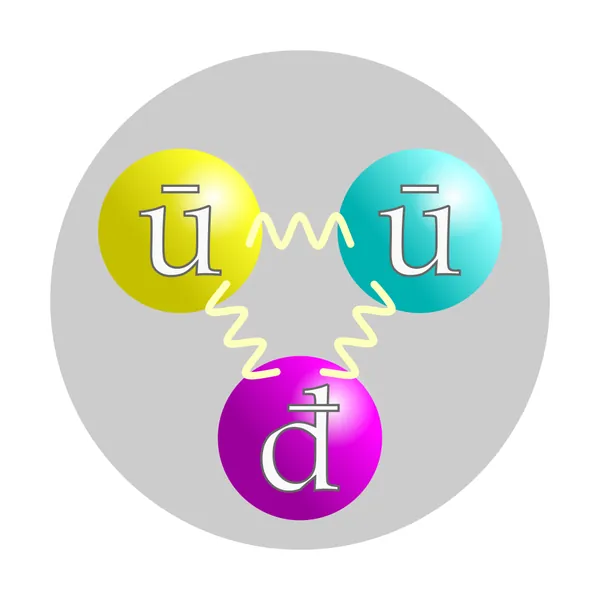
Antiproton
A particle with the same mass as the proton but opposite electric charge; it is the proton's antiparticle and annihilates on contact with matter.
- Year
- 1955
- People involved
- Emilio G. Segrè, Owen Chamberlain
- Section
- Physics
History
The antiproton is the antiparticle of the proton: it has the same mass but a negative electric charge, and when it meets a proton both are destroyed, releasing energy in the form of other particles. Its existence followed from quantum theory, specifically from the equation Paul Dirac published in 1928, which implied solutions with negative energy and therefore antimatter counterparts. That same theory predicted the positron, the antimatter version of the electron, which was found earlier. Dirac received the Nobel Prize in Physics in 1933, and in his lecture he anticipated a particle equal to the proton but with opposite charge.
Before 1955, antimatter was largely a theoretical idea. Physicists knew that protons could be created in high-energy collisions, but they had not reliably produced their antimatter partners. That changed at the Bevatron, a particle accelerator at the University of California, Berkeley, where Emilio Segrè and Owen Chamberlain detected antiprotons in 1955. Their work earned them the 1959 Nobel Prize in Physics. The confirmation mattered because it showed that the symmetry between matter and antimatter predicted by theory also held for baryons, the family of particles that includes the proton.
An antiproton is made of two up antiquarks and one down antiquark, the antimatter versions of the quarks that build the proton. Every property measured so far matches the proton's, except electric charge and magnetic moment, which have opposite signs. The magnetic moment describes how a particle behaves in a magnetic field, somewhat like a tiny compass needle. Why the universe contains almost only matter and little antimatter remains an open question in physics.
Antiprotons also occur naturally. Since 1979 they have been detected in cosmic rays, first by balloon-borne instruments and later by satellites. The most accepted explanation is that they form when high-energy cosmic-ray protons strike atomic nuclei in the interstellar medium. The resulting antiprotons are trapped by the galaxy's magnetic fields, and their expected numbers can be calculated. An excess over that expectation could hint at exotic processes, such as dark matter annihilation or the evaporation of primordial black holes, which are hypothetical tiny black holes from the early universe. So far no data have confirmed either idea, although the subject remains an active area of research. Cosmic antiprotons have also been used to set limits on their own lifetime, which according to these measurements is at least about one or two million years.
In the laboratory, Fermilab routinely produced antiprotons to collide with protons in the Tevatron collider. In these collisions, the quarks of a proton and the antiquarks of an antiproton carry most of the momentum, allowing higher average collision energies than proton-proton collisions. At CERN, antiprotons are made by accelerating protons and smashing them into an iridium rod; the antiprotons are then separated from the debris with magnets in a vacuum. In 2011 the ASACUSA experiment measured their mass and found it equal to the proton's within experimental precision, supporting CPT symmetry, which holds that a particle and its antiparticle share mass and lifetime.
Today the antiproton is valuable as a scientific tool. When it annihilates in matter it releases energy that laboratory studies suggest could be used in treatments for certain cancers, an approach similar to proton therapy. Studying its properties, such as its magnetic moment, also tests whether matter and antimatter behave identically, a question central to understanding why the universe is as it is.
Timeline
- 1928Paul Dirac publishes his equation, which implies the existence of antimatter.
- 1933Dirac receives the Nobel Prize and predicts a particle equal to the proton with opposite charge.
- 1955Segrè and Chamberlain experimentally confirm the antiproton at Berkeley's Bevatron.
- 1959Segrè and Chamberlain receive the Nobel Prize in Physics for this discovery.
- 1979Antiprotons are detected in cosmic rays.
- 2011The ASACUSA experiment at CERN finds the antiproton's mass equal to the proton's within its precision.
Trivia and anecdotes
A belt around Earth
In 2011, the team behind the PAMELA detector reported a belt of antiprotons trapped by Earth's magnetic field. Similar belts may exist around the giant planets.
Antimatter on the move
In March 2026, the BASE team at CERN transported a cloud of 92 antiprotons in a portable cryogenic trap by truck and then resumed the experiment with them.
 Emilio G. Segrè1905–1989 · Physics
 Owen Chamberlain1920–2006 · Physics
