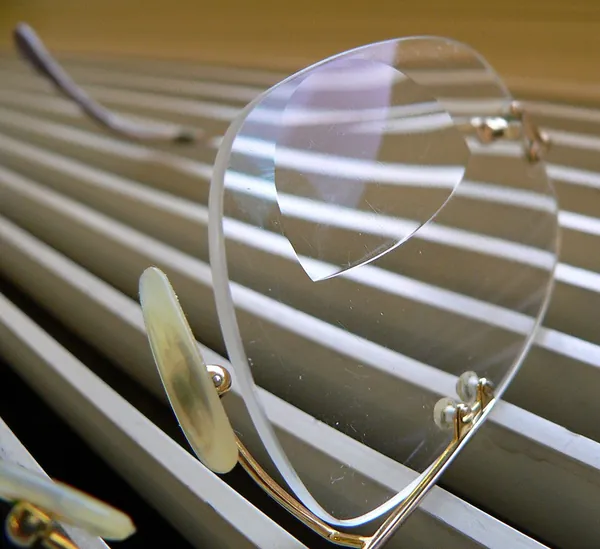

Bifocal lens
Eyeglass lens with two zones of power, one for distance in the upper half and one for close-up reading in the lower half.
- Year
- 1784
- People involved
- Benjamin Franklin
- Section
- Scientific instruments
History
Bifocals are eyeglasses with two distinct optical powers, one for seeing far away and one for seeing up close. They are most often prescribed to people with presbyopia, the age-related loss of the eye's ability to focus on nearby objects, who also need correction for nearsightedness, farsightedness or astigmatism. Their value lies in solving with a single pair of glasses a problem that once meant carrying two.
Before bifocals, anyone who needed sharp vision at different distances had to switch glasses each time they looked up from a book. Benjamin Franklin gave the solution a practical form around 1784, after complaining about this nuisance. He relied on a simple observation: when we read we look down, and when we look at distant things we raise our eyes. So he placed the lens for close work in the lower half of the frame and the lens for distance in the upper half.
Franklin's method was handmade. Two different lenses were cut in half and fitted together into the rim of the frame. This arrangement is called the executive bifocal, and it is still used today as a way to slow the progression of nearsightedness. The joins were fragile and uncomfortable, and the design took time to improve.
The credit given to Franklin is not entirely secure. A widely repeated story says he cut his lenses so he could follow French conversation at court by reading the lips of speakers, but this is a legend without documentary proof. Historians have found hints that others wore them earlier. The College of Optometrists concluded that the only certain point is that Franklin was among the first to wear them, and that his name became linked to the type early on. Some of his British friends may have worn them from the 1760s, though this is uncertain. Many inventions also arise independently in several places.
The word "bifocal" was coined by John Isaac Hawkins in 1824. Hawkins, who also invented trifocals, credited Franklin with the idea. Around 1837 Isaac Schnaitmann made a one-piece bifocal, and at the end of the nineteenth century Louis de Wecker devised a way to fuse the two halves, a method patented by John Louis Borsch Jr. in 1908.
In 1915 Henri Courmettes patented the flat-top reading segment, also called the D segment, which offered a wide reading area, fewer prismatic effects and no image jump when moving between close and distant viewing. The Univis Lens Company produced it in quantity from 1926. In 1955 Irving Rips of Younger Optics developed the first commercially viable bifocal without a visible line, a forerunner of progressive lenses.
Today most bifocals are made by moulding a small reading segment onto a main lens, and the segments come in many shapes and sizes. They have drawbacks. The reading zone has a narrow field of view, so wearers must learn to move the head or the text rather than the eyes, and some people experience dizziness or headaches. When walking, the lower segment blurs the ground and raises the risk of falls. At a computer, the screen sits at an intermediate distance, so progressive or dedicated single-vision lenses are often recommended instead. Researchers are now developing lenses that can adjust their power selectively, and prototypes have been built with a liquid crystal layer between two glass plates.
Timeline
- 1760Franklin's British friends may have worn split lenses, though this is uncertain.
- 1784Benjamin Franklin popularises the bifocal after complaining about having to switch glasses.
- 1824John Isaac Hawkins coins the term bifocal and credits Franklin with the idea.
- 1837Isaac Schnaitmann makes a one-piece bifocal.
- 1908John Louis Borsch Jr. patents the method for fusing the two halves of the lens.
- 1915Henri Courmettes patents the flat-top reading segment.
- 1926Univis Lens Co. begins mass production of the flat-top segment.
- 1955Irving Rips develops the first commercial bifocal without a visible line, a forerunner of progressive lenses.
Trivia and anecdotes
The lip-reading story
It is said that Franklin cut his lenses to read the lips of French speakers at court, but this is a legend without documentary proof.
A beetle with bifocals
The aquatic larva of the diving beetle Thermonectus marmoratus has two retinas and two separate focal planes in its main eyes, like a bifocal, to switch between close and distant vision when hunting mosquito larvae.