Big Bang
A cosmological model describing how the universe expanded from an early state of extreme density and temperature, about 13.8 billion years ago.
- Year
- 1931
- People involved
- Georges Lemaître
- Section
- Astronomy and space
History
The Big Bang is the cosmological model that describes how the universe expanded from an early state of extreme density and temperature. It is worth stressing that it does not describe an explosion spreading into empty space; rather, it describes the expansion of space and time themselves. Its importance lies in allowing scientists to reconstruct the history of the cosmos from a hot, dense past, and in being supported by a broad body of evidence for several decades. According to the standard model, the event took place about 13.8 billion years ago, a figure obtained from several independent measurements that agree with one another.
At the beginning of the twentieth century, most astronomers assumed that the universe was static and eternal. In 1912, the American astronomer Vesto Slipher measured the redshift of light from many spiral nebulae and found that almost all of them were moving away from Earth, although he did not grasp the cosmological consequences of this result. At that time it was also controversial whether these nebulae were part of the Milky Way or separate galaxies. Albert Einstein had applied general relativity to the cosmos, but his equations did not allow a static universe, a result he found troubling and tried to correct by adding a term known as the cosmological constant. In 1922, the Russian mathematician Alexander Friedmann used Einstein's equations to show that the universe could be expanding or contracting, and his equations became the mathematical foundation of the theory.
The decisive step came in the later 1920s. In 1927, the Belgian physicist and Catholic priest Georges Lemaître independently reached similar equations and proposed that the recession of the nebulae was caused by the expansion of the universe. In 1929, the astronomer Edwin Hubble, working with Milton Humason, measured distances to distant galaxies using Cepheid variable stars and found that the farther a galaxy is, the faster it recedes. This relation, known as Hubble's law, was the first direct observational sign of an expanding universe. In 1931, Lemaître went further: if the universe is expanding, then running time backwards it must have been more compact, until it reached an initial point he called the primeval atom. Lemaître knew that a beginning in time was uncomfortable for many scientists, who preferred an eternal universe.
In 1948, the Ukrainian-born physicist George Gamow and his colleagues argued that the universe had begun hot and dense, and that early nuclear reactions had produced the light elements. Gamow also predicted that a faint leftover radiation from that era should still exist. In March 1949, Fred Hoyle, a supporter of the rival steady-state theory, used the phrase big bang during a BBC broadcast to refer, with some scorn, to Lemaître's idea, and the name stuck, although Hoyle later denied he had meant it as an insult. For a time, the two theories had similar numbers of supporters. The balance shifted with the accidental discovery in 1964 of the cosmic microwave background, a uniform signal arriving from every direction in the sky that matched what a hot early universe would leave behind. By the late 1960s, Roger Penrose, Stephen Hawking and George Ellis had shown that general relativity leads to singularities, points of infinite density in the past, which strengthened the case for a finite beginning.
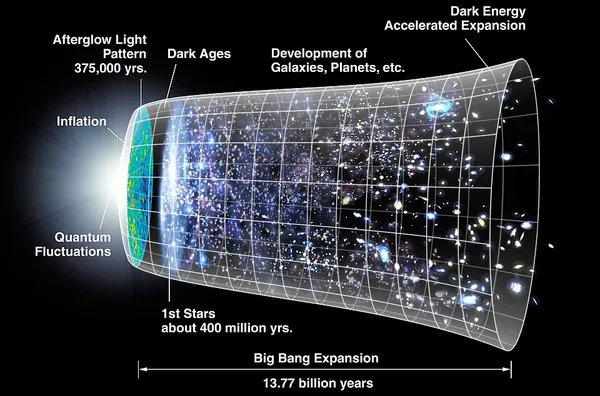
The model was completed over the following decades. In 1981, Alan Guth proposed cosmic inflation, a brief episode of extremely rapid expansion in the earliest moments, which helps explain why the universe looks so uniform and why its geometry is nearly flat. From there, the usual sequence describes a universe that keeps cooling: particles form first, then protons and neutrons, then light nuclei, and after roughly 300,000 to 400,000 years atoms become stable and light can travel freely, producing the background radiation we observe today. Small differences in density then grew under gravity into clouds, stars and galaxies. Today it is known that most matter is dark and that the expansion is accelerating, which is attributed to dark energy, making up roughly 70 percent of the total. Satellites such as COBE and WMAP, together with large telescopes, have refined these values to a precision that would have seemed unlikely only a few decades ago.
The Big Bang has had a wide influence. It provides the framework for studying how galaxies formed, where chemical elements came from, and how the cosmos has evolved, and it serves as a reference point for observational astronomy and particle physics. Important questions remain open, however: there is no complete theory of quantum gravity to describe the very first instants, and the nature of dark matter and dark energy is still unknown. The model describes the evolution of the universe from a very early moment with great success, but it does not by itself explain why that beginning occurred or what, if anything, preceded it, questions that lie beyond present physics.
Timeline
- 1912Vesto Slipher measures the redshift of spiral nebulae and finds that most are moving away from Earth.
- 1922Alexander Friedmann derives from Einstein's equations that the universe can expand.
- 1927Georges Lemaître proposes that the recession of the nebulae is caused by the expansion of the universe.
- 1929Edwin Hubble establishes the relation between distance and recession speed of galaxies, known as Hubble's law.
- 1931Lemaître suggests that the universe emerged from a primeval atom.
- 1948George Gamow predicts that a residual radiation from the hot early universe should exist.
- 1949Fred Hoyle uses the phrase big bang on the BBC, and the name eventually catches on.
- 1964The cosmic microwave background is discovered by chance, providing strong support for the model.
Trivia and anecdotes
A name with a double edge
Hoyle is popularly said to have meant big bang as a mockery of Lemaître's idea, though he later denied this and said it was just a vivid image.
A priest in cosmology
Lemaître was a Catholic priest, and some scientists of his time were wary of linking the beginning of time with religious ideas.
A disputed name
Scientists themselves point out that the term is misleading, because it suggests an explosion into empty space, which the model does not describe.
 Georges Lemaître1894–1966 · Astronomy and space
