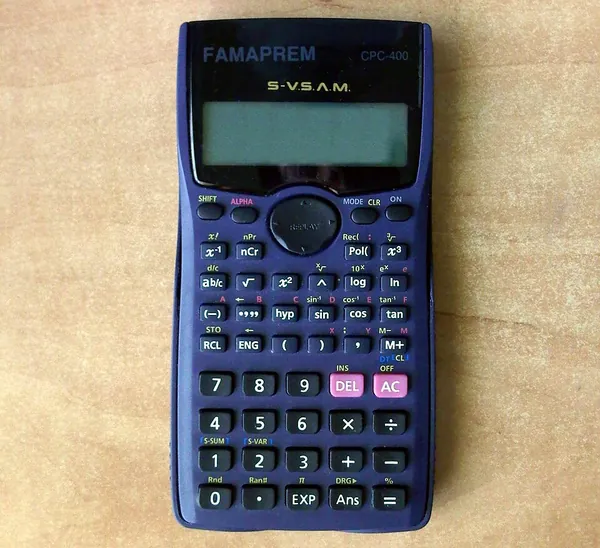

Calculator
A device that carries out arithmetic, from simple sums to complex mathematical calculations.
- Year
- 1642
- Section
- Computing
History
A calculator is a device built to carry out arithmetic, from simple sums to complicated mathematical work. It matters because it relieved people of slow, error-prone number work, and today it is found in almost every digital device.
Long before machines, people counted with bones, pebbles, counting boards and the abacus, which Sumerians and Egyptians were already using before 2000 BC. The seventeenth century added new aids such as Napier's bones and logarithms. William Oughtred invented the slide rule in 1622, and his pupil Richard Delamain made it known in 1630. Until then, calculation was a semi-manual task done with pencil and paper, and the person doing it was called a calculator. The work was tedious and prone to mistakes, and the user had to judge for themselves whether a result was the right size.
The first mechanical machines came with the Renaissance. In 1623 Wilhelm Schickard built a device that combined an adding mechanism with mechanised multiplication tables, so that multiplication and division relied on addition. In 1642 Blaise Pascal presented a machine that could add and subtract directly; multiplying and dividing meant repeating those steps patiently. Historians still debate who deserves credit for the first mechanical calculator, since the two designs had different aims. Gottfried Leibniz spent about forty years on a four-operation machine, the stepped reckoner, and in the process devised the wheel that bears his name, but he never produced a fully working machine. In the eighteenth century Poleni built one of the first fully functional machines capable of all four operations, though such devices stayed complex and of limited use.
The electronic calculator arrived in the 1960s, when the first solid-state model was built, meaning one with no moving parts and electronic components instead. Pocket models became popular in the 1970s, partly thanks to the Intel 4004 microprocessor, which Intel developed for the Japanese company Busicom. A microprocessor is a chip that carries out the instructions it receives. Integrated circuits, small chips that pack many electronic components together, shrank the devices and cut their cost. By the end of that decade a basic calculator was affordable for most people and common in schools.
A modern calculator combines a power source, a keypad, a processor and a display. Many handle numbers in binary-coded decimal, a system that treats each digit separately and makes it easy to drive seven-segment displays. Displays have moved from light-emitting diodes and vacuum fluorescent tubes to liquid crystals, and power comes from batteries or solar cells.
In 1986 calculators still made up an estimated 41 percent of the world's general-purpose computing hardware; by 2007 that share had fallen below 0.05 percent. Their functions now live in phones, tablets and computers, and spreadsheets and algebra software have taken over much of their work. Dedicated devices still serve classrooms, engineering and finance, and companies such as Casio, Sharp, Hewlett-Packard and Texas Instruments continue to make them.
Timeline
- 2000 BCSumerians and Egyptians use the abacus and other counting aids, by approximate dating.
- 1622William Oughtred invents the slide rule.
- 1623Wilhelm Schickard builds a mechanical machine combining addition with mechanised multiplication tables.
- 1642Blaise Pascal presents a machine that adds and subtracts directly.
- 1960The first solid-state electronic calculator is built in the early 1960s.
- 1970Pocket models become popular after the development of the Intel 4004 microprocessor.
- 1986Calculators account for an estimated 41 percent of general-purpose computing capacity worldwide.
- 2007Their share of global computing capacity drops below 0.05 percent.
Trivia and anecdotes
A misleading fraction
The fraction 1/7 appears on screen as 0.14285714, and many people fail to recognise it in that decimal form.
Decimal coding on CDs
CDs store the track number in binary-coded decimal, which limits them to 99 tracks.
Errors that are not always clear
Some calculators can tell two kinds of error apart, although it is not always obvious to the user which is which.