
Heat equation
A partial differential equation describing how heat, or temperature, spreads through a region over time.
- Year
- 1822
- People involved
- Joseph Fourier
- Section
- Mathematics
History
The heat equation is a partial differential equation, meaning a relation that links how a quantity changes in space and over time. It describes how the temperature of a body evolves: heat flows from warmer regions toward cooler ones, and over time temperature differences smooth out. Its importance lies in the fact that the same type of equation also models many other diffusion phenomena beyond heat.
Before Fourier, the study of heat relied largely on experiments and intuition about how temperature passes between bodies in contact. Some mathematicians and physicists of the eighteenth century had treated conduction problems, but without a general framework linking the flow of heat to the way temperature varies from point to point. Fourier, a French mathematician and administrator with a strong interest in the physics of heat, approached the problem from two principles: the law named after him, which states that the heat flow is proportional to the temperature gradient, and the conservation of energy. Applying both to a small region of material, he obtained an equation relating how quickly the temperature changes to the curvature of its spatial distribution.
Fourier presented his results in 1822 in his work Théorie analytique de la chaleur. To solve the equation he represented the temperature distribution as a sum of simple periodic functions, an idea that gave rise to what is now called Fourier series. His work was not accepted without reservations: some colleagues questioned the rigor of his methods, and the general validity of the series took decades to be fully clarified. Over time, however, the approach became a central tool of mathematical analysis.
Since then, the equation and its variants have been applied in thermal engineering, in the study of chemical diffusion, and in modelling phenomena as diverse as Brownian motion, which is studied through the Fokker–Planck equation, or the propagation of signals in nerve cells. It also appears in some problems of quantum mechanics and in financial models. In practice it helps design insulation, predict how an object cools or warms, and estimate temperature distributions in engines and buildings.
Timeline
- 1822Fourier publishes the Théorie analytique de la chaleur, where he formulates the heat equation.
- 1822Fourier uses sums of periodic functions to solve the equation, the origin of Fourier series.
- The equation becomes a central model for diffusion processes in physics and mathematics.
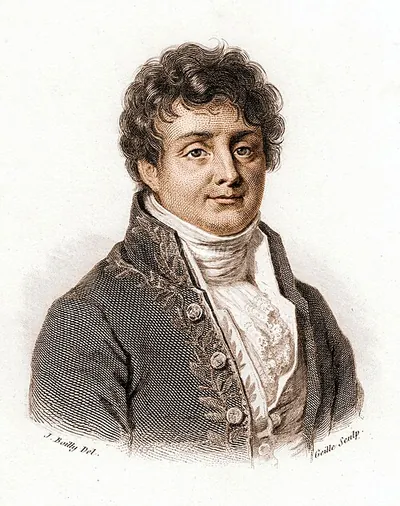 Joseph Fourier1768–1830 · Mathematics
