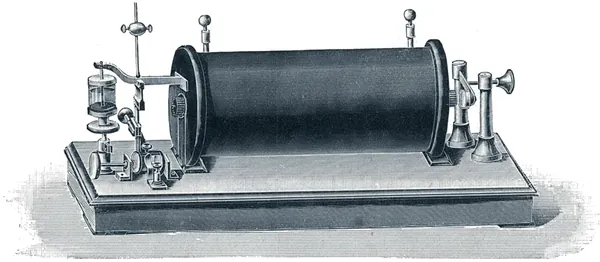
Induction coil
A transformer that turns a low-voltage direct current into brief, very high-voltage pulses that can jump across a gap as a spark.
- Year
- 1851
- People involved
- Heinrich Daniel Ruhmkorff
- Section
- Technology and communications
History
The induction coil, also called a spark coil or Ruhmkorff coil, is a transformer that converts a low-voltage direct current, such as that from a battery, into pulses of very high voltage. Those pulses can leap across a small air gap as a visible spark. It matters because it was the first type of electrical transformer, and for more than half a century it supplied high voltage to devices as different as X-ray machines and early radio transmitters.
Before the coil, electromagnetic induction was a newly discovered effect. In 1831 Michael Faraday had shown that a changing current in one circuit induces a voltage in a nearby circuit, even without any connection between them. Faraday had experimented with coils of wire, but no practical device existed that could use this effect to produce high voltages.
The American physician Charles Grafton Page built a coil of this kind in 1836. In the same year, independently, the Irish priest Nicholas Callan made one at St. Patrick's College in Maynooth. Soon afterwards, George Henry Bachhoffner and William Sturgeon found that an iron core made of separate wires cut the power lost to eddy currents, the swirling currents that heat metal. Between 1836 and the 1860s researchers worked mostly by trial and error, and uncovered rules that still govern every transformer, such as the link between the ratio of turns in the two windings and the output voltage.
Early coils were interrupted by hand. The key advance was the automatic hammer interrupter, a metal arm that vibrated when the magnetised core pulled it, opening and closing the circuit many times a second. It was developed by James William MacGauley in 1838, Johann Philipp Wagner in 1839 and Christian Ernst Neeff in 1847. In 1853 Hippolyte Fizeau proposed adding a capacitor to soften the spark that formed at the contacts when the current was cut. Ruhmkorff, whose name the coil often carries, raised the voltage by greatly lengthening the secondary winding, using up to about 10 km of wire, and produced sparks up to 16 inches long.
In 1853 William Thomson calculated the period of the electrical oscillations that follow each spark, and in 1887 Heinrich Hertz studied the electromagnetic waves that this discharge gives off. Coils became early radiotelegraph transmitters: an operator pressed a telegraph key, and the spark sent pulses that receiving stations picked up at a distance as Morse code, an early step toward broadcast radio. From the 1880s to the 1920s they also powered X-ray machines, arc lamps and electrotherapy devices.
The hammer had a clear limit: it could not manage more than about 200 interruptions per second, and in powerful coils the arcs soon burned its contacts away. That led to mercury interrupters, in which a needle dipped in and out of a container of mercury, and then to the electrolytic interrupter invented by Arthur Wehnelt in 1899, which reached about 2000 breaks per second through hydrogen bubbles. It generated a great deal of heat, and the hydrogen could explode. Mercury turbine interrupters reached up to 10,000 breaks per second and became the most common type in commercial wireless stations.
Today the coil survives mainly as the ignition coil of combustion engines, which makes the spark at the spark plugs, and as a classroom demonstration of induction. Its principle still lives on in the high-voltage transformers that power much of modern electrical equipment.
Timeline
- 1831Michael Faraday formulates the law of electromagnetic induction.
- 1836Charles Grafton Page and Nicholas Callan independently build the first induction coils.
- 1838James William MacGauley develops an automatic hammer interrupter.
- 1853Hippolyte Fizeau proposes adding a capacitor to damp the spark at the contacts.
- 1887Heinrich Hertz studies the electromagnetic waves emitted by the coil's discharge.
- 1899Arthur Wehnelt invents the electrolytic interrupter, capable of about 2000 breaks per second.
Trivia and anecdotes
A priest among the pioneers
Nicholas Callan was a Catholic priest and researcher at St. Patrick's College in Maynooth, Ireland. He arrived at the coil at almost the same time as the American physician Charles Grafton Page.
Record sparks
Ruhmkorff coils produced sparks up to 16 inches long thanks to a secondary winding of about 10 km of wire. In 1877, a coil built by Alfred Apps exceeded one metre of spark.
A dangerous interrupter
The Wehnelt electrolytic interrupter was very effective, but it produced a lot of heat and the hydrogen it released could explode.
 Heinrich Daniel Ruhmkorff1803–1877 · Physics
