Law of mass action
A law stating that, for a reversible chemical reaction at equilibrium and constant temperature, the ratio between the concentrations of products and reactants stays fixed.
- Year
- 1864
- People involved
- Cato Maximilian Guldberg, Peter Waage
- Section
- Chemistry
History
The law of mass action describes what happens when a reversible chemical reaction reaches equilibrium. A reversible reaction can proceed in both directions, so reactants and products coexist. At constant temperature, the ratio between their concentrations remains fixed, which allows chemists to predict how far a reaction will go and how much product it will yield.
Until the mid-nineteenth century, chemists generally believed that chemical affinity, the tendency of two substances to react, depended mainly on their nature. Claude Louis Berthollet had proposed ideas about reversible reactions that served as a starting point, but no quantitative formulation existed. In 1864 the Norwegian chemists Cato Maximilian Guldberg and Peter Waage argued that the affinity between two reactants also depended on how much of each was present in the mixture. They expressed this through the concept of active mass, which for substances in solution equals concentration and for solids is treated as a constant. The concept later became known as activity.
Their first papers were written in Danish and attracted little notice, and the French publication of 1867 suffered the same fate. That later work contained a modified version of the law along with the experimental data behind it. To simplify the calculations, they assumed that affinity was proportional to the product of the active masses of the reactants, which amounts to setting the exponents of their first formulation to one. The law thus became a relation between concentrations at equilibrium, expressed by a constant now called the equilibrium constant. Guldberg and Waage also grasped that equilibrium is dynamic: the forward and reverse reactions proceed at equal rates, so the mixture appears unchanged even though transformations continue in both directions.
In 1877 the Dutch chemist Jacobus Henricus van 't Hoff reached similar conclusions independently, unaware of their earlier work. This prompted Guldberg and Waage to publish a fuller and more developed account in German in 1879, and van 't Hoff then accepted their priority. In that account, the proportionality of reaction rate was justified by the frequency of collisions between molecules, an idea borrowed from the kinetic theory of gases that Boltzmann had developed in 1872. The exponents were also identified, for the first time, with the stoichiometric coefficients, the numbers that show how many molecules of each species take part in a reaction.
Modern chemistry keeps the form of the equilibrium constant with one important change: activities replace concentrations. The concept of activity was developed by Josiah Willard Gibbs in the 1870s, but it did not become widely known in Europe until the 1890s. Today the constant is derived from equilibrium thermodynamics and the chemical potential, a quantity describing how strongly each substance tends to change. The original kinetic derivation is no longer considered valid, yet the core insight that the driving forces of the forward and reverse reactions become equal at equilibrium proved correct.
The rate relationship holds strictly only for elementary reactions, which take place in a single step. Many reactions proceed through several stages with reactive intermediates, and the law applies to each stage separately. Guldberg and Waage were fortunate that their examples, ester formation and hydrolysis, follow this rate expression. Within biochemistry, researchers still debate whether the law describes conditions inside cells accurately, where particles may be held in place and diffusion is slow. Several modifications have been proposed, but no consensus has emerged.
Today the law helps chemists calculate yields in laboratory and industrial processes and predict how an equilibrium shifts when concentrations or temperature change.
Timeline
- 1864Guldberg and Waage publish their first formulation of the law, in Danish, proposing that affinity depends on active masses.
- 1867They simplify the law by setting the exponents to one and present their experimental data in a French publication.
- 1872Boltzmann develops the kinetic theory of gases, which later underpins the justification of reaction rates used in 1879.
- 1877Van 't Hoff independently reaches similar conclusions, unaware of their earlier work.
- 1879Guldberg and Waage publish an expanded account in German; van 't Hoff acknowledges their priority.
- 1890The concept of activity, formulated by Gibbs in the 1870s, becomes widely known in Europe.
Trivia and anecdotes
Papers in Danish
The 1864 papers were written in Danish and went largely unnoticed, as did the French publication of 1867.
Shared priority
Van 't Hoff reached similar conclusions in 1877 without knowing the earlier work, and after the expanded account of 1879 he recognized Guldberg and Waage's priority.
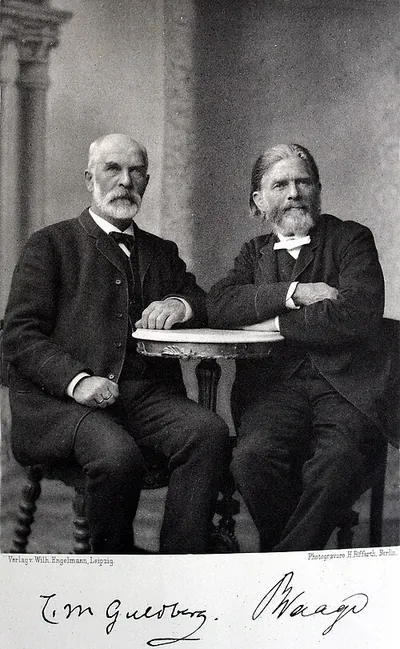 Cato Maximilian Guldberg1836–1902 · Chemistry
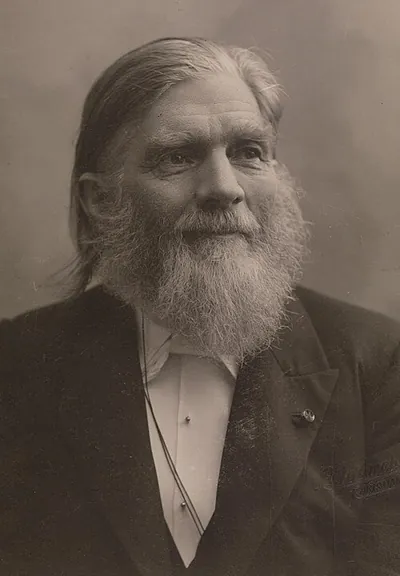 Peter Waage1833–1900 · Chemistry