Neyman–Pearson lemma
An optimal rule for choosing between two simple statistical hypotheses, based on the ratio of their likelihoods.
- Year
- 1933
- People involved
- Jerzy Neyman
- Section
- Mathematics
History
The Neyman–Pearson lemma answers a basic question in statistics: how to decide between two rival hypotheses as effectively as possible. A hypothesis is a claim about the world that data can test; here, two specific values of a parameter are compared, such as the mean of a population. The result shows that, if the chance of wrongly rejecting a true hypothesis is fixed in advance, the most powerful decision region is built from the ratio of the likelihoods of the two hypotheses, that is, how probable the observed data are under each one.
Before this, statistics was dominated largely by Ronald Fisher's significance testing, which worked with a single null hypothesis and asked how surprising the observed data were under it. Fisher did not introduce an explicit alternative, so the two kinds of mistake could not be weighed against each other. Jerzy Neyman and Egon Pearson proposed adding that competing hypothesis and studying both types of error: rejecting a true claim, and accepting a false one. Their collaboration began around 1927, bringing together Neyman, who had been trained in Warsaw, and Pearson, son of Karl Pearson, at University College London.
The result appeared in 1933. It states that the test based on the likelihood ratio is the most powerful among all tests with the same type I error level, so no other decision rule detects the alternative better while keeping that control. In practice the lemma yields concrete tests. If the standard deviation of a normal population is known and one must decide whether its mean is μ0 or μ1, the likelihood ratio reduces to a function of the sample mean, and the rule becomes rejecting the null hypothesis when that mean exceeds a threshold. The threshold is set from the significance level chosen.
Reception was mixed. Fisher criticised the Neyman–Pearson approach harshly, especially the notion of inductive behaviour, in which a test guides decisions rather than measuring the evidence in a single case. Over time, though, their framework became the basis of much modern applied statistics, with its vocabulary of power, type II error and significance level. The lemma also spread: Abraham Wald adapted it to sequential analysis during the Second World War, and Samuel Karlin and Herman Rubin generalised it to composite hypotheses with monotone likelihood ratios.
Today the lemma has concrete uses. In electronic engineering it helps set the rate of false alarms or missed detections in radar and digital communication systems. In particle physics it is used to build analysis-specific likelihood ratios, testing at the LHC, in proton collision data, whether signs of new physics appear against the predictions of the Standard Model. Its central idea, balancing decision errors through a ratio of probabilities, remains at the heart of many tools for deciding under uncertainty.
Timeline
- 1927The work that would lead to the lemma begins in the collaboration between Neyman and Pearson.
- 1933Neyman and Pearson publish the paper containing the lemma and the framework of two error types.
- 1945Wald develops the sequential version of the test during the Second World War.
- Karlin and Rubin extend the lemma to composite hypotheses with monotone likelihood ratios.
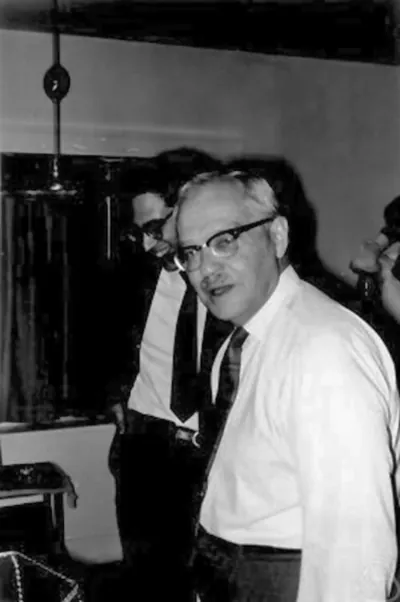 Jerzy Neyman1894–1981 · Mathematics