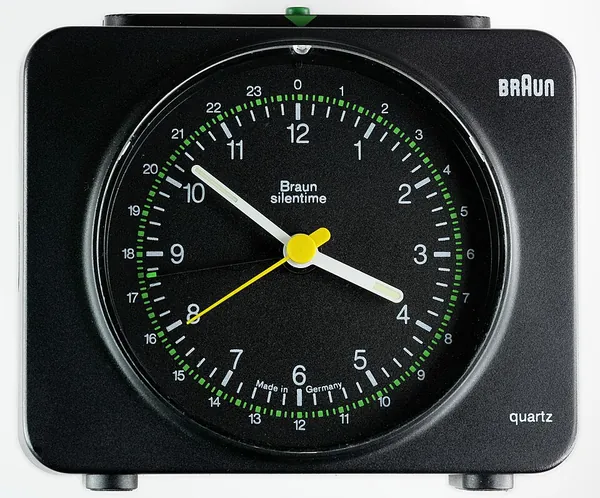

Quartz clock
A watch that keeps time with the very regular vibration of a small quartz crystal powered by a battery.
- Year
- 1927
- Section
- Scientific instruments
History
A quartz clock keeps time through the vibration of a quartz crystal, a mineral that oscillates at a very stable frequency when electricity is applied. Each oscillation works like a regular tick, and an electronic circuit counts those ticks and converts them into seconds, minutes and hours. Its importance lies in replacing the pendulum and the spring as the basis of fine timekeeping, and in becoming the most widely used timekeeping technology on the planet.
Before quartz, precision depended on pendulum clocks and spring-driven mechanisms, which were sensitive to temperature, shocks and wear. In 1880, Jacques and Pierre Curie discovered that quartz is piezoelectric: when it is deformed it generates electricity, and when it receives electricity it deforms. An electronic oscillator was invented in 1912, and in 1919 the British physicist William Eccles used one to keep a tuning fork vibrating, reducing the energy losses typical of mechanical systems.
The decisive step came in the 1920s. In 1921, Walter G. Cady built the first quartz crystal oscillator, and it soon became clear that quartz was steadier than the steel resonators that radio engineers had been using, which disappeared within a few years. In 1923, D. W. Dye of Britain's National Physical Laboratory and Warren Marrison of Bell Laboratories produced precise timing signals with quartz oscillators. The exact date of the first quartz clock Marrison and J. W. Horton built at Bell is uncertain, and it is placed around 1920, although the model described in detail is the 1927 one. That device used a block of crystal driven by electricity to produce pulses at 50,000 cycles per second, which a frequency divider reduced to a usable rate to drive a synchronous motor. It was a bulky and delicate laboratory instrument.
For the next three decades, quartz clocks served mainly as time standards in laboratories. In 1932, a quartz clock detected small variations in the Earth's rotation rate over periods of just a few weeks. That same year, in Japan, Issac Koga developed a way of cutting the crystal so that its frequency barely changed with temperature. The United States National Bureau of Standards, now NIST, based its national time standard on quartz clocks until the 1960s, when it moved to atomic clocks. Vacuum-tube counting circuits were large and power-hungry, so practical use remained limited. In 1953, the Swiss firm Longines presented the first quartz movement, which was still considerably large.
The breakthrough came with cheap semiconductors and digital logic in the 1960s. In 1964, Seiko used its Quartz Crystal QC-591 as a backup timekeeper for the marathon at the Tokyo Olympic Games. In 1967 the first wristwatch prototypes appeared: the Beta 1 from the Centre Électronique Horloger in Neuchâtel, and Seiko's Astron. At Christmas 1969, Seiko put the Astron 35SQ on sale, the first commercial quartz wristwatch, which lost only about five seconds a month. It was made of gold and cost 1,250 dollars, roughly the price of a car at the time. In 1971, Girard-Perregaux launched the Calibre 350 with a 32,768 Hz crystal, a frequency that became the standard because it is a power of two, so a simple chain of dividers can produce one pulse per second.
During the 1970s, MOS integrated circuits allowed a button battery to last about twelve months while powering a stepping motor or a liquid crystal display. In 1972, Hamilton Watch launched the first digital watch under the Pulsar brand, which Seiko later acquired, and Longines soon produced the first with an LCD screen. Mass production in Japan and Hong Kong, by makers such as Casio, Citizen and Seiko, made quartz cheap and added alarms, chronographs and calendars that had been reserved for expensive watches. Many buyers replaced mechanical watches that needed winding, and the Swiss industry went through what became known as the quartz crisis. In 1983, the Swatch, with its simple quartz mechanism, revived the appeal of analogue watches.
Since the 1980s, quartz has dominated the wristwatch market. A standard quartz watch may gain or lose about 15 seconds in 30 days within a normal temperature range, and having few moving parts makes it more resistant to magnetism and knocks. In 1992, Seiko launched the Kinetic, a quartz watch without a battery in which arm movement drives a generator that powers the circuit. Today quartz crystals keep time in watches, computers and household appliances, and standard crystal units are inexpensive mass-produced components.
Timeline
- 1880Jacques and Pierre Curie discover the piezoelectricity of quartz.
- 1921Walter G. Cady builds the first quartz crystal oscillator.
- 1927Bell Laboratories describes a quartz clock producing pulses at 50,000 cycles per second.
- 1953Longines presents the first quartz movement.
- 1964Seiko uses the QC-591 as a backup timekeeper at the Tokyo marathon.
- 1969Seiko sells the Astron 35SQ, the first commercial quartz wristwatch.
- 1983The Swatch, with a simple quartz mechanism, revives analogue watches.
Trivia and anecdotes
A watch priced like a car
The gold Astron 35SQ cost 1,250 dollars, a figure comparable to the price of a car at the time. Its launch slogan predicted that one day all watches would be made this way.
A frequency chosen for mathematical convenience
The crystal vibrates 32,768 times per second, which is 2 to the power of 15. Being a power of two, a chain of divide-by-two stages is enough to obtain one pulse per second.
A clock that noticed the Earth turning
In 1932, a quartz clock was able to measure small variations in the Earth's rotation rate over a few weeks.