Reflecting telescope
A telescope that forms its images with curved mirrors instead of lenses.
- Year
- 1668
- People involved
- James Gregory
- Section
- Scientific instruments
History
A reflecting telescope is an optical instrument that gathers light with a curved mirror and brings it to a focus to form an image, rather than using lenses. Its main advantage is that it avoids chromatic aberration, a defect that blurred the images of the lens telescopes of the 17th century. Glass bends each colour of light by a slightly different amount, so objects were often fringed with false colours. Over time this made the reflector the preferred design for large research instruments and for many amateur astronomers.
Long before the instrument existed, the idea that a curved mirror could behave like a lens was familiar. An 11th-century treatise on optics, attributed to Alhazen, spread across early modern Europe in Latin translations. In 1571 Thomas Digges published his father Leonard's posthumous book, which credited Leonard with the idea of using concave and convex mirrors to observe distant regions. In 1636 the French friar Marin Mersenne proposed a design with a parabolic mirror and a small mirror placed in front of it, with a hole through which light reached the eye. Soon after the lens telescope appeared, Galileo and others also discussed mirror-based designs, but none of these early proposals worked well enough to last.
In 1663 the Scottish mathematician James Gregory published his design in the book Optica Promota. He improved Mersenne's idea by adding a concave secondary mirror that sent the light back through a hole in the main mirror. This produced an upright image, useful for looking at things on the ground. Gregory never built a working version himself, and in 1673 Robert Hooke constructed one, which became known as the Gregorian telescope. The first reflector that clearly worked, however, was the one Isaac Newton completed in 1668. It used a metal main mirror with a spherical surface and a small flat mirror set at an angle, which sent the image out through the side of the tube to an eyepiece. This Newtonian design remains one of the simplest and cheapest, and it is still a favourite for home-built telescopes. It should be noted that the source credits Gregory with the invention, while most histories of optics regard Newton's instrument as the first working reflector; Gregory's contribution was chiefly the design.
The reception was slow. Early mirrors were made of speculum metal, an alloy that reflected only about two thirds of the light and tarnished easily. Each re-polishing could change the precise curve the mirror needed, so performance kept degrading. It took more than a century for reflectors to become popular. Key improvements included the making of accurate parabolic mirrors in the 18th century, glass mirrors coated with silver, which Léon Foucault developed in 1858, and aluminium coatings applied in a vacuum from the 20th century onwards. The Leviathan of Parsonstown, with a metal mirror about 1.8 metres wide, was the largest telescope of the 19th century, despite the drawbacks of its metal.
The design then branched into many variants. The Cassegrain, first published in a 1672 design attributed to Laurent Cassegrain, uses a hyperbolic secondary mirror that folds the light, giving a long focal length in a short tube. The Ritchey-Chrétien, developed in the early 1910s, uses two hyperbolic mirrors and corrects aberrations at the edge of the image; it is now the most common design among professional telescopes. The Schmidt design combines a spherical mirror with a correcting plate to produce wide-field images. In the late 20th century, active optics adjusted the shape of large mirrors to counter their own weight, and segmented mirrors combined many modular pieces into one large surface.
Today nearly all major research telescopes are reflectors, and the best known of them, the Hubble Space Telescope, works on this principle. The largest designs exceed 10 metres in diameter, something impractical with lenses, which can only be held at their edges and sag under their own weight. The same reflection principle is used for other kinds of radiation, such as X-rays, whose telescopes use grazing-incidence mirrors to form images. Reflectors remain central to both professional observation and amateur astronomy.
Timeline
- 1571Thomas Digges publishes his late father Leonard's book, which credits him with the idea of using mirrors for distant observation.
- 1636Marin Mersenne proposes a telescope with a parabolic mirror and a small mirror placed in front of it.
- 1663James Gregory publishes in Optica Promota a design with a concave secondary mirror.
- 1668Isaac Newton completes the first reflector that clearly works, with a metal mirror and a flat diagonal mirror.
- 1673Robert Hooke builds a Gregorian telescope based on Gregory's design.
- 1858Léon Foucault develops silver-coated glass mirrors, which last longer than metal ones.
- 1910George Willis Ritchey and Henri Chrétien invent the Ritchey-Chrétien design, now the most used by professional observatories.
Trivia and anecdotes
The Leviathan of Parsonstown
With a metal mirror about 1.8 metres wide, it was the largest telescope of the 19th century, even though metal tarnishes easily.
A design that endures
The Newtonian telescope remains one of the simplest and cheapest designs, and is very popular with amateurs who build their own instruments.
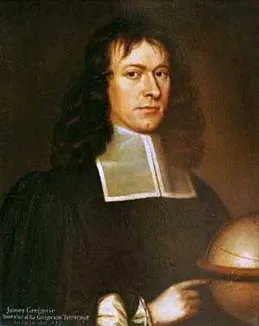 James Gregory1638–1675 · Astronomy and space