Three-phase electric power
A method of generating, transmitting and using electricity with three alternating currents offset by 120 degrees from one another.
- Year
- 1888
- People involved
- Nikola Tesla
- Section
- Energy
History
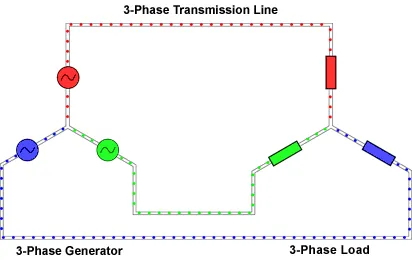
Three-phase electric power is the most widely used form of alternating current for generating, transmitting and distributing electricity. It combines three alternating currents of the same frequency and amplitude, each one lagging a third of a cycle behind the next. Because of this offset, the power delivered to a balanced load stays constant, something single-phase systems cannot achieve. That property makes it especially useful for motors and heavy industry.
Before it was developed, commercial electricity was delivered mainly as direct current or single-phase alternating current. Motors powered by a single alternating current struggled to start and run smoothly. The idea of several offset currents grew out of motor research: in 1885 Galileo Ferraris was studying rotating magnetic fields, the effect that lets a motor turn without mechanical contact between its moving and fixed parts.
Ferraris published his results on 11 March 1888 in a paper to the Royal Academy of Sciences in Turin. His motor was a two-phase design, with currents offset by 90 degrees. Two months later, Nikola Tesla obtained a patent for a three-phase motor, an application he had filed on 12 October 1887. Around the same time, other inventors reached polyphase systems independently, among them Mikhail Dolivo-Dobrovolsky, Jonas Wenström, John Hopkinson and William Stanley Jr. The development is therefore usually described as simultaneous rather than the work of one person.
Two devices made the system practical: the polyphase alternator and the power transformer. The alternator turns mechanical motion into electricity, with coils arranged so their voltages are offset by a third of a cycle. The transformer raises or lowers alternating voltage with small losses, so power can travel long distances through wires of moderate thickness. This made it possible to use hydroelectric power from distant dams and carry that energy to wherever mechanical work was needed.
Working for the German company AEG, Dolivo-Dobrovolsky built a three-phase generator and motor in 1888 and studied star and delta connections. In 1891, at an international electrotechnical exhibition in Germany, a three-wire three-phase line carried 221 kW at 15 kV over 176 kilometres, with about 75 per cent efficiency, to power a fountain and lights. The demonstration also included a three-phase transformer, a squirrel-cage induction motor and what is considered the world's first three-phase hydroelectric plant, at Lauffen am Neckar. In 1890 Wenström received a Swedish patent for a similar system. In 1893 a three-phase link carried power 15 kilometres from a waterfall at Hällsjön in Sweden, generally regarded as the first commercial use.
The system spread quickly through power grids around the world. Homes are often supplied with a single phase today, but power stations generate and transmit three-phase electricity, and industry depends on three-phase motors. High-voltage direct current has gained ground for very long links in the twenty-first century, yet three-phase remains the backbone of the grid.
Timeline
- 1885Galileo Ferraris studies rotating magnetic fields, the basis of alternating-current motors.
- 1887Nikola Tesla files the patent application for his three-phase motor on 12 October.
- 1888Ferraris publishes his work on 11 March and Dolivo-Dobrovolsky develops a three-phase generator and motor at AEG.
- 1890Jonas Wenström obtains a Swedish patent for a similar three-phase system.
- 1891A 176-kilometre three-phase line transmits power at an exhibition in Germany.
- 1893The first commercial application transmits power over 15 kilometres in Sweden.
Trivia and anecdotes
Two inventors, one idea
Ferraris presented his two-phase motor before Tesla, but Tesla's three-phase design proved more practical and became the industry standard.
Fewer cables for the same power
A three-phase system without a neutral can carry the same power as a single-phase one using only about three quarters of the conductor material.
 Nikola Tesla1856–1943 · Energy
