Transfinite number
Infinite numbers, introduced by Georg Cantor, that extend counting and ordering beyond the natural numbers to measure infinite sets.
- Year
- 1883
- People involved
- Georg Cantor
- Section
- Mathematics
History
Transfinite numbers are "infinite" values in a precise sense: they are larger than every natural number. They come in two families. Cardinals tell how many elements an infinite set has, while ordinals tell the position of an element within an infinite ordered sequence. For finite sets these two ideas agree, but once they are extended to infinity they part ways.
Before Cantor, infinity was treated vaguely and was largely a problematic notion that mathematicians preferred to avoid. The word was applied to any non-finite set without distinguishing sizes. Georg Cantor, a German mathematician, began studying these questions around 1873, when he asked whether the natural numbers could be paired one-to-one with the real numbers. He showed that they could not, which revealed that there are infinities of different sizes. Even more surprisingly, he found that the rational numbers can be paired with the natural numbers, even though they seem far more numerous.
To measure infinite sets, Cantor relied on one-to-one correspondence: two sets have the same size if each element of one can be matched with exactly one element of the other. Using this idea he defined the first transfinite number, aleph-null, the size of the set of natural numbers. Aleph-one followed as the next size. He also defined the ordinal omega, the position the first infinity occupies when the natural numbers are put in order. Cantor coined the term "transfinite" in 1895, wishing to avoid the connotations he associated with the word "infinite", which he felt implied a perfection reserved for the divine.
The arithmetic of these numbers behaves differently from that of finite numbers. Addition and multiplication of transfinite cardinals are well defined, obtained from the size of the union and the Cartesian product of two disjoint sets. Subtraction and division, however, cannot be defined unambiguously, because the cancellation rules that work for finite numbers fail. Exponentiation is also defined: the set of all subsets of a set of size b has size 2 raised to b.
A central open question is the continuum hypothesis, which states that no size lies between that of the natural numbers and that of the real numbers. In 1938 Kurt Gödel showed it cannot be refuted from the standard axioms of set theory, and in 1963 Paul Cohen showed it cannot be proved from them either. The hypothesis is therefore independent of those axioms, much as the parallel postulate is independent of the rest of Euclidean geometry.
Today transfinite numbers are a basic tool of set theory, which underpins most of modern mathematics. They appear in logic, in computability theory and in the study of infinite structures. Cantor met resistance in his lifetime, but his ideas became part of ordinary mathematical language and changed how infinity is understood.
Timeline
- 1873Cantor shows that the real numbers cannot be paired one-to-one with the natural numbers.
- 1883Cantor publishes the foundations of his theory of transfinite numbers.
- 1895Cantor coins the term "transfinite" to avoid the connotations of the word "infinite".
- 1938Gödel proves that the continuum hypothesis cannot be refuted from the Zermelo-Fraenkel axioms.
- 1963Cohen proves that the continuum hypothesis cannot be proved from those axioms.
Trivia and anecdotes
A term chosen with caution
Cantor preferred "transfinite" to "infinite" because he believed that the truly infinite was a divine quality that should not be attributed to human constructions.
Pairing numbers
The natural numbers can be paired with the rationals, although the rationals seem far more numerous. This shows how finite intuitions fail when applied to infinity.
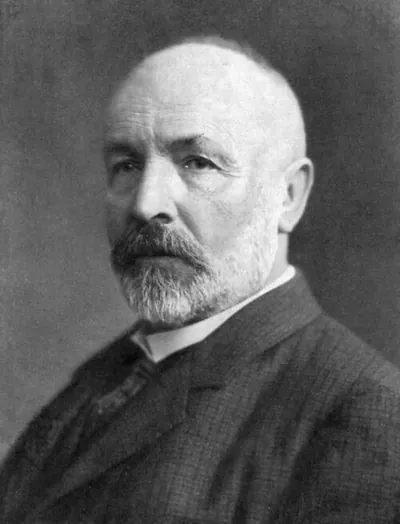 Georg Cantor1845–1918 · Mathematics