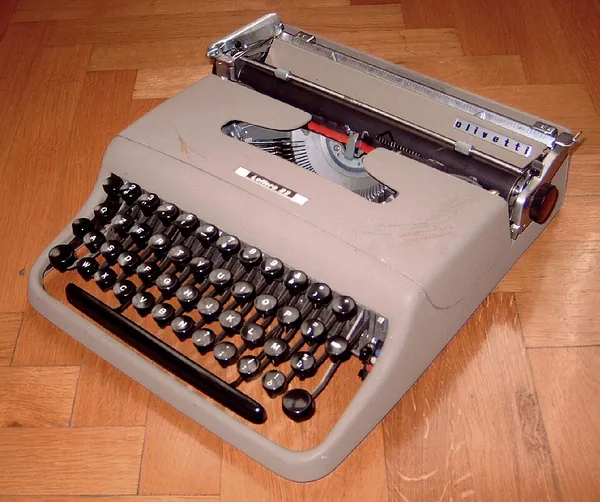
Typewriter
A mechanical device with keys that, when pressed, strike an inked ribbon to print characters onto paper.
- Year
- 1868
- People involved
- Christopher Latham Sholes
- Section
- Technology and communications
History
A typewriter is a machine with a set of keys that, when pressed, make a metal type strike an inked ribbon and leave a character on the page. Its importance lies in making writing faster, more legible and repeatable, and for over a century it was a basic tool in offices, newsrooms and homes.
Before a practical machine existed, many inventors tried to write mechanically. In 1714 Henry Mill received a British patent for a device that, judging by its description, resembled a typewriter, though little more is known about it. Around 1808 the Italian Pellegrino Turri built one for a blind friend, and in 1829 the American William Austin Burt patented the "Typographer," often cited as the first typewriter, although even that claim is debated since Turri's machine came earlier. These early devices were slow and were never sold in quantity. Between 1829 and 1870 many more were patented in Europe and America, yet none reached commercial production, and many aimed to help blind people.
The first typewriter sold in any real numbers was the Danish pastor Rasmus Malling-Hansen's writing ball, invented in 1865 and marketed in 1870. It arranged short letter pistons around a sphere, and its layout aimed to let the fastest fingers strike the most common letters. It sold well in Europe and was reportedly used in London offices until 1909. The decisive commercial step came in 1873, when Remington began producing the machine designed by Christopher Sholes, Carlos Glidden and Samuel W. Soule, patented in 1868 with the involvement of Frank Haven Hall. Sholes soon distanced himself from his own design, but its key arrangement spread widely. Early models had flaws: they typed only capitals, the text stayed hidden until the line was finished, and they were costly and bulky.
Manufacturers gradually fixed these problems. Around 1895 so-called visible typewriters appeared, letting the user watch the text as it was typed. By about 1920 the manual machine had reached a fairly standard design: keys linked to metal type, an inked ribbon, and a cylinder holding the paper that advanced when the carriage return lever was pulled at the end of each line. Its spread was helped by the mass entry of women into offices as typists, which changed the impersonal tone of business and official correspondence. Electric and later electronic models extended its capabilities through the twentieth century.
The typewriter's influence lives on in indirect ways. Its QWERTY key layout remains the de facto standard for English-language computer keyboards, although the reasons for its original design are still unclear. In the 1980s word processors replaced it in most developed countries, though it stays in use in some regions with unreliable electricity. It is now regarded as obsolete. The last company making typewriters, in India, closed its final factory in Mumbai in 2011, and the last machine made in Europe came off the line in Wales in 2012.
Timeline
- 1714Henry Mill receives a British patent for a device resembling a typewriter.
- 1829William Austin Burt patents the "Typographer," often cited as the first typewriter.
- 1870Malling-Hansen's writing ball is marketed, the first typewriter sold with regularity.
- 1873Remington starts producing the Sholes and Glidden machine in Ilion, New York.
- 1895Visible typewriters appear, letting users watch their text as they type.
- 1980Word processors largely replace typewriters in developed countries.
- 2012The last typewriter made in Europe is produced in Wrexham, Wales.
Trivia and anecdotes
An invention with many parents
Historians estimate that some form of typewriter was invented around 52 times by people seeking a workable design.
Built for the blind
Many early machines, such as Turri's, were made so that blind people could write.
 Christopher Latham Sholes1819–1890 · Technology and communications
