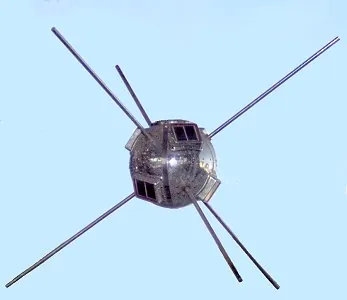

Vanguard 1
A small American satellite launched in 1958, the first to run on solar power and the oldest human-made object still in orbit around Earth.
- Year
- 1958
- Section
- Astronomy and space
History
Vanguard 1 is an American satellite that was launched on 17 March 1958. It matters for two reasons. It was the first spacecraft to be powered by sunlight, and together with the upper stage of its rocket it is the oldest human-made object still circling the Earth. Its story shows both the pressure of the space race and the way scientists can make good use of a craft that was built for a limited working life.
The Soviet Union had launched Sputnik 1 in October 1957, and the United States had no satellite in orbit. The Vanguard Project, which began officially in September 1955, was meant to put the country at the forefront of space exploration, but its first attempts ended in failure. The direct predecessor, Vanguard TV3, exploded on its launch pad on 6 December 1957, only two months after Sputnik 1 had gone up. That setback damaged confidence in the American aerospace industry. Three organisations shared the work. The Army ran the tracking stations on the ground, the Air Force provided the launch site, and the Naval Research Laboratory (NRL) designed, built and checked both the satellite and the rocket. The project was part of the American contribution to the International Geophysical Year, which ran from July 1957 to December 1958.
The satellite was an aluminium sphere about 16.5 centimetres across and weighing 1.47 kilograms, with six slender antennas, each 30 centimetres long. It carried two transmitters. The first, rated at 10 milliwatts and working at 108 megahertz, ran on mercury batteries. The second, rated at 5 milliwatts and working at 108.03 megahertz, drew power from six solar cells made by Bell Laboratories. A solar cell turns light into electricity, and using one in orbit was a new idea at the time. The small sphere left little room for larger panels. The instruments included a Geiger counter for measuring radiation, a micrometeoroid detector, a magnetometer for recording magnetic fields, and two thermistors, temperature sensors, to track the inside temperature and test the insulation.
The launch was delayed so that Explorer 1, the first American satellite, could pass over Florida first. A three-stage rocket then lifted off from Cape Canaveral and placed Vanguard 1 in an elliptical orbit tilted 34.25 degrees. It ranged from about 654 to about 3969 kilometres above the surface and took roughly 134 minutes to complete one circuit. Early estimates suggested the satellite could stay up for around 2,000 years. However, solar radiation pressure and atmospheric drag, especially during periods of intense solar activity, changed the height of the orbit's lowest point, the perigee. The expected lifetime therefore fell to roughly 240 years.
The battery transmitter sent temperature readings for about sixteen days and tracking signals for twenty. The solar-powered transmitter kept working for more than six years. The signals grew weaker until they were last received at the Minitrack station in Quito, Ecuador, in May 1964. Since then, the satellite has been followed optically through telescopes from the ground.
Radio signals were also used to measure the total number of electrons between the satellite and the receiving stations. The tracking data revealed that the Earth is not a perfect sphere, nor a regular ellipsoid. Instead it has a slightly lopsided shape, something like a pear with its stem at the North Pole. This shape, called the geoid, helped cartographers draw more accurate maps of the islands of the Pacific. The orbit itself was used to study the density of the upper atmosphere according to altitude, latitude, season and solar activity. Scientists found that the atmosphere resisted the satellite more than expected, because the upper layers thin out more gradually than had been assumed. The Minitrack tracking network, which was part of the mission, laid groundwork for a later system designed to spot spy satellites passing over American territory.
The orbit has changed slowly over the decades. In 1973 its highest point was 3928 kilometres up, its lowest point 654 kilometres, and one circuit took 133.8 minutes. By the year 2000, the apogee had dropped to 3839 kilometres, the perigee to 652 kilometres, and the period to 132.8 minutes. In March 2009 the satellite passed 200,000 orbits, a distance of about 10 billion kilometres. Only the Pioneer and Voyager probes have travelled farther, but they are heading out of the solar system, whereas Vanguard 1 still circles our planet.
The legacy of Vanguard 1 is both technical and scientific. Much of its technology was later used on other American satellites, most notably solar power in space. Because its aerodynamic properties have barely changed, Vanguard 1 and its sister satellites Vanguard 2 and Vanguard 3 provide an atmospheric data record now more than sixty years old. In 2008 the NRL marked the fiftieth anniversary with a day-long meeting, and the satellite's track over Washington was simulated. On 17 March 2023 it completed 65 years in orbit. Private groups have proposed retrieving it, both to preserve it as a historic object and to study the long-term effects of a spacecraft left in orbit. There is a precedent: in 1984 the space shuttle Discovery recovered two malfunctioning communications satellites. Because Vanguard 1 remains property of the United States government, any recovery would first need an agreement with that government.
Timeline
- 1955In September the first official American satellite programme, the Vanguard Project, begins.
- 1957On 6 December the rocket carrying Vanguard TV3 explodes and the satellite never reaches orbit.
- 1958On 17 March Vanguard 1 enters orbit from Cape Canaveral, becoming the fourth satellite successfully launched.
- 1964In May the satellite's signal is received for the last time at the station in Quito, Ecuador.
- 1973Orbital measurements show a perigee of 654 kilometres and an apogee of 3928 kilometres.
- 2008The Naval Research Laboratory marks the fiftieth anniversary of the launch with a meeting at its headquarters.
- 2023On 17 March the satellite completes 65 years in orbit, making it the oldest artificial object in space.
Trivia and anecdotes
The grapefruit satellite
Soviet leader Nikita Khrushchev mocked the small Vanguard 1 as 'the grapefruit satellite'. The joke fell flat, since many Soviet citizens of the time, living through severe shortages, did not know what a grapefruit was.
A record for staying up
The satellite and the upper stage of its rocket hold the record for the longest time in space of any human-made objects, which means they have covered more distance over the Earth's surface than any others.
A tracking system with a legacy
The Minitrack tracking system developed for this satellite laid the groundwork for a later network designed to detect spy satellites flying over American territory.