
Bell Labs
American research and development laboratory founded in 1925 within AT&T, now owned by Nokia.
- Year
- 1925
Bell Labs traces its origins to the engineering department of Western Electric, the manufacturing arm of the Bell System telephone network, which operated from the late nineteenth century at 463 West Street in New York City. After years of advances in telecommunications, that unit was reorganised on 1 January 1925 as Bell Telephone Laboratories, owned jointly by Western Electric and AT&T. It began with about 3,600 engineers, scientists and support staff, and its first president was Frank B. Jewett.
For decades the laboratory enjoyed one of the largest research budgets in technology anywhere in the world, helped by AT&T's dominance of American telephony. Its output includes the transistor, announced in 1947 by Walter Brattain, William Shockley and John Bardeen, who later shared a Nobel Prize; Claude Shannon's information theory of 1948; the solar cell of 1954; the laser, developed in 1957; and Telstar 1, the first communications satellite in orbit, launched in 1962. Staff also helped create the Unix operating system and the C and C++ programming languages, and contributed to radio astronomy. Its researchers have won nine Nobel Prizes and four Turing Awards in total.
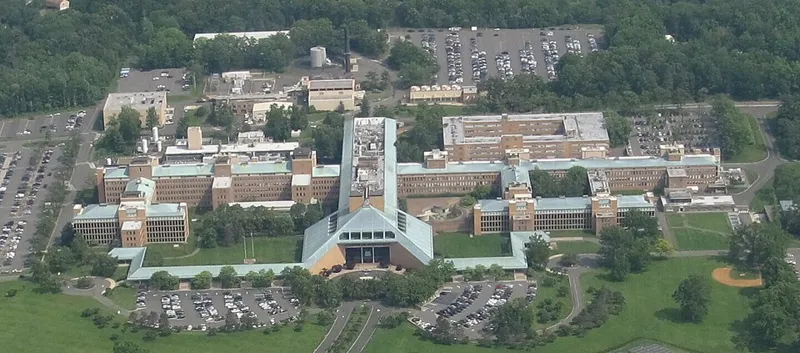
In 1984, after AT&T was restructured, part of the laboratory became Bellcore. In 1996 the remainder went to Lucent Technologies, which later merged with Alcatel and was eventually bought by Nokia. Headquarters moved to Murray Hill, New Jersey, in 1967, and the company still runs labs in several countries, including Spain.
Many older sites have closed or changed use since 2001. The mirrored-glass building in Holmdel, designed by Eero Saarinen, was shut in 2007 and has since been turned into a mixed commercial and residential development. The research sites are not generally open to the public.
Trivia and anecdotes
The three-legged white water tower at Holmdel was built to resemble a transistor, with each leg standing for one of the device's three terminals.