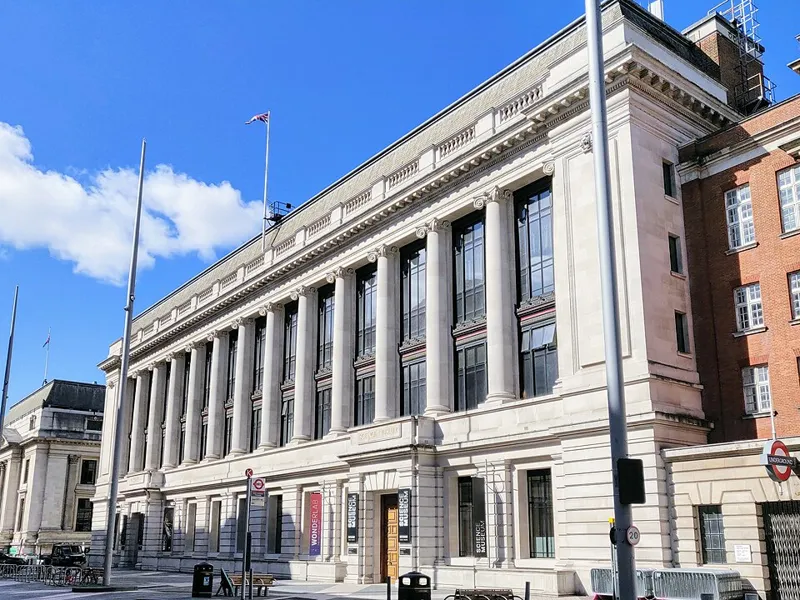

Science Museum
A major museum of the history of science and technology on Exhibition Road in South Kensington, London, part of the Science Museum Group.
- Year
- 1909
- Open to visitors
- Yes
The Science Museum traces its origins to 1857, when Bennet Woodcroft gathered objects from the Royal Society of Arts and surplus items from the Great Exhibition of 1851. It began as part of the South Kensington Museum, alongside what is now the Victoria and Albert Museum. In 1858 its machinery collection became the Museum of Patents, renamed the Patent Office Museum in 1863. That collection held many of the most famous objects now in the museum.
The science collections were renamed the Science Museum in 1885, and a separate director was appointed in 1893. The Patent Office was absorbed in 1901. Its present building, designed by Richard Allison, began in 1913, but the First World War halted work, and it opened in stages between 1919 and 1928. Later extensions followed, including a pioneering interactive Children's Gallery in 1931 and the Wellcome Wing in 2000.
The museum's galleries are arranged by field, from the origins of computing to space travel, and cover communications, agriculture, mathematics, geophysics and medicine. It is more a museum of the history of science, with many display cases, than a hands-on science centre, though it has an IMAX cinema, a virtual reality simulator and Wonderlab, a space where visitors can carry out experiments. Highlights include Charles Babbage's Difference Engine No. 2, Foucault's original pendulum, a Boulton and Watt steam engine and the Apollo 10 command module Charlie Brown, which orbited the Moon in 1969. Stephenson's Rocket, the oldest surviving steam locomotive, has been on permanent display at the National Railway Museum in York since 2019. Admission to the permanent galleries is free, although temporary exhibitions may charge a fee.
Trivia and anecdotes
For many years the museum kept Charles Babbage's brain preserved in formaldehyde, alongside part of his machine. Visitors can now see a reconstruction of the DNA double helix made by Francis Crick and James Watson.