
Adolfo Ernst
Naturalist, botanist and zoologist of German birth, founder of the Venezuelan positivist school · 1832–1899
- Born
- October 6, 1832
- Died
- August 11, 1899
- Country
- Venezuela, Kingdom of Prussia
- Section
- Biology
Biography
Adolf Ernst was a naturalist, botanist and zoologist of German birth who spent most of his career in Venezuela during the second half of the nineteenth century. His work helped bring modern natural science to that country. He was a professor, an organiser of public institutions and the author of a large body of work on plants, animals, indigenous peoples and archaeology.
He was born in 1832 in Primkenau, in the German region of Silesia, the son of Adolf Ernst and Catalina Bischoff. After finishing school in his hometown he enrolled at the University of Berlin, where he studied natural sciences, pedagogy and modern languages. There he befriended two sons of the Venezuelan general Judas Tadeo Piñango, who encouraged him to try his luck in Venezuela, where a trained European educator could find work. He arrived in December 1861, sailing from Hamburg. In August 1864 he married Enriqueta Tresselt in Caracas, and the couple had five children.
His institutional work was considerable. In May 1867 he founded the Society of Physical and Natural Sciences of Caracas, and in 1874 he created the National Museum, the forerunner of today's Museum of Science. In 1876 he took over the direction of the National Library and gave it a strong boost. During the presidency of Antonio Guzmán Blanco he helped organise several international exhibitions, including those in Vienna (1873), Bremen (1874), Chile (1875), Philadelphia (1876) and Chicago (1891), where Venezuelan products and resources were displayed.
From 1874, at the request of President Guzmán Blanco, he set up the chair of Natural History at the Central University of Venezuela. From there he taught two core theories of biology in his day: the transformism of Jean-Baptiste Lamarck, which holds that species change over generations, and Charles Darwin's natural selection, which explains that change through the differing survival of better-adapted individuals. He also taught Charles Lyell's principles, which treat geology as the product of slow, continuous processes. He inspired and founded the Venezuelan positivist school, whose pupils included Lisandro Alvarado, José Gil Fortoul and Rafael Villavicencio. In 1889 the university awarded him a doctorate in Philosophy in recognition of his teaching and research.
His scientific output was very large. More than 478 works are attributed to him, mostly on botany, zoology and ethnography, though he also worked on geography, geology, linguistics, anthropology, physics, palaeontology and archaeology. He studied regions such as the Caracas valley, Lake Maracaibo, the Andes, Venezuelan Guayana and La Orchila island, as well as the Aroa copper mines and the Betijoque diamond mines. He is regarded as a pioneer of ethnobotany in Venezuela for his studies of the history of the yuca (cassava) plant (1890) and the banana (1893). In anthropology, the collections of the National Museum allowed him to describe indigenous groups such as the Guajiro, Ayamán and Warao peoples. In archaeology he drew attention to the stone plaques of the Andean region known as bat wings. One of his main achievements was making Venezuelan material known to international scientific journals such as Globus, Zeitschrift für Ethnologie, American Anthropologist and the Bulletin de la Société d'Anthropologie de Paris.
His legacy lives on in the institutions he helped create and in the generation of Venezuelan scientists and thinkers he trained. His complete works were collected decades after his death in Caracas in 1899.
Main contributions
- 1874Dichotomous key to the plant families, a guide for identifying plants through pairs of opposing traits.
- 1875Catalogue of the library of the University of Caracas.
- 1876Systematic list of the molluscs known from around Caracas and other parts of the country.
- 1878Study of the deformities, diseases and pests of the coffee tree in Venezuela.
- 1881Botanical memoir on embarbascar, fishing with poisonous plants.
- 1891General report on the Aroa copper mines.
Trivia and anecdotes
A journey encouraged by friends
His friendship with two sons of General Judas Tadeo Piñango, whom he met in Berlin, is what encouraged him to move to Venezuela.
The bat wings
The stone plaques of the Andean region that he studied were popularly named bat wings because of their shape.
Their contemporaries
While Adolfo Ernst was alive (1832–1899)…
Alive at the same time
Discovered or invented in those years
- 1846NeptuneThe eighth and most distant planet of the Solar System, an ice giant found through mathematical prediction before any direct sighting.
- 1859EvolutionThe process by which the heritable traits of living populations change over generations, explaining the diversity of life from common ancestors.
- 1869Periodic tableAn arrangement of the chemical elements into rows (periods) and columns (groups), ordered by atomic number, that reveals recurring chemical behaviour and lets scientists predict properties.
- 1869Deoxyribonucleic acidA double-stranded molecule that carries the genetic instructions of nearly all living things and many viruses.
- 1876TelephoneA device that carries the human voice over distance by turning sound into electrical signals and back into sound at the other end of the line.
- 1884CarA road vehicle with four wheels and its own engine, mainly built to carry people.
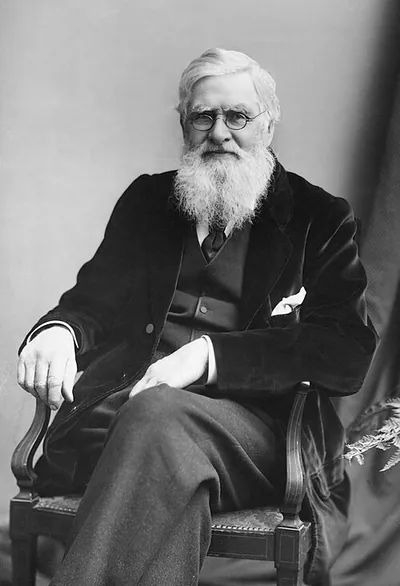 Alfred Russel Wallace1823–1913 · Biology
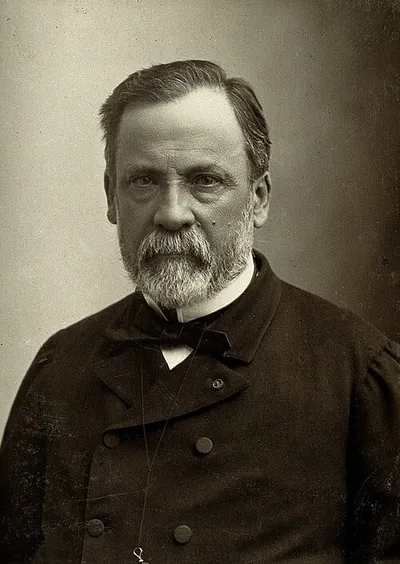 Louis Pasteur1822–1895 · Biology
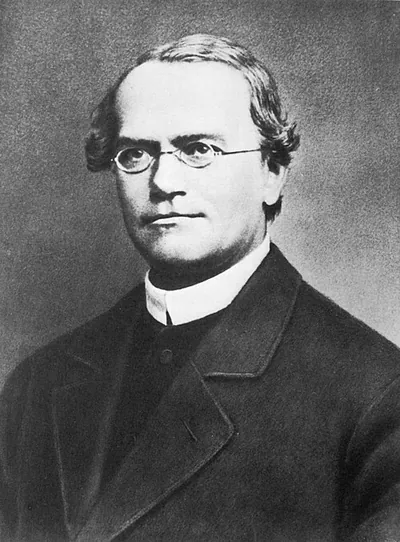 Gregor Mendel1822–1884 · Biology
 Robert Koch1843–1910 · Biology
 Camillo Golgi1843–1926 · Biology
 Élie Metchnikoff1845–1916 · Biology
