
Albert Ladenburg
German chemist known for his work on benzene structure and alkaloids · 1842–1911
- Born
- July 2, 1842
- Died
- August 15, 1911
- Country
- Grand Duchy of Baden
- Section
- Chemistry
Biography
Albert Ladenburg (1842-1911) was a German chemist who worked in the second half of the nineteenth century, when organic chemistry was beginning to explain substances through the internal arrangement of their atoms. He is remembered for isolating hyoscine, also called scopolamine, and for his joint work with August Kekulé on the structure of benzene.
He came from a well-known Jewish family in Mannheim, where he attended a Realgymnasium. After the age of fifteen he studied at the technical school in Karlsruhe, focusing on mathematics and modern languages. He then moved to the University of Heidelberg, where he studied chemistry and physics under Robert Bunsen, and he also took physics courses in Berlin. He earned his doctorate in Heidelberg.
In 1873 he became professor of chemistry and director of the laboratory at Kiel, a post he held until 1889, when he took the same role at the University of Breslau. His honours included honorary membership of the Pharmaceutical Society of Great Britain in 1886 and the Hanbury Medal in 1889. In 1905 he received the Davy Medal for his research in organic chemistry, especially the synthesis of natural alkaloids, which are plant-derived compounds that act on the body. In 1900 he founded the Chemische Gesellschaft Breslau, which he led until 1910.
In 1880 he isolated hyoscine for the first time. In Ghent he spent about six months with Kekulé, who introduced him to structural theory, the idea that atoms link together in fixed patterns to form molecules. The two studied benzene together. Ladenburg proposed that its molecule was prismatic, a view that proved wrong. The structure was finally realised in 1973 with the synthesis of prismane, which is why the compound is also called Ladenburg benzene. He later spent around eighteen months in Paris with Charles-Adolphe Wurtz and Charles Friedel, studying organosilicon and tin compounds, before returning to Heidelberg to teach.
In 1904 he published a book on the relationship between religion and science, which prompted a public reply titled Religion und Naturwissenschaft. His son Rudolf (1882-1952) became an atomic physicist. Another son, Eric, died in a boating accident in the early 1900s.
His legacy combines research with the history of science. His 1868 work Entwicklungsgeschichte der Chemie von Lavoisier bis zur Gegenwart traces the development of chemistry from Lavoisier onward, and his name remains linked to prismatic benzene and to scopolamine.
Main contributions
- 1868A history of chemistry from Lavoisier onward, tracing how the discipline developed.
- 1880Isolation of hyoscine, also known as scopolamine, a plant-derived alkaloid.
- A proposed prismatic structure for the benzene molecule, which later proved to be wrong.
- Research on silicon and tin compounds carried out in Paris with Wurtz and Friedel.
- Contribution to the Handwörterbuch der Chemie, a thirteen-volume chemistry dictionary published between 1882 and 1896.
Teachers and students
Trivia and anecdotes
A prism-shaped benzene
Ladenburg's prismatic idea was considered wrong for decades. The molecule prismane, made in 1973, showed that such a shape was possible and gave his name to the idea as Ladenburg benzene.
A book that drew a reply
His 1904 book on religion and science received a public response that named him in its title, which was unusual for the time.
Their contemporaries
While Albert Ladenburg was alive (1842–1911)…
Alive at the same time
Discovered or invented in those years
- 1846NeptuneThe eighth and most distant planet of the Solar System, an ice giant found through mathematical prediction before any direct sighting.
- 1859EvolutionThe process by which the heritable traits of living populations change over generations, explaining the diversity of life from common ancestors.
- 1869Periodic tableAn arrangement of the chemical elements into rows (periods) and columns (groups), ordered by atomic number, that reveals recurring chemical behaviour and lets scientists predict properties.
- 1876TelephoneA device that carries the human voice over distance by turning sound into electrical signals and back into sound at the other end of the line.
- 1884CarA road vehicle with four wheels and its own engine, mainly built to carry people.
- 1903AirplaneA fixed-wing aircraft, heavier than air, powered by engines or rockets, that stays aloft because its wings generate lift.
 James Crafts1839–1917 · Chemistry
 Adolf von Baeyer1835–1917 · Chemistry
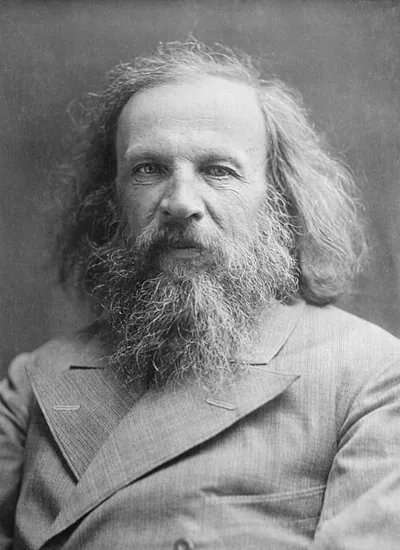 Dmitri Mendeleev1834–1907 · Chemistry
 Alfred Nobel1833–1896 · Chemistry
 Emil Fischer1852–1919 · Chemistry
 Jacobus Henricus van 't Hoff1852–1911 · Chemistry
