
Alexander Crum Brown
Scottish organic chemist who devised a graphic system for drawing molecules · 1838–1922
- Born
- March 26, 1838
- Died
- October 28, 1922
- Country
- United Kingdom of Great Britain and Ireland
- Section
- Chemistry
Biography
Alexander Crum Brown (1838-1922) was a Scottish organic chemist whose work changed the way molecules are drawn. He lived at a time when chemistry was shifting from describing substances to explaining how their atoms are arranged, and his diagrams remain a basic tool in every chemistry classroom.
He was born on 26 March 1838 at 4 Bellevue Terrace in Edinburgh. His father, the Reverend John Brown, was minister of Broughton Place Church, and his mother, Margaret Fisher Crum, was a sister of the chemist Walter Crum. She died in 1841, when he was still a small child. He spent five years at the Royal High School and one at Mill Hill School in London before entering the University of Edinburgh in 1854. There he studied arts first and then medicine, won a gold medal in chemistry and natural philosophy, and took his medical degree in 1861. In 1862, while also working towards a science degree at the University of London, he became that university's first Doctor of Science.
He then went to Germany to deepen his chemistry, first with Robert Bunsen at Heidelberg and later with Adolph Wilhelm Hermann Kolbe at Marburg. He returned to Edinburgh in 1863 as an extra-academical lecturer and was appointed Professor of Chemistry in 1869, a post he held until retiring in 1908. His candidacy was backed by leading chemists such as Baeyer, Bunsen and Wöhler. One of his students was Arthur Conan Doyle, later the creator of Sherlock Holmes.
His most influential work was a graphic way of representing molecules. From 1864 he drew each atom as a symbol inside a circle, linked by dashed lines that showed how many bonds it could form, a property known as valence. The scheme was published in 1864 and was an early form of the structural formulas still taught today. His medical training had drawn him towards physiology and pharmacology, and in 1867 and 1868 he worked with Thomas Richard Fraser on how a substance's chemical makeup affects its action on the body. They altered alkaloids chemically and compared their effects before and after the change. Around the same period he identified the double bond in ethylene, a finding that later mattered greatly to the plastics industry.
His interests reached well beyond chemistry, including phonetics, mathematics and crystallography. In the 1880s he advised the Bank of Scotland on colours, inks and designs for banknotes that could not easily be copied photographically. The notes were completed in 1885, but forgeries turned up in Glasgow and Edinburgh in 1888. The forger, John Hamilton Gray Mitchell, was identified in 1889; he had copied the note using traditional artistic methods, and the bank revised its design. In 1912 Crum Brown introduced the name kerogen for the insoluble organic matter found in oil shale.
He was not physically strong but was rarely ill, and he spent much of his holidays walking in the Scottish Highlands and across Europe. In 1866 he married Jane Bailie Porter, who died in 1910; her sister Margaret later married the physicist Peter Guthrie Tait. In 1870 he was criticised for awarding the Hope Scholarship to two male students rather than to Edith Pechey, one of the first women to enrol at the university, who had come third. He feared that giving the prize to a woman would offend his colleagues and male students, and the affair made the headlines of The Times.
He died in Edinburgh on 28 October 1922, aged 84, and was buried in Dean Cemetery, still working almost to the end. His name lives on in the Crum Brown Chair of Chemistry, established at the University of Edinburgh in 1967, and in 2015 a street on the King's Buildings campus was named after him.
Main contributions
- 1864Molecular diagram system: atoms drawn as circled symbols joined by dashed lines according to valence, an early form of structural formulas.
- 1867Research with Thomas Richard Fraser on the link between the chemical makeup of alkaloids and their physiological action.
- 1885Design of Bank of Scotland banknotes with colours and inks hard to reproduce photographically.
- 1912Proposal of the name kerogen for the insoluble organic matter in oil shale.
- Discovery of the double bond in ethylene, later important for the plastics industry.
Trivia and anecdotes
A famous student
Among his Edinburgh students was Arthur Conan Doyle, who later created Sherlock Holmes.
Forgery with paint
The forger of the fake notes used traditional artistic techniques rather than photography, which forced the bank to change its design.
Their contemporaries
While Alexander Crum Brown was alive (1838–1922)…
Alive at the same time
Discovered or invented in those years
- 1846NeptuneThe eighth and most distant planet of the Solar System, an ice giant found through mathematical prediction before any direct sighting.
- 1859EvolutionThe process by which the heritable traits of living populations change over generations, explaining the diversity of life from common ancestors.
- 1869Periodic tableAn arrangement of the chemical elements into rows (periods) and columns (groups), ordered by atomic number, that reveals recurring chemical behaviour and lets scientists predict properties.
- 1876TelephoneA device that carries the human voice over distance by turning sound into electrical signals and back into sound at the other end of the line.
- 1884CarA road vehicle with four wheels and its own engine, mainly built to carry people.
- 1903AirplaneA fixed-wing aircraft, heavier than air, powered by engines or rockets, that stays aloft because its wings generate lift.
 James Crafts1839–1917 · Chemistry
 Adolf von Baeyer1835–1917 · Chemistry
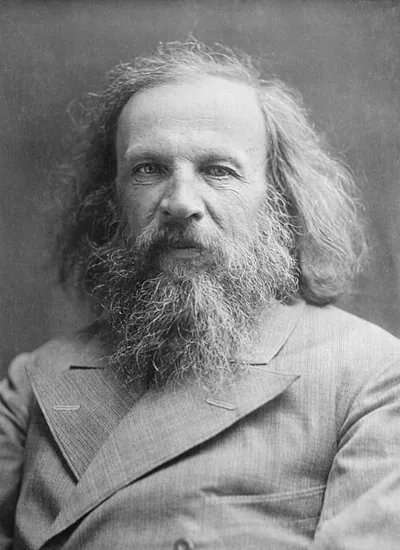 Dmitri Mendeleev1834–1907 · Chemistry
 Alfred Nobel1833–1896 · Chemistry
 August Kekulé1829–1896 · Chemistry
 Stanislao Cannizzaro1826–1910 · Chemistry
