
Amalie Dietrich
German naturalist who collected plants, animals and objects for a Hamburg museum during her years in Australia · 1821–1891
- Born
- May 26, 1821
- Died
- March 9, 1891
- Country
- Kingdom of Saxony
- Section
- Biology
Biography
Amalie Dietrich (born 1821 in Siebenlehn, Saxony; died 1891) was a German naturalist who travelled through Australia as a collector for the Godeffroy Museum in Hamburg. Her work in the mid-nineteenth century gave European scientists access to many species from a little-studied continent, but her legacy is also bound up with colonial practices that are deeply controversial today.
She was born Koncordie Amalie Nelle on 26 May 1821, the daughter of a leather worker and a woman who knew local herbs. She attended the village school and had no formal scientific training. Around 1846 she married Wilhelm August Salomo Dietrich, a chemist and pharmacist who made a living by gathering plants and other specimens to sell to collectors and institutions. Their daughter Charitas was born in 1848. Working alongside her husband, Amalie learned the craft of collecting, pressing and preparing specimens.
Between 1845 and 1862 the couple struggled to get by, selling alpine flowers to chemists and museums. Their marriage broke down in 1861, when she discovered that her husband was unfaithful. She carried on collecting on her own and came to the attention of Johan Cesar Godeffroy, a wealthy merchant who wanted collectors for his museum. She signed a ten-year contract, left her daughter with foster parents and sailed for Australia in May 1863.
For almost a decade she worked mainly in Queensland, based at times in Brisbane, Rockhampton, Mackay and Bowen. She gathered plants, insects, animals, objects made by Indigenous Australians and human remains. She is thought to have been the first European to capture a taipan snake, although this claim is not firmly established. Her exact route remains uncertain. She left Australia in February 1872.
Her work also had a darker side. She collected human remains and Indigenous objects to sell to European museums, at a time of violence against Indigenous communities. A widely repeated story, linked to the Archer family, claims she asked an employee to shoot an Aboriginal person to obtain a specimen. Historians debate whether it is true, but it is well documented that she sent human remains to Hamburg.
Back in Hamburg she worked for the museum until 1879, when Godeffroy's bankruptcy ended her employment. She then practised natural remedies and joined societies of naturalists. After an illness she moved in with her daughter and died in 1891. Her name survives in several species, including the wasp Nortonia amaliae and the acacia Acacia dietrichiana. Her specimens are still consulted in herbaria around the world, although she never published under her own name or chose the names of her plants. Her daughter's 1909 biography is considered unreliable, and recent studies present her as a skilled collector who was also part of an exploitative system.
Main contributions
- 1863Expedition to Queensland, Australia. She collects plants, animals and objects for the Godeffroy Museum over almost a decade.
- 1868Description of Aongstroemia dietrichiae, a moss based on one of her specimens, named in her honour.
- 1875Zur Flora von Queensland by Christian Luerssen, a regional flora based on her collections.
- 1882Acacia dietrichiana, an Australian wattle described by Ferdinand von Mueller and named after her.
- Nortonia amaliae, a wasp named after her, in recognition of her collecting work.
- The National Herbarium of Victoria holds 2790 of her specimens, and her collections remain an important resource in herbaria worldwide.
Trivia and anecdotes
The taipan snake
She is believed to have been the first European to capture a taipan, one of the world's most venomous snakes. The claim is not fully confirmed.
A biography written by her daughter
Her daughter Charitas published a popular biography in 1909, but it is considered unreliable and included letters she invented.
Their contemporaries
While Amalie Dietrich was alive (1821–1891)…
Alive at the same time
Discovered or invented in those years
- 1846NeptuneThe eighth and most distant planet of the Solar System, an ice giant found through mathematical prediction before any direct sighting.
- 1859EvolutionThe process by which the heritable traits of living populations change over generations, explaining the diversity of life from common ancestors.
- 1869Periodic tableAn arrangement of the chemical elements into rows (periods) and columns (groups), ordered by atomic number, that reveals recurring chemical behaviour and lets scientists predict properties.
- 1869Deoxyribonucleic acidA double-stranded molecule that carries the genetic instructions of nearly all living things and many viruses.
- 1876TelephoneA device that carries the human voice over distance by turning sound into electrical signals and back into sound at the other end of the line.
- 1884CarA road vehicle with four wheels and its own engine, mainly built to carry people.
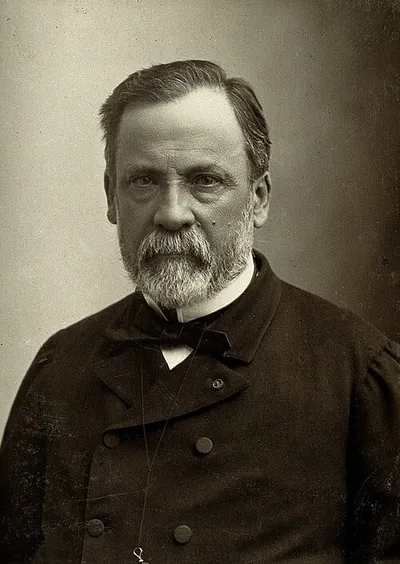 Louis Pasteur1822–1895 · Biology
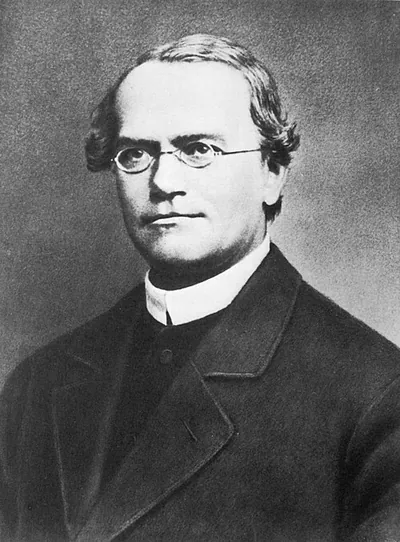 Gregor Mendel1822–1884 · Biology
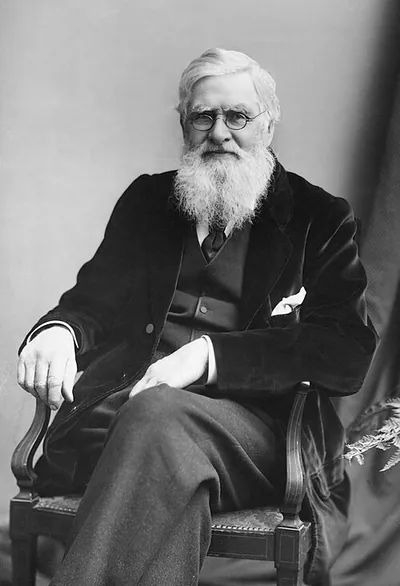 Alfred Russel Wallace1823–1913 · Biology
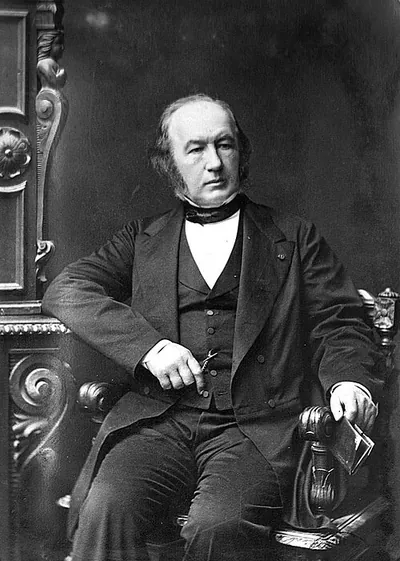 Claude Bernard1813–1878 · Biology
 Theodor Schwann1810–1882 · Biology
 Charles Darwin1809–1882 · Biology
