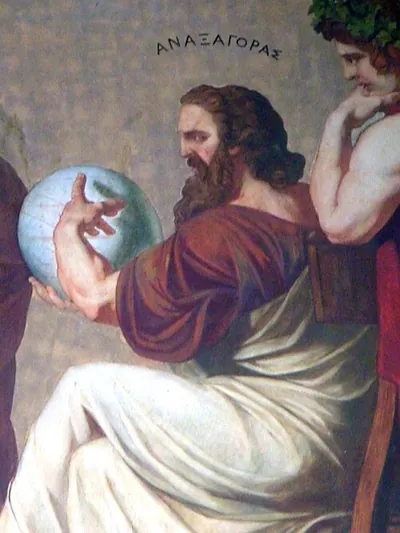
Anaxagoras
Pre-Socratic Greek philosopher who introduced the concept of nous (mind) as the ordering force of the universe · 499 BC–427 BC
- Born
- 499 BC
- Died
- 427 BC
- Section
- Physics
Extended biography
Birth and early years
Anaxagoras was born in Clazomenae, a town on the Ionian coast of Asia Minor, in the early fifth century BC, probably around 500 BC. The ancient sources agree on roughly that period, but none records the exact date, so every figure in his life should be read as an approximation. His hometown belonged to a Greek world that was then under the control of the Persian Empire, a situation that shaped the history of the entire region and, in turn, affected his own life.
Some later biographers say that he came from a well-off family, perhaps of aristocratic origin. If so, this would have allowed him to devote himself to study without having to work for a living, a privilege in Greece at the time. The detail comes from writers long after his death and cannot be checked against documents from his own era, so it is best taken as a reasonable assumption rather than an established fact.
His thinking belongs to the tradition of the first natural philosophers, known today as the Presocratics. These thinkers tried to explain the world through natural causes instead of myths about gods and heroes. Anaxagoras was familiar with the teachings of Anaximenes, Parmenides, Zeno and Empedocles, and his work responds to them directly. Understanding this background matters, because his ideas were not invented in isolation. They were answers to questions that others had already raised about the origin and change of things.
His interest in observation also belongs to this early period. Ancient authors describe him as someone who trusted what could be seen, remembered and checked, rather than relying only on inherited opinion. In the fifth century BC that habit was still unusual, and it appears in almost everything that survives of his thought.
Athens and the circle of Pericles
According to tradition, Anaxagoras reached Athens after the wars against the Persians, and he may have had some connection with that conflict. The sources do not agree on the date of his arrival. The Spanish version of this profile places it around 483 BC, while the English reference article gives about 456 BC. Both are estimates, and a difference of more than twenty years shows how hard it is to reconstruct his chronology with confidence.
He was the first foreign thinker to settle in Athens, a city that was then the political and cultural centre of the Greek world. There he became close to Pericles, the most influential statesman of those years. This friendship is one of the best attested facts of his life, and it helps explain what happened later, when his political enemies seem to have targeted him in order to reach Pericles through him.
He is said to have taught in Athens for about thirty years. The figure comes from ancient sources and cannot be verified, but it suggests that his teaching was long and respected. Among those who are said to have been his pupils are Pericles himself, Archelaus, Protagoras of Abdera, the historian Thucydides, the tragedian Euripides and, according to some accounts, Democritus and Socrates.
This list mixes well-documented names with others that rest on later traditions. The case of Socrates is especially debated. The two may have lived in Athens at the same time, but there is no proof that they ever met. In Plato's Phaedo, Socrates recalls reading Anaxagoras's books eagerly as a young man and later growing disappointed with them. The scene is literary, so it reflects the picture Plato wished to present as much as any verifiable event.
The atmosphere of Athens, with its courts, assemblies and public debates, encouraged philosophical argument. Anaxagoras took part in that intellectual climate, and his ideas about nature and mind circulated among people being educated in the city. His presence there helps explain why later playwrights and thinkers knew of his doctrines.
Mind as the orderer: nous
Parmenides had argued that change was impossible, because what is cannot stop being or turn into something else. For a natural philosopher this was a serious challenge, since the world around us is full of transformation. Anaxagoras took up the challenge and tried to explain change without denying it. His answer was to imagine that reality was made of an original mixture of basic ingredients that are never destroyed or created.
In this initial mixture, he proposed, everything was present in a confused way, in tiny particles he called seeds, spermata in Greek. Aristotle later named them homoiomeries, meaning similar parts, because each one shared the composition of the whole it belonged to. A thing looks like what it is because one kind of particle predominates in it over the others. The difference between a stone and a piece of meat, on this view, would not come from one having something the other lacks, but from which ingredient is more abundant in each.
This idea has an interesting consequence: nothing is pure. Everything contains portions of other things, and its character depends on which particles dominate. Anaxagoras thought that the things we see around us form from this mixture, each with its own particular balance.
But sorting such a mixture required a force, and this is where nous enters. The word is usually translated as mind, intelligence or reason. Anaxagoras described it as a subtle agent, pure and independent of matter, that penetrates the whole and sets it in motion. Its first visible effect was motion, which separated like from unlike and gave shape to the aggregates of similar parts. In Greek philosophy, it is one of the earliest explicit proposals of an ordering intelligence as the cause of the universe.
It is important not to confuse nous with a personal god of the kind found in traditional religion. The sources present it as a rational force animating matter, one that, according to some interpreters, possesses complete knowledge and power. The Roman writer Cicero claimed that Anaxagoras was the first to hold that the universe had been designed and made by the rational power of an infinite mind. In the nineteenth century, the German philosopher Wilhelm Dilthey went so far as to call him the founder of monotheism in Europe. Both readings are later interpretations rather than words that Anaxagoras himself is known to have written, so they should be treated as the opinions of those who advanced them.
The doctrine of nous was not only an account of the cosmos but also an attempt to separate material causes from rational ones. That distinction became central to the thought of Plato and Aristotle, who discussed it and reworked it in very different ways.
Explaining the sky without myths
Anaxagoras applied his view of nature to the heavens, which in his time were often explained by the will of the gods. His most cited contribution is a natural explanation of eclipses. Tradition credits him with understanding that the Sun and the Moon were material bodies rather than capricious divinities. An eclipse visible in Greece in 463 BC may have served as a basis for his observations, although there is no direct proof of this.
According to the sources, he held that the Sun was a mass of red-hot metal, larger than the Peloponnese, and that the Moon was earthy, had mountains, and shone because it reflected sunlight rather than producing its own. A statement that the sun gives the moon its brightness is attributed to his writings in ancient testimony. Its authenticity is considered likely but not certain. The idea, which now seems obvious, was a striking novelty at a time when many people assumed the Moon gave off its own light.
He is also credited with suggesting that the stars were bodies of the same nature as the Sun, and that they were so distant that their heat did not reach the Earth in any noticeable way. If this attribution is correct, it anticipates a conclusion that modern astronomy confirmed: the Sun is a star among others. However, the sources do not explain how he reached this view, so it should be approached with caution.
About the Earth, he believed it was flat and floated on a dense layer of air beneath it. In his account, disturbances in that air could cause earthquakes. We now know that the Earth is not flat and that earthquakes have geological causes, so these ideas were mistaken. Their historical value lies less in the conclusions than in the method: looking for material causes instead of divine ones, and offering explanations that could be debated.
Another group of explanations concerns atmospheric phenomena and the stones that fall from the sky. Anaxagoras tried to account for meteors, rainbows and the rocks that arrive from space. Pliny reports that he was credited with predicting the fall of a meteorite in 467 BC. The story is possible, but it reaches us through much later authors, so it is best regarded as a tradition rather than a documented event.
His most daring idea on this subject is panspermia, which he put forward by suggesting that life could exist throughout the universe and be scattered across it. The modern term refers to the hypothesis that the seeds of life might travel between celestial bodies. Anaxagoras had no instruments to test such an idea, but it shows how far he was willing to think beyond what could be seen from the Earth.
Observation, craft and mathematics
The sources stress that Anaxagoras's method rested on experience, memory and technical skill. This meant relying on what was observed repeatedly, on what could be recalled from earlier cases, and on practical abilities like those of craftsmen and physicians. That approach set him apart from those who reasoned only from abstract principles, and it explains why he is regarded as a promoter of the systematic study of nature.
He is also credited with rational explanations of how fish breathe and with studies of the anatomy of the brain. The details of this work have been lost, and what survives consists of brief references in later authors. Even so, they indicate that his interests extended beyond the heavens to the bodies of living things, which was still largely unexplored territory in his day.
In mathematics, Plutarch, in his work On Exile, states that Anaxagoras was the first Greek to attempt the problem of squaring the circle. This is a geometric puzzle: using only an unmarked straightedge and a compass, build a square with the same area as a given circle. He is said to have worked on it while in prison. It is now known that the problem has no solution with those tools, but the attempt shows his concern with precision and proof.
It is wise to separate what is documented from what is legendary. The stories about his predictions, some of his gestures and his youthful anecdotes reached us through authors who wrote long afterwards, sometimes centuries later. The most solid material is the body of ideas that survives in the testimony of Aristotle, Plato and other commentators. From these it is possible to reconstruct, with reasonable reliability, what he thought, although not always in detail.
Trial, exile and death in Lampsacus
After some thirty years of teaching in Athens, Anaxagoras was charged with impiety. According to Diogenes Laertius and Plutarch, the reason was that he held views about the Sun and the Moon that clashed with traditional religion, such as the claim that the Sun was a mass of glowing metal and the Moon a rock. Other accounts suggest the charge may have been political, given his close relationship with Pericles. It cannot be ruled out that some details of the trial were added by later biographers.
According to the same Diogenes Laertius, Pericles spoke in his defence at the trial. Even so, Anaxagoras was forced to leave Athens and retired to Lampsacus, a colony of Miletus on the eastern shore of the Dardanelles. The English reference article places this exile around 433 BC. For a thinker who had lived at the intellectual centre of the Greek world, the move was a considerable loss.
He died in Lampsacus around 428 BC. Some sources claim that he let himself die of hunger, a story that the tradition repeats but that cannot be confirmed. What does seem certain is that he was respected there. According to tradition, the people of the city raised an altar to Mind and Truth in his honour and kept the anniversary of his death for many years. An annual celebration called the Anaxagoreia was also established in his memory.
The inscription said to have been placed over his grave captures how his contemporaries saw him: a man who, in his search for truth, had reached as high as the heavens. The words are flattering and so cannot be treated as a neutral witness, but they show how much his figure meant to the community that welcomed him in his last years.
The contrast between his trial in Athens and the honours paid to him in Lampsacus illustrates a tension that runs through the whole history of philosophy: the friction between those who offer rational explanations and those who defend what a society regards as sacred. Anaxagoras lived that tension directly, and his case was remembered for centuries as an example of the clash between free thought and power.
Legacy and reception
Only fragments survive from his main work, On Nature. Most of what is known today comes from quotations preserved by the commentator Simplicius of Cilicia, who lived in the sixth century AD. This means that much of what we know about Anaxagoras reaches us through other writers, who interpreted him and sometimes criticised him, so their readings must be compared with care.
It is said that his book could be bought in the Athenian marketplace for a drachma, a modest price suggesting that it circulated among a fairly wide public. Several authors of his time seem to have known his ideas: Sophocles, Euripides and Aristophanes appear to have been familiar with them, judging by the contents of their surviving plays. For Aeschylus the link is less certain and rests on a testimony preserved by Seneca.
Plato and Aristotle took him as a starting point. Plato accepted that mind is the cause of the order of the universe, but criticised Anaxagoras for seeking, above all, material causes. Aristotle took up his doctrine with a critical eye. A classic comparison sums up the difference between them: for Anaxagoras, human beings became intelligent because they had hands; for Aristotle, they had hands because they were intelligent. The contrast shows how the first explained the shape of living things by material conditions, while the second subordinated those conditions to a purpose.
His figure reappeared in European culture over the centuries. Dante places him in Limbo in the Divine Comedy, in Canto IV of the Inferno. Nicholas of Cusa devoted a chapter of his De docta ignorantia, written in 1440, to a sentence attributed to him, according to which each thing is in each thing. Friedrich Nietzsche praised him in Philosophy in the Tragic Age of the Greeks and defended the view that his nous was a kind of free act that ordered a mixed chaos. Goethe included him as a character in the second act of the second part of Faust.
During the French Revolution, the politician Pierre-Gaspard Chaumette changed his name to Anaxagoras in December 1792, explaining that he had replaced the name of a saint with that of a philosopher. In the twentieth century, astronomy kept his memory in two forms: the lunar crater Anaxagoras, named in his honour in 1935, and the asteroid (4180) Anaxagoras.
His legacy lies less in definitive answers than in a way of asking questions. Anaxagoras sought natural causes for phenomena that others attributed to supernatural forces, and he argued that observation and reason could account for the heavens. Many of his ideas were later superseded, but his attempt to separate rational explanation from myth remains one of the starting points of Western science.
Quotes
“Man is intelligent because he has hands.”
“Mind governs the universe.”
“Nothing is born nor perishes. Life is an aggregation and death a separation.”
“Mind is infinite and self-ruled, and is mixed with nothing, but is alone itself by itself.”
Main contributions
- 467 BCPredicted the fall of a meteorite, according to a report passed on by Pliny; its authenticity is doubtful.
- 463 BCA correct explanation of eclipses, probably based on observing the eclipse of 463 BC.
- Theory of seeds (spermata): the world is a mixture of primary particles whose proportions determine things.
- The concept of nous, an ordering intelligence that sets the original mixture in motion and separates like from unlike.
- The idea that the Moon receives its light from the Sun and does not produce it by itself.
- The hypothesis that the Sun is a mass of incandescent metal and that the stars are bodies of the same nature placed at great distances.
- The proposal that life exists throughout the universe and could have been distributed through it (panspermia).
Teachers and students
Trivia and anecdotes
An altar to Mind and Truth
According to the sources, the people of Lampsacus built him an altar dedicated to Mind and Truth and held an annual festival in his memory.
Voluntary or legendary starvation
Diogenes Laertius says he let himself die of hunger in exile, but the story may be a later legend.
Hands and intelligence
Anaxagoras is said to have believed that humans became intelligent because they had hands, the reverse of Aristotle's view.
Their contemporaries
While Anaxagoras was alive (499 BC–427 BC)…
Alive at the same time
Discovered or invented in those years
- 432 BCMetonic cycleA period of 19 years after which the Moon's phases fall again on the same calendar dates, used to align the solar year with the lunar months.
- 430 BCAtomismAncient philosophical idea that all matter is made of tiny indivisible particles called atoms, combined in empty space to form bodies.
 Archimedes286 BC–211 BC · Physics
 Evangelista Torricelli1608–1647 · Physics
 Christiaan Huygens1629–1695 · Physics
 Isaac Newton1643–1727 · Physics
 Henry Cavendish1731–1810 · Physics
 Charles-Augustin de Coulomb1736–1806 · Physics
