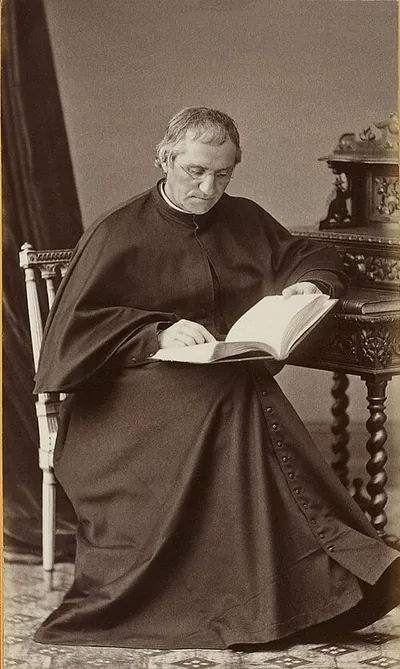
Armand David
French priest, missionary and naturalist who introduced many Chinese plants and animals to Western science · 1826–1900
- Born
- September 7, 1826
- Died
- November 10, 1900
- Country
- France
- Section
- Biology
Biography
Jean Pierre Armand David (Espelette, 7 September 1826 - Paris, 10 November 1900) was a Lazarist missionary priest who devoted much of his life to studying the natural world of China. Living in the second half of the nineteenth century, when European museums competed to gather specimens from little-explored regions, he made known to the West a great many animals and plants that science had never recorded. Several species still carry his name in recognition of this work.
He was born in Espelette, a village in the French Basque Country near Bayonne, in the Pyrenees-Atlantiques department. He was one of three sons in a prosperous local family. His father, Fructueux, was both a doctor and a magistrate, and a keen lover of nature, which may explain the young Armand's early interest in the natural sciences.
He joined the Congregation of the Mission, known as the Lazarists or Vincentians, in 1848. By then he was already passionate about science and taught it at the Savana College in Italy. He was ordained a priest in 1851, and in 1862 he was posted to Peking. Almost as soon as he arrived, he began gathering material for a natural history museum, mostly animals but also plants, fossils and minerals. At the request of the French government, part of this collection was sent to Paris, where it attracted great attention.
The Jardin des Plantes, Paris's leading centre for natural history, then commissioned him to make scientific journeys across China and build up its holdings. Between 1872 and 1876 he travelled from Peking to Hunan province, then on to Xi'an and along the Han river. He sent his specimens to European specialists, who described them and gave them scientific names. Taxonomy, the science of classifying living things, and biogeography, the study of where species live, both benefited greatly from this material. His botanical work in the western mountains of China, which Westerners had not explored before, yielded hundreds of samples, including fifty-two new species of rhododendron and around forty primulas.
Among his best-known discoveries were the giant panda, which he first described from Baoxing County, and Père David's deer. The deer had nearly vanished from the wild, surviving only in a few animals kept in the gardens of the Chinese emperor. David managed to obtain one and sent it to Europe. He also sent back the first known specimen of the emerald ash borer, an insect that now causes serious damage to ash trees. Plants named after him include Buddleja davidii, Davidia involucrata and the Chinese white pine, Pinus armandii. The genus Davidia, a tree he found in western China in 1868, is named after him as well.
In 1888 he travelled to Paris and presented his findings at the International Catholic Scientific Congress held that year. By then he had examined 200 species of mammals, 63 of them unknown to zoologists, and 807 species of birds, 65 of which had not been described before. He had also gathered dozens of reptiles, amphibians, fish and insects, which he passed on to specialists for detailed study. Despite this scientific output, he never neglected his missionary duties. He was remembered for his devotion to his faith and for his careful obedience to every detail of his order's rules. He died in Paris in 1900.
His legacy is twofold. He left a large body of specimens that enriched European museums and gave later researchers a base for studying the fauna and flora of Asia. He also gave his name to many taxa, the groups of living things that scientists classify. He was admitted to the Paris Academy of Sciences in 1872, and in 1896 he received a gold medal from several geographical and scientific societies, as well as the Cross of the Legion of Honour. Botanists still cite him with the standard author abbreviation David when naming plants he described or collected.
Main contributions
- 1862Start of his Peking collection: he gathered animals, plants, fossils and minerals from China, part of which was sent to France.
- 1868Discovery of the genus Davidia, a tree from western China that bears his name.
- 1877Les Oiseaux de la Chine, a work on the birds of China written with Émile Oustalet.
- 1888Presentation in Paris of 200 mammal species (63 unknown) and 807 bird species (65 undescribed).
- Finding and description of the giant panda, observed in Baoxing County.
- Recovery of Père David's deer, nearly extinct in the wild, and shipment of a specimen to Europe.
- Collection of 52 new rhododendron species and about forty primulas from the mountains of western China.
Trivia and anecdotes
The deer's name
Père is French for father, which is why the deer is known as Père David's deer. Alphonse Milne-Edwards gave it that name.
A deer saved in the imperial gardens
When David arrived in China, the deer survived only as a few animals kept in the emperor's gardens. He managed to obtain one and sent it to Europe.
A fish and a snake named for him
The fish Sarcocheilichthys davidi was named by Henri Émile Sauvage in 1878, because David had collected the type specimen. Sauvage also named Père David's rat snake, Elaphe davidi, in 1884.
Their contemporaries
While Armand David was alive (1826–1900)…
Alive at the same time
Discovered or invented in those years
- 1846NeptuneThe eighth and most distant planet of the Solar System, an ice giant found through mathematical prediction before any direct sighting.
- 1859EvolutionThe process by which the heritable traits of living populations change over generations, explaining the diversity of life from common ancestors.
- 1869Periodic tableAn arrangement of the chemical elements into rows (periods) and columns (groups), ordered by atomic number, that reveals recurring chemical behaviour and lets scientists predict properties.
- 1869Deoxyribonucleic acidA double-stranded molecule that carries the genetic instructions of nearly all living things and many viruses.
- 1876TelephoneA device that carries the human voice over distance by turning sound into electrical signals and back into sound at the other end of the line.
- 1884CarA road vehicle with four wheels and its own engine, mainly built to carry people.
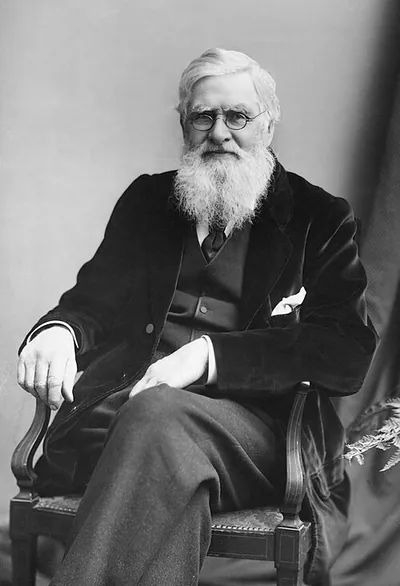 Alfred Russel Wallace1823–1913 · Biology
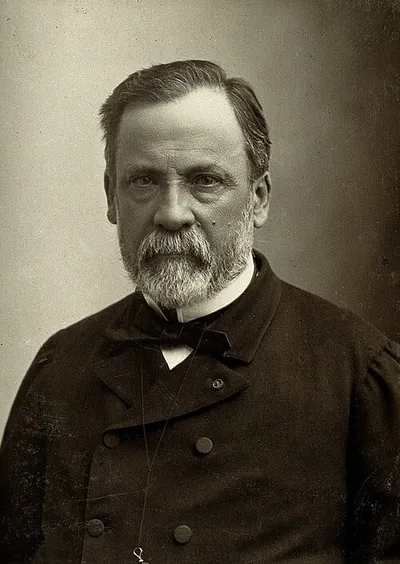 Louis Pasteur1822–1895 · Biology
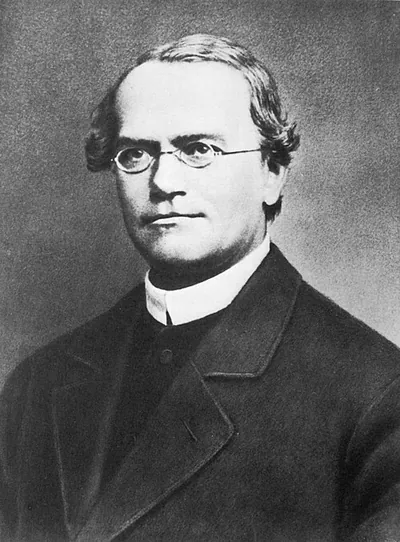 Gregor Mendel1822–1884 · Biology
 Claude Bernard1813–1878 · Biology
 Theodor Schwann1810–1882 · Biology
 Charles Darwin1809–1882 · Biology
