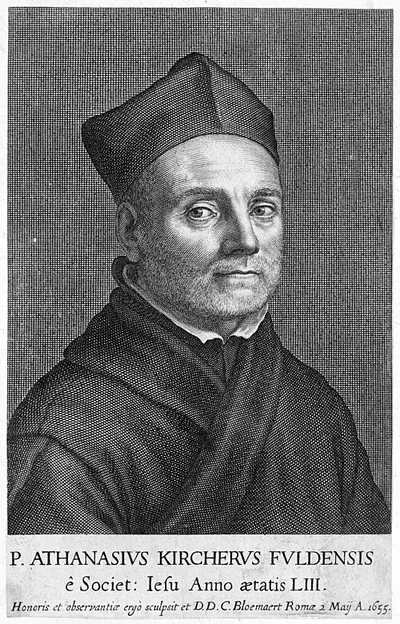
Athanasius Kircher
German Jesuit priest and polymath of the Baroque era, scholar of ancient Egypt, China, volcanoes and music · 1602–1680
- Born
- May 2, 1602
- Died
- November 27, 1680
- Country
- Holy Roman Empire
- Section
- Physics
Biography
Athanasius Kircher (Geisa, c. 1601 or 1602 - Rome, 1680) was a German Jesuit priest and polymath of the Baroque period, whom his contemporaries called the master of a hundred arts. He lived through the Thirty Years' War and was a celebrated scientific figure in his lifetime, though his reputation declined towards the end of it. He matters today for his curiosity about ancient Egypt, China, volcanoes and music, and because his Latin books circulated widely across Europe.
He was born in Geisa, in the territory of the Abbey of Fulda in Hesse. The exact year is uncertain: Kircher himself did not know it for sure, and sources give either 1601 or 1602. His father, Johannes Kircher, held a doctorate in theology from the University of Mainz but was never ordained. The family was too poor to pay for the education of all its children, so the father placed several of them in religious orders. Athanasius studied humanities at the Jesuit college in Fulda between 1614 and 1618 and then entered the Society of Jesus, at the seminary in Paderborn, on 2 October 1618. He excelled in natural sciences and classical languages, learned Greek and Hebrew thoroughly, and took lessons in Hebrew from a rabbi alongside his school studies.
At Paderborn he studied philosophy and theology, but in 1622 he fled to Cologne to escape the advance of Protestant armies. From 1622 to 1624 he taught Greek at Koblenz. He then moved to Heiligenstadt, where he taught mathematics, Hebrew and Syriac, and prepared fireworks and moving stage scenery for the visiting Elector Archbishop of Mainz, an early sign of his fascination with machines. He was ordained a priest in 1628 and became professor of ethics and mathematics at the University of Würzburg, where he also taught Hebrew and Syriac. That same year he began to take an interest in Egyptian hieroglyphs, a passion that would shape much of his later work.
The war kept forcing him to move. Würzburg was attacked and captured shortly after Kircher reportedly had a vision of bright light and armed horsemen in the city. People later credited him with foreseeing the disaster, though he insisted he had not relied on astrology. His first book dealt with magnetism. Caught up in the conflict, he was driven to the papal university at Avignon. In 1633 he was summoned to Vienna to succeed Kepler as mathematician to the Habsburg court, but the appointment was cancelled after the intervention of Nicolas-Claude Fabri de Peiresc, and he was sent to Rome instead. His ship had already set out for Vienna, was blown off course, and brought him to Rome before he learned of the change. From 1634 he taught mathematics, physics and oriental languages at the Collegio Romano, and from then on he made Rome his home for the rest of his life. In 1638 he travelled through southern Italy and studied the Strait of Messina, where he was struck by an underground rumbling.
In Sicily and Naples he studied volcanic activity. He collected the remains of large animals at Trapani and Palermo, which he took to be those of 'antediluvian elephants', watched eruptions of Etna and Stromboli, and was lowered on a rope into the crater of Vesuvius to measure it and examine its inner structure, a feat he compared with that of Pliny the Elder. This work led to his Mundus Subterraneus, published between 1664 and 1678. In it he suggested that the tides were caused by water moving to and from a subterranean ocean, and he ascribed fossils to the remains of animals, though also to giant races of humans, an error that later science corrected. He also included a map of Atlantis, which he based on Egyptian sources and Plato's account.
His name is closely linked to ancient Egypt. He learned Coptic in 1633 and published its first grammar in 1636, the Prodromus Coptus. He rightly argued that Coptic preserved the final stage of ancient Egyptian, thereby establishing the link between the two languages. His attempts to read hieroglyphs, however, failed. He assumed they were occult symbols rather than a phonetic script, and in his Oedipus Aegyptiacus (1652-1654) he offered translations of simple texts that had no real basis. The Egyptologist E. A. Wallis Budge called them utter nonsense. Even so, some scholars regard him as a pioneer of serious hieroglyphic study, and the data he collected were later consulted by Champollion.
Kircher also worked on optics and light. In his Ars Magna Lucis et Umbrae (1646) he described a catoptric lamp that projected images onto the wall of a darkened room. He did not invent the device, but he improved it and suggested ways to use it, and that is why the magic lantern is often wrongly credited to him. In 1641 he described a magnetic clock, devised by another Jesuit, in which a sphere was moved by magnetic force. The clock had been used to support the Copernican system, and Kircher showed that the same motion could be produced by a hidden water clock in its base. In music, his Musurgia Universalis (1650) argued that musical harmony mirrored the proportions of the universe. He also described the aeolian harp, a stringed instrument played by the wind, and proposed a 'cat piano' that was never built. In medicine, in 1646 he used a microscope to examine the blood of plague victims. In his Scrutinium Pestis of 1658 he argued that the disease was caused by microorganisms, though what he saw were probably blood cells. He also recommended isolation and quarantine to limit its spread.
His interest in China began early: in 1629 he told his superiors he wished to become a missionary there. In 1667 he published China Illustrata, an encyclopedic work that mixed accurate maps with mythical material such as a study of dragons. It relied heavily on the reports of the Jesuits Michael Boym and Martino Martini. It highlighted the early presence of Nestorian Christians and the Xi'an Stele, but it also held ideas that do not survive scrutiny, such as the claim that the Chinese descended from the sons of Ham and that Chinese characters were abstract hieroglyphs. Umberto Eco later noted that these views reflected a European ethnocentric attitude towards other civilisations.
In 1675 he published Arca Noë, a study of Noah's Ark in which he calculated that overcrowding would not have been a problem and discussed how the animals were fed and cared for. The same book argued that species could change after the Flood and that some were hybrids, ideas that have led some historians to call him a forerunner of evolutionary thought. The Voynich Manuscript came to him through a chain of requests. The book collector Georgius Barschius wrote to him in 1637 and again in 1639 asking him to study it, and received no reply. Johannes Marcus Marci sent the manuscript to him in 1665 or 1666, but there is no evidence that Kircher made any progress with it. It stayed in the Jesuit library in Rome and later passed through other collections, until Wilfrid Voynich bought it in 1912. The story that accompanies it is now doubted.
Kircher was famous in his own time. He corresponded with more than 760 scholars, physicians and clergy around the world and was among the first to earn a living from the sale of his books. His museum in Rome, the Museum Kircherianum, held antiquities and his own inventions. Towards the end of his life his reputation waned as the rationalism of Descartes gained ground; Descartes described him as more quack than scholar. Interest in his work revived in the late twentieth century, mainly for the beauty of its illustrations and its encyclopedic ambition, and a lunar crater bears his name.
Main contributions
- 1636Prodromus Coptus: the first grammar of the Coptic language, in which he argued that it preserved the final stage of ancient Egyptian.
- 1641Magnes: a treatise on magnetism that included a magnetic clock, which he showed could work through a hidden water clock.
- 1646Ars Magna Lucis et Umbrae: a study of projecting images with a catoptric lamp, a forerunner of the magic lantern that he improved but did not invent.
- 1650Musurgia Universalis: a treatise on music that argued musical harmony reflected the proportions of the universe.
- 1658Scrutinium Pestis: proposed that plague was caused by microorganisms and recommended isolation measures.
- 1664Mundus Subterraneus: a work on volcanoes, fossils and the Earth's interior, in which he proposed a subterranean ocean.
- 1667China Illustrata: an encyclopedia of China that mixed accurate maps with myths, based on reports by Jesuits.
- 1675Arca Noë: a biblical study of Noah's Ark that included ideas about species changing over time.
Teachers and students
Trivia and anecdotes
Descent into Vesuvius
Kircher was lowered on a rope into the crater of Vesuvius, a feat he compared with that of Pliny the Elder.
A magic lantern he did not invent
He is often credited with the magic lantern, but he only described and improved a projection device that already existed.
The cat piano
He proposed an instrument that would drive spikes into cats' tails so they would yowl when the keys were played, but it was never built.
Their contemporaries
While Athanasius Kircher was alive (1602–1680)…
Alive at the same time
Discovered or invented in those years
- 1608TelescopeAn optical instrument that gathers electromagnetic radiation, mainly visible light, to see distant objects in far more detail than the naked eye can.
- 1654ProbabilityA numerical measure, between 0 and 1, of how likely an event is to occur.
- 1665CellThe smallest unit of matter that can be considered alive: a compartment enclosed by a membrane that holds genetic material and carries out the functions of life on its own.
- 1669PhosphorusA non-metallic chemical element, with symbol P and atomic number 15, essential to life and widely used in fertilisers, matches and detergents.
- 1675CalculusThe branch of mathematics that studies continuous change and quantities that accumulate or vary smoothly, split into differential and integral calculus.
- 1676BacteriaSingle-celled prokaryotic microorganisms without a defined nucleus, forming one of the three great domains of life.
 Evangelista Torricelli1608–1647 · Physics
 Christiaan Huygens1629–1695 · Physics
 Isaac Newton1643–1727 · Physics
 Henry Cavendish1731–1810 · Physics
 Charles-Augustin de Coulomb1736–1806 · Physics
 Thomas Young1773–1829 · Physics
