
Brian Houghton Hodgson
British naturalist and ethnologist, East India Company official and British Resident in Nepal · 1800–1894
- Born
- February 1, 1800
- Died
- May 23, 1894
- Country
- Kingdom of Great Britain, United Kingdom of Great Britain and Ireland
- Section
- Biology
Biography
Brian Houghton Hodgson was a British civil servant in the East India Company, a naturalist and an ethnologist whose work helped Europeans learn about the wildlife, languages and Buddhism of the Himalayas in the nineteenth century. He spent almost his whole life in India and Nepal, where he served as British Resident in Kathmandu. His career combined colonial diplomacy with the fieldwork science of his day, and his descriptions of birds and mammals are still cited.
He was born in Prestbury, Cheshire. The date most often given is 1 February 1800, although some sources place his birth in 1801. He was the second of seven children. His father lost money in a poor bank investment, and the family had to sell their home, so money was tight during his childhood. He studied at Macclesfield Grammar School and then at Richmond in Surrey. With help from a company director, he was admitted to the East India Company College, where he showed a real gift for languages and won a prize in Bengali. One of the people who shaped him there was Thomas Malthus, a family friend who worked at the college.
At seventeen he sailed to India as a writer for the Company. His ability in Persian and Sanskrit helped his career move forward. After a spell in the Kumaon region he was sent to Nepal, and in 1833 he became British Resident at Kathmandu. His poor health made him prefer the Himalayan hills to the plains, and that preference explains his lasting interest in the region.
His time in Nepal was shaped by politics. Hodgson noticed the resentment caused by Britain's annexation of Nepalese land, and he believed that trade with Tibet and recruiting Nepalese men for the British army might ease relations. He first backed Bhimsen Thapa, then turned to the young King Rajendra and later to rivals of Thapa. When one of the king's infant sons died in 1837, Thapa was suspected and put in custody, and the unrest that followed threatened the British residency itself. In 1842 a dispute with the merchant Kashinath brought a rebuke from Lord Ellenborough, and Hodgson resigned in 1844.
His deepest interest lay in language, literature and religion. He learned Nepali and Newari, gathered Buddhist texts in Sanskrit and Pali, and worked with the scholar Amritananda. He believed that shared language revealed kinship between peoples, so he argued that the original populations of the Himalayas were neither Aryan nor Caucasian but 'Tamulian', a classification now seen as mistaken. He also wrongly assumed that the Sanskrit texts were older than those in Pali. In 1837 he sent Eugène Burnouf the first Sanskrit copy of the Lotus Sutra known to reach him.
As a naturalist he collected bird and mammal skins, which he gave to the British Museum in 1843 and 1858. Because a Nepalese court order kept him inside Kathmandu, he hired local hunters to gather specimens. He described many species, including the Tibetan antelope, which bears his scientific name Pantholops hodgsonii, and the pygmy hog, Porcula salvania. He discovered 39 mammal species and 124 bird species that had not been described before, and he himself described 79 of those birds.
In his personal life he married Anne Scott at The Hague; she died in 1868. In 1870 he married Susan Townshend. He returned to England in 1858 and never went back to India. He was admitted to the Royal Asiatic Society in 1828, the Linnean Society in 1835 and the Royal Society in 1877. His legacy lies in his collections, manuscripts and studies of Himalayan Buddhism and languages. He also defended teaching in local languages against Macaulay's push for English, and he is remembered as a pioneer in the study of Nepalese Buddhism and the zoology of the region.
Main contributions
- 1837He sent Eugène Burnouf the first Sanskrit copy of the Lotus Sutra that reached him, a key Buddhist text for European scholarship.
- 1841Illustrations of the Literature and Religion of the Buddhists, a study of Buddhist literature and religion.
- 1843His first donation of bird and mammal collections to the British Museum, followed by another in 1858.
- 1844A catalogue of Nepalese birds observed between 1824 and 1844, recording the species he had described himself.
- 1874Essays on the Languages, Literature, and Religion of Nepal and Tibet, a collection of his studies of the region's languages and faiths.
- 1880Miscellaneous Essays relating to Indian Subjects, a collection that includes his defence of teaching in local languages.
Trivia and anecdotes
An antelope with his name
The Tibetan antelope carries his scientific name, Pantholops hodgsonii, in recognition of his discoveries.
Hunting without leaving the city
A Nepalese court order barred him from travelling beyond Kathmandu, so he sent local hunters to gather his specimens.
A change of diet
According to his biographers, in 1837 he gave up meat and alcohol in an effort to improve his health.
Their contemporaries
While Brian Houghton Hodgson was alive (1800–1894)…
Alive at the same time
Discovered or invented in those years
- 1803AtomThe basic unit of a chemical element: a nucleus of protons and usually neutrons surrounded by a cloud of electrons.
- 1846NeptuneThe eighth and most distant planet of the Solar System, an ice giant found through mathematical prediction before any direct sighting.
- 1859EvolutionThe process by which the heritable traits of living populations change over generations, explaining the diversity of life from common ancestors.
- 1869Periodic tableAn arrangement of the chemical elements into rows (periods) and columns (groups), ordered by atomic number, that reveals recurring chemical behaviour and lets scientists predict properties.
- 1876TelephoneA device that carries the human voice over distance by turning sound into electrical signals and back into sound at the other end of the line.
- 1884CarA road vehicle with four wheels and its own engine, mainly built to carry people.
 Charles Darwin1809–1882 · Biology
 Theodor Schwann1810–1882 · Biology
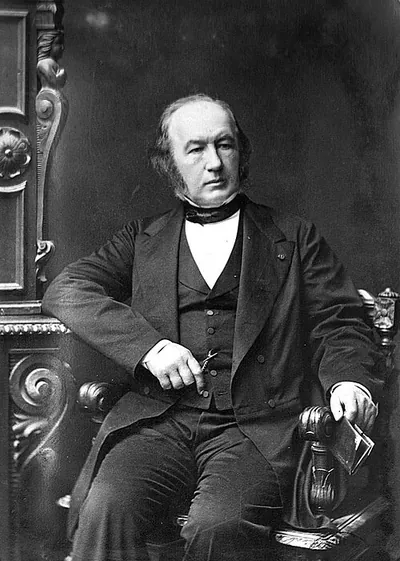 Claude Bernard1813–1878 · Biology
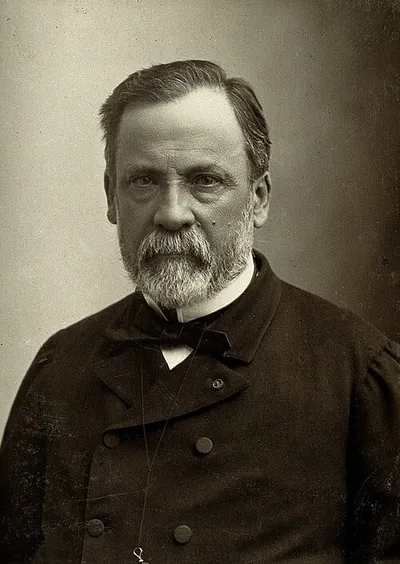 Louis Pasteur1822–1895 · Biology
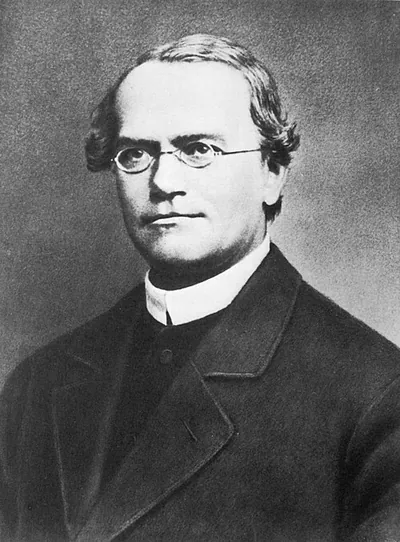 Gregor Mendel1822–1884 · Biology
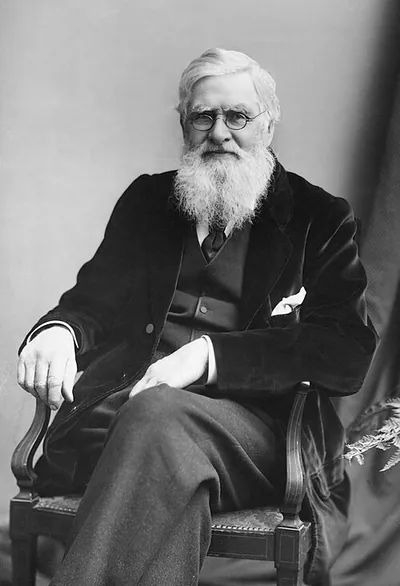 Alfred Russel Wallace1823–1913 · Biology
