
Camille Jordan
French mathematician known for group theory and the Cours d'analyse · 1838–1922
- Born
- January 5, 1838
- Died
- January 22, 1922
- Country
- France
- Section
- Mathematics
Biography
Marie Ennemond Camille Jordan (Lyon, 1838 – Paris, 1922) was a French mathematician whose work spanned two quite different areas: group theory, which studies sets of operations that can be combined under precise rules, and analysis, the branch dealing with limits, functions and infinite processes. He worked during a period of rapid growth in French mathematics, and several results bearing his name are still taught to students today.
Jordan was born in Lyon in 1838 and trained at the École polytechnique in Paris, the school that prepared engineers and was then the heart of French scientific education. After graduating he worked as a mining engineer, a technical career that paid his bills, though mathematics was clearly his real interest. Later he returned to the École polytechnique as an examiner, keeping him connected to teaching.
In 1876 he took up a chair at the Collège de France, succeeding Joseph Liouville, one of the most influential mathematicians of the age. Liouville had founded a journal of pure and applied mathematics, and from 1885 Jordan edited it, a role he kept until 1921. Through that post he helped shape what French mathematicians published and debated.
His best-known work in group theory appeared in the Traité des substitutions, published in 1870. The book examines permutations, the different ways of rearranging a set of objects, and organises much of what was then known about them. It earned him the Prix Poncelet that year. His work also helped bring Galois theory, developed to explain why some polynomial equations cannot be solved by simple formulas, into the mainstream of mathematical thought.
Jordan also investigated the Mathieu groups, among the first examples of sporadic groups, which are abstract structures that fit none of the general families. They remain central to the classification of finite groups.
In analysis, his Cours d'analyse de l'École polytechnique became a widely used text with a rigorous treatment of calculus. He also worked on Jordan measure, a method of assigning area to regions of the plane that predates modern measure theory.
In topology, the study of shapes and the properties that survive bending without cutting or gluing, Jordan proved that a simple closed curve divides the plane into two regions. The Jordan curve theorem looks obvious at first glance, yet its rigorous proof proved difficult, and it is essential in complex analysis.
In linear algebra, the Jordan normal form expresses a matrix in an almost diagonal shape, which makes powers of it and systems of differential equations easier to handle. His name also appears in the Jordan-Chevalley decomposition and the Jordan-Hölder theorem on composition series.
He is remembered for unusual notational choices that sometimes made his writing harder to follow. He was elected to the French Academy of Sciences on 4 April 1881 and gave an invited lecture at the International Congress of Mathematicians in Strasbourg in 1920.
His legacy lives on in the results that still appear in textbooks, in the asteroid 25593 Camillejordan and in the Institut Camille Jordan. He died in Paris in 1922. He should not be confused with Wilhelm Jordan, associated with Gauss-Jordan elimination, or with the physicist Pascual Jordan, whose name is attached to Jordan algebras.
Main contributions
- 1870Traité des substitutions: a treatise on permutations and permutation groups that organised much of the knowledge of its time.
- Jordan curve theorem: a simple closed curve divides the plane into two regions, a key result in complex analysis.
- Jordan normal form: a way of writing a matrix in an almost diagonal shape that simplifies calculations in linear algebra.
- Jordan-Hölder theorem: a basic result on the composition series of a group.
- Jordan measure: a method of assigning area to regions of the plane, predating modern measure theory.
- Mathieu groups: among the first examples of sporadic groups, studied by Jordan.
Teachers and students
Studied under:
Taught:
Trivia and anecdotes
Unusual notation
He is remembered for uncommon notational choices that sometimes made his texts harder to read.
An asteroid named after him
The asteroid 25593 Camillejordan and the Institut Camille Jordan carry his name in his honour.
Their contemporaries
While Camille Jordan was alive (1838–1922)…
Alive at the same time
Discovered or invented in those years
- 1846NeptuneThe eighth and most distant planet of the Solar System, an ice giant found through mathematical prediction before any direct sighting.
- 1859EvolutionThe process by which the heritable traits of living populations change over generations, explaining the diversity of life from common ancestors.
- 1869Periodic tableAn arrangement of the chemical elements into rows (periods) and columns (groups), ordered by atomic number, that reveals recurring chemical behaviour and lets scientists predict properties.
- 1876TelephoneA device that carries the human voice over distance by turning sound into electrical signals and back into sound at the other end of the line.
- 1884CarA road vehicle with four wheels and its own engine, mainly built to carry people.
- 1903AirplaneA fixed-wing aircraft, heavier than air, powered by engines or rockets, that stays aloft because its wings generate lift.
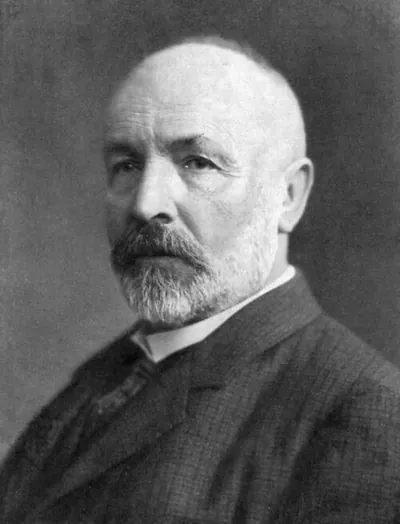 Georg Cantor1845–1918 · Mathematics
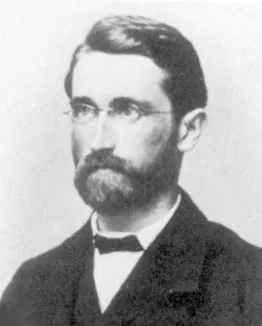 Richard Dedekind1831–1916 · Mathematics
 Felix Klein1849–1925 · Mathematics
 Bernhard Riemann1826–1866 · Mathematics
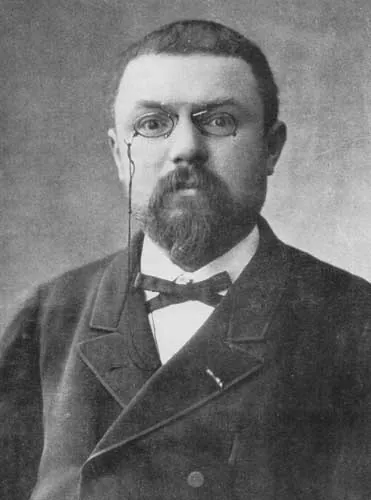 Henri Poincaré1854–1912 · Mathematics
 Giuseppe Peano1858–1932 · Mathematics
