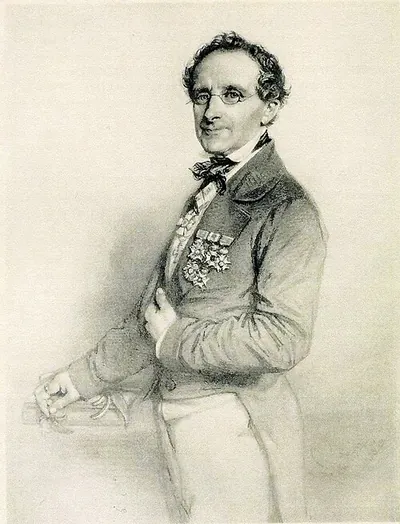
Carl Ludwig Blume
German-Dutch botanist and entomologist who studied the flora of Java and directed the Rijksherbarium at Leiden · 1796–1862
- Born
- June 9, 1796
- Died
- February 3, 1862
- Country
- Kingdom of the Netherlands, Duchy of Brunswick
- Section
- Biology
Biography
Carl Ludwig Blume (1796-1862) was a German-born botanist and entomologist who spent most of his career in the Netherlands and its colony in the East Indies. Active in the first half of the nineteenth century, when European powers sent naturalists to catalogue tropical plants, he is remembered for his work on the flora of Java and for leading the state herbarium at Leiden.
Born on 9 June 1796 in Braunschweig, in northern Germany, Blume appears under several names: Carl Ludwig in German, Karel Lodewijk in Dutch, and the short form K. L. Blume, which can make his publications harder to trace. He trained in medicine, as the M.D. in the title of one of his catalogues shows, and later studied at Leiden University, where most of his working life would unfold.
In 1823 he became deputy director of agriculture at the botanical gardens at Buitenzorg, today Bogor, on Java, then a Dutch colony. There he compiled a catalogue of the native and exotic plants growing in the garden, an ordered list of species with their names and descriptions. He stayed until 1826, a period that gave him direct access to the living plants he would describe for the rest of his life.
His main ambition was to document the flora of Java and nearby islands. Between 1825 and 1827 he published Bijdragen tot de flora van Nederlandsch Indië, followed by Enumeratio plantarum Javae in 1827-1828. With Johannes B. Fischer he began the Flora Javae, a work issued in parts over several decades. He also described orchid genera, among them Anoectochilus in 1825. The four-volume Rumphia, published between 1835 and 1849, gathered his studies of the plants of the East Indies.
Blume also worked on insects, so he was an entomologist as well as a botanist. For a period he corresponded by letter with Charles Darwin, the naturalist who would soon set out his theory of evolution by natural selection.
In 1827 he became a correspondent of the Royal Institute of the Netherlands. He later directed the Rijksherbarium at Leiden, the national herbarium, a large collection of pressed and labelled plants that botanists use as a reference. In 1855 he was elected a foreign member of the Royal Swedish Academy of Sciences.
Alongside Philipp Franz von Siebold, Blume turned his attention to horticulture. Around 1839 the two built a venture that imported living plants from Japan and the Dutch East Indies and sold them to Dutch growers. In 1842 they founded the Royal Society for the Encouragement of Horticulture in the Netherlands, which aimed to restore the country's reputation for fine gardens by holding annual plant exhibitions and sharing new species among its members. Blume sold his share to Siebold in 1844 and gave up the society's directorship the following year.
He died in Leiden on 3 February 1862. His legacy lives on in the botanical journal Blumea, named after him, and in the plant genus Blumea, which honours him.
Main contributions
- 1823A catalogue of the native and exotic plants of the Buitenzorg botanical garden in Java.
- 1825A description of the orchid genus Anoectochilus, one of several orchid genera he studied.
- 1825Bijdragen tot de flora van Nederlandsch Indië, contributions to the flora of the Dutch East Indies, published between 1825 and 1827.
- 1828Flora Javae, written with Johannes B. Fischer, describing the plants of Java and nearby islands in several parts.
- 1835Rumphia, four volumes of botanical studies on the plants of the East Indies, published up to 1849.
- 1842Founding of the Royal Society for the Encouragement of Horticulture in the Netherlands, together with Philipp Franz von Siebold.
- 1849Museum botanicum Lugduno-Batavum, published between 1849 and 1857 on the botanical museum at Leiden.
- 1858Collection des Orchidées les plus remarquables de l'Archipel Indien et du Japon, with texts and colour engravings of orchids from the region.
Trivia and anecdotes
A name with several forms
Blume appears in texts under his German name, his Dutch name or the abbreviation K. L. Blume, which sometimes makes his work hard to find.
A link with Darwin
Blume corresponded by letter with Charles Darwin for a time, although the sources do not describe what those letters contained.
Their contemporaries
While Carl Ludwig Blume was alive (1796–1862)…
Alive at the same time
Discovered or invented in those years
- 1803AtomThe basic unit of a chemical element: a nucleus of protons and usually neutrons surrounded by a cloud of electrons.
- 1811MoleculeAn electrically neutral group of at least two atoms held together by chemical bonds in a defined arrangement.
- 1821ElectricityThe set of physical phenomena linked to the presence and movement of electric charge, and one of the most versatile forms of energy in modern life.
- 1839PhotographyA technique for creating lasting images by recording light, either on a light-sensitive material or with an electronic sensor.
- 1846NeptuneThe eighth and most distant planet of the Solar System, an ice giant found through mathematical prediction before any direct sighting.
- 1859EvolutionThe process by which the heritable traits of living populations change over generations, explaining the diversity of life from common ancestors.
 Charles Darwin1809–1882 · Biology
 Theodor Schwann1810–1882 · Biology
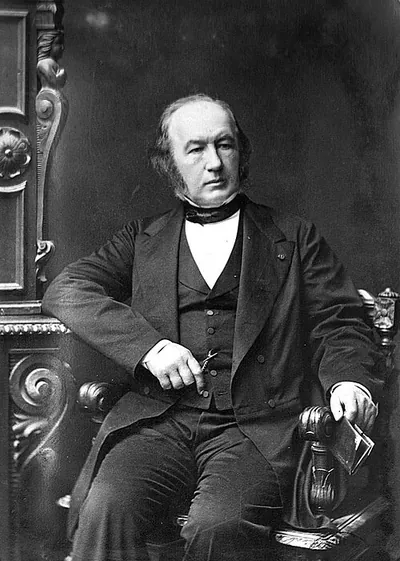 Claude Bernard1813–1878 · Biology
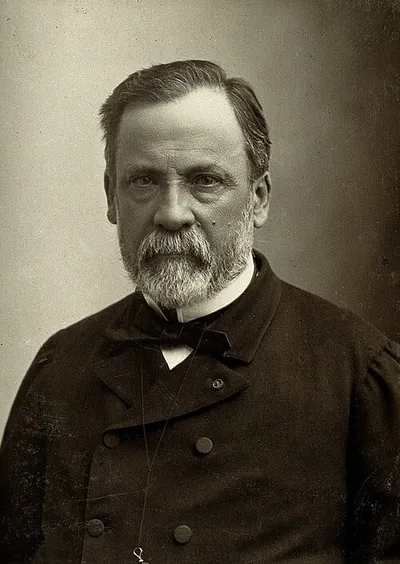 Louis Pasteur1822–1895 · Biology
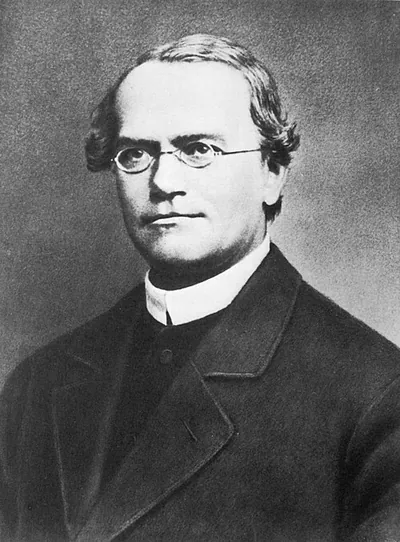 Gregor Mendel1822–1884 · Biology
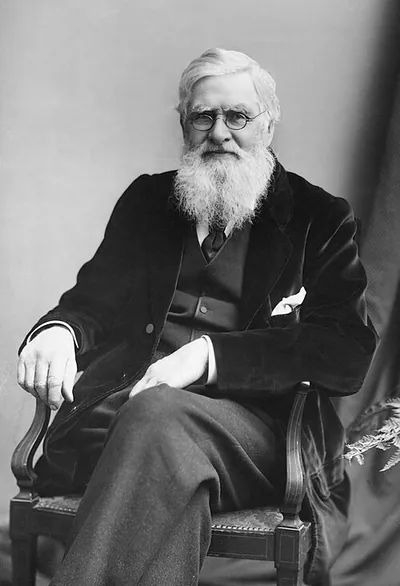 Alfred Russel Wallace1823–1913 · Biology
