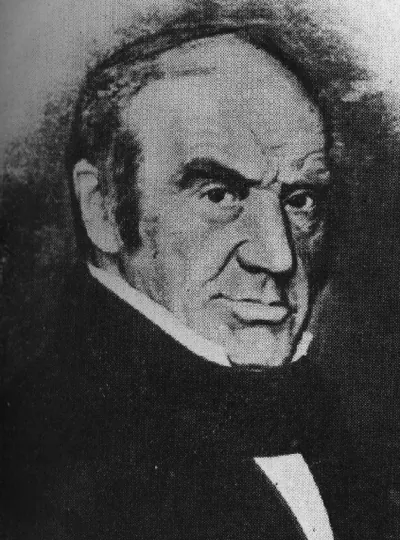
Carl Ludwig Koch
German entomologist and arachnologist who classified many spiders · 1778–1857
- Born
- September 21, 1778
- Died
- August 23, 1857
- Country
- Kingdom of Bavaria
- Section
- Biology
Biography
Carl Ludwig Koch (1778-1857) was a German entomologist who specialised in spiders and other arachnids, and who spent much of his career describing and organising species in the first half of the nineteenth century. He is best remembered for classifying a large number of spiders, including the Brazilian whiteknee tarantula and the common house spider, and for a multi-volume work on the arachnids of Germany.
Koch was born on 21 September 1778 in Kusel, then part of the Holy Roman Empire, and died on 23 August 1857 in Nuremberg. He worked as an inspector of water and forests, a post in the forestry administration, and devoted much of his life to the study of animals alongside it. Details of his formal training and teachers are not recorded in the available sources.
His main project was Die Arachniden, a series of sixteen volumes published between 1831 and 1848 with descriptions and illustrations of arachnids. Carl Wilhelm Hahn (1786-1836) began the work, and Koch was responsible for the final twelve volumes. Arachnids are animals with four pairs of legs, such as spiders and scorpions, unlike insects, which have six. Koch also finished the chapter on spiders in Faunae insectorum germanicae initia, a work by Georg Wolfgang Franz Panzer (1755-1829) on the insects of Germany.
With Georg Karl Berendt he wrote Die im Bernstein befindlichen Myriapoden, Arachniden und Apteren der Vorwelt (1854), a study of myriapods, arachnids and wingless insects preserved in amber. The specimens came from Berendt's collection and are now held in the Museum für Naturkunde in Berlin. Koch also published work on the crustaceans, myriapods and arachnids of Germany, on plant lice, and a general survey of Bavarian zoology.
He should not be confused with his son, Ludwig Carl Christian Koch (1825-1908), who also became a well-known entomologist and arachnologist. In species descriptions the father is abbreviated C.L. Koch and the son L. Koch.
Koch's legacy lies mainly in arachnid taxonomy. His descriptions remain a reference for identifying many spider species, and his works are still consulted by specialists.
Main contributions
- 1831Die Arachniden (1831-1848): a sixteen-volume work describing arachnids, of which Koch wrote the last twelve volumes.
- 1835Deutschlands Crustaceen, Myriapoden und Arachniden (1835-1844): a study of the crustaceans, myriapods and arachnids of Germany.
- 1837Übersicht des Arachnidensystems (1837-1850): an overview of the classification system of arachnids.
- 1854A monograph on myriapods, arachnids and wingless insects preserved in amber, written with Georg Karl Berendt.
- 1857Die Pflanzenläuse, Aphiden: a work on aphids, insects that feed on plants.
Trivia and anecdotes
A name easily confused
Father and son had almost identical names and both became entomologists, so species descriptions distinguish them as C.L. Koch and L. Koch.
Their contemporaries
While Carl Ludwig Koch was alive (1778–1857)…
Alive at the same time
Discovered or invented in those years
- 1781UranusThe seventh planet from the Sun, an ice giant discovered by William Herschel in 1781, the first planet found with a telescope.
- 1803AtomThe basic unit of a chemical element: a nucleus of protons and usually neutrons surrounded by a cloud of electrons.
- 1811MoleculeAn electrically neutral group of at least two atoms held together by chemical bonds in a defined arrangement.
- 1821ElectricityThe set of physical phenomena linked to the presence and movement of electric charge, and one of the most versatile forms of energy in modern life.
- 1839PhotographyA technique for creating lasting images by recording light, either on a light-sensitive material or with an electronic sensor.
- 1846NeptuneThe eighth and most distant planet of the Solar System, an ice giant found through mathematical prediction before any direct sighting.
 Georges Cuvier1769–1832 · Biology
 Edward Jenner1749–1823 · Biology
 Charles Darwin1809–1882 · Biology
 Theodor Schwann1810–1882 · Biology
 Jean-Baptiste de Lamarck1744–1829 · Biology
 Claude Bernard1813–1878 · Biology
