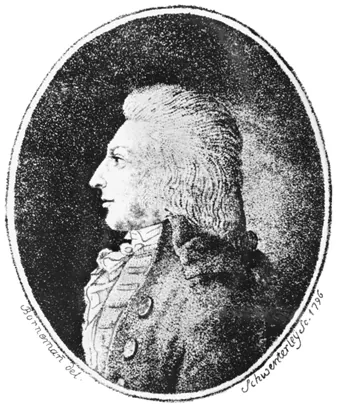
Christiaan Hendrik Persoon
South African-born botanist and mycologist, later based in France, regarded as the father of systematic mycology · 1761–1836
- Born
- February 1, 1761
- Died
- November 16, 1836
- Country
- France
- Section
- Biology
Biography
Christiaan Hendrik Persoon (born in Cape Town in 1761, died in Paris in 1836) was a botanist and mycologist, a specialist in fungi. Born in the Cape Colony while it was under Dutch rule, he spent almost all his adult life in Paris and is remembered as one of the founders of the systematic classification of fungi, a field that had been studied with little method before him. His work marks the start of modern mycology in the early nineteenth century.
His father was an immigrant of Pomeranian origin and his mother came from a Dutch family; she died soon after he was born. Little is recorded about his childhood in South Africa. In 1775, at the age of thirteen, he was sent to Europe to be educated, and his father died a year later, leaving him an orphan far from home. He began studying theology at Halle but switched to medicine, which he studied at Leiden and Göttingen. That medical training gave him a livelihood, while his real passion remained botany.
In 1799 he received his doctorate from the Academy of German Naturalists at Erlangen, by which time he was already known for his work on fungi. He settled in Paris by about 1803, renting the upper floor of a house in a poor district. He ran a small medical practice but gave much of his free time to botany. Accounts describe him as poor, unmarried and largely withdrawn from social life, yet he kept up a wide correspondence with botanists across Europe, which helped him assemble a large herbarium, a collection of dried and mounted plant specimens.
His earliest work was a set of fungus illustrations published in three parts between 1790 and 1793. His most influential contribution was the Synopsis methodica fungorum of 1801, in which he arranged fungi using the naming system of Linnaeus, giving each species a two-part scientific name. The book became the starting point for naming several groups, including the rusts and smuts, and was treated by his contemporaries as an essential reference. He also described many polypores, bracket-shaped fungi, mostly from his own collections in central Europe, along with some tropical species sent to him from a round-the-world expedition. His best-known general work, the Synopsis plantarum, appeared in 1805 to 1807 and described about 20,000 plant species.
His money troubles shaped the fate of his herbarium. In 1825 the Dutch government bought it for 800 florins, and it now belongs to the National Herbarium of the Netherlands in Leiden. He had been elected a corresponding member of the Royal Swedish Academy of Sciences in 1815. Over his career he formally described 2,269 fungal species, a measure of how much of the field he covered.
His legacy lives on in the many genera and families named after him and in the journal Persoonia, which covers the molecular phylogeny and evolution of fungi and is published by the National Herbarium of the Netherlands and the CBS Fungal Biodiversity Centre. The Australian genus Persoonia, a group of small trees and shrubs, also honours him. Persoon remains a basic name in mycology, and his systematic method is still a landmark in the history of the discipline.
Main contributions
- 1790Abbildungen der Schwämme (Illustrations of the fungi), an illustrated work issued in three parts between 1790 and 1793, his earliest publication on the subject.
- 1801Synopsis methodica fungorum, a work that arranges fungi using Linnaeus's system and became the basis for naming several groups.
- 1805Synopsis plantarum, a popular two-volume work describing about 20,000 plant species.
- 1817Species plantarum, a large five-volume work published between 1817 and 1827.
- 1819Traité des champignons comestibles, a treatise on edible mushrooms.
- 1822Mycologia Europae, a three-volume survey of European fungi, published between 1822 and 1823.
Trivia and anecdotes
A herbarium sold out of necessity
To ease his financial difficulties, he agreed to give his herbarium to the House of Orange in return for a lifelong pension. The collection is now kept in Leiden.
A genus bearing his name
The Australian genus Persoonia, a group of small trees and shrubs, and the scientific journal Persoonia both carry his name.
Their contemporaries
While Christiaan Hendrik Persoon was alive (1761–1836)…
Alive at the same time
Discovered or invented in those years
- 1766HydrogenThe lightest and most abundant chemical element in the universe, atomic number 1, which under normal conditions is a colourless, odourless and highly flammable gas.
- 1772NitrogenChemical element with atomic number 7, a colourless, odourless gas that makes up about 78% of Earth's air and is an essential part of proteins and nucleic acids.
- 1774OxygenA colorless, odorless gas, symbol O and atomic number 8, that forms the dioxygen in air and is essential for respiration in most living things.
- 1781UranusThe seventh planet from the Sun, an ice giant discovered by William Herschel in 1781, the first planet found with a telescope.
- 1803AtomThe basic unit of a chemical element: a nucleus of protons and usually neutrons surrounded by a cloud of electrons.
- 1821ElectricityThe set of physical phenomena linked to the presence and movement of electric charge, and one of the most versatile forms of energy in modern life.
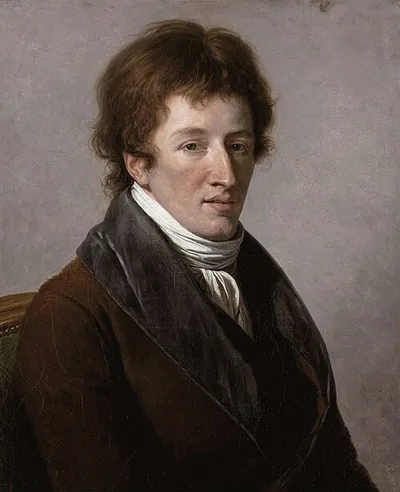 Georges Cuvier1769–1832 · Biology
 Edward Jenner1749–1823 · Biology
 Jean-Baptiste de Lamarck1744–1829 · Biology
 Charles Darwin1809–1882 · Biology
 Theodor Schwann1810–1882 · Biology
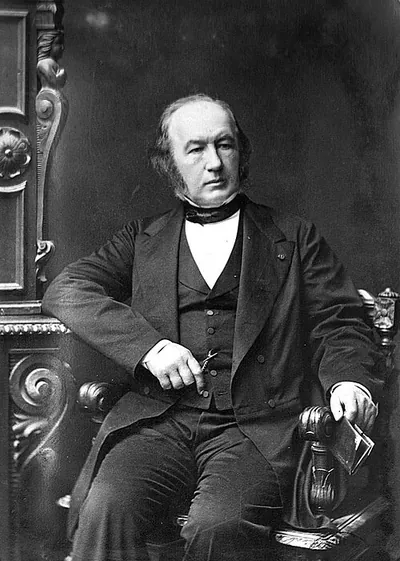 Claude Bernard1813–1878 · Biology
