
Conrad Gessner
Swiss naturalist, physician and bibliographer, one of the great polymaths of the Renaissance · 1516–1565
- Born
- April 5, 1516
- Died
- December 23, 1565
- Country
- Switzerland
- Section
- Biology
Biography
Conrad Gessner (Zurich, 1516-1565) was a Swiss naturalist, physician and bibliographer, one of the great polymaths of the Renaissance. His zoological and bibliographical work marked a turning point: he is regarded as the starting point of modern zoology and as one of the fathers of scientific bibliography. He lived at a time when learning still rested almost entirely on the authority of classical writers, and he insisted on looking at nature with his own eyes.
He was born in Zurich into a poor family; his father was a furrier. His father's death at the Battle of Kappel in 1531 left the household in serious hardship. Teachers and friends, among them Oswald Myconius and Heinrich Bullinger, recognised his talent and helped him continue his education. He studied classical languages and even took a role in a school performance of Aristophanes' Plutus, and later studied at Strasbourg, Bourges and Paris, where a patron from Bern, Job Steiger, supported him financially.
Religious unrest drove him back to Zurich in 1535. There he married young, a choice some considered unwise since his bride had no dowry either. Friends once again came to his aid: he was able to study medicine in Basel, and in 1537 he obtained the chair of Greek at the newly founded academy in Lausanne, then under the authority of Bern. A Greek-Latin dictionary he had published that same year helped open that door.
In Lausanne he had time to devote himself to botany, the study of plants. Between 1540 and 1541 he attended the famous medical school at Montpellier, and in 1541 he took his doctorate at Basel. He settled in Zurich to practise medicine, taught Aristotelian physics at the Carolinum, the forerunner of the city's university, and eventually became the city physician. That post left him time for research and writing. His summer journeys through the Swiss mountains, undertaken mainly to collect plants, were an essential part of how he worked.
His method rested on four components: observation, dissection, travel and accurate description. Rather than repeating ancient authors, he wanted to check what they said for himself. His Historia animalium, published in Zurich between 1551 and 1558 in four volumes covering quadrupeds, egg-laying quadrupeds, birds and fishes, is an enormous encyclopedia of some 4,500 pages. It mixed ancient sources such as the Bible, Aristotle and Pliny with his own observations and hand-coloured woodcuts. Not everything was reliable: he also included fabulous creatures such as the unicorn and the basilisk, which he knew only from medieval bestiaries. A fifth volume on snakes appeared in 1587.
His Bibliotheca universalis, published in 1545 after four years of work, catalogued in Latin, Greek and Hebrew the known writers and the titles of their works, with brief notes. It listed some three thousand authors in alphabetical order. A second, thematic volume, the Pandectarium, appeared in 1548 with nineteen of the twenty-one books planned. Many specialists regard it as the first modern system of bibliographic classification. He is also credited with using a card system to organise his notes, an early version of what is now called the Zettelkasten method, although this claim rests on later interpretation.
His interest in languages produced the Mithridates (1555), an account of around 130 languages that included the Lord's Prayer in twenty-two of them. His botany largely remained unpublished: during his lifetime he issued the Catalogus plantarum (1542) and few other botanical works, and his major Historia plantarum did not appear until 1754. He is credited with being among the first Europeans to describe species such as the tulip, which he saw in Augsburg in 1559, as well as the guinea pig and the brown rat.
Gessner was also an avid lover of mountains. In 1541 he wrote to his friend J. Vogel of Glarus that he meant to climb at least one peak every year, not only to gather flowers but to exercise his body. In 1555 he published an account of his climb to the Gnepfstein, the lowest summit of the Pilatus range, at about 1,920 metres.
He died of the plague in Zurich in December 1565, after treating a member of the Bullinger family. That same year, already ennobled, he is said to have created the pencil in Germany, although this is a doubtful attribution. His legacy is broad: zoology, bibliography and botany all owe him a great deal, and several species and the plant family Gesneriaceae bear his name. His portrait appeared on Swiss 50-franc banknotes between 1978 and 1994.
Main contributions
- 1537Greek-Latin dictionary (Lexicon Graeco-Latinum), a reference work for the study of classical languages.
- 1545Bibliotheca universalis, a catalogue of known authors and their works in Latin, Greek and Hebrew, regarded as a landmark of bibliography.
- 1548Pandectarium, a thematic index often seen as the first modern system of bibliographic classification.
- 1551Historia animalium, a four-volume zoological encyclopedia (1551-1558) regarded as the starting point of modern zoology.
- 1555Mithridates, an account of about 130 languages with the Lord's Prayer in twenty-two of them.
- 1559One of the first European descriptions of the tulip, which he called the Turkish tulip after seeing it in Augsburg.
- 1565He is credited with creating the graphite pencil, a doubtful attribution that is often repeated.
Trivia and anecdotes
A tulip with a Turkish name
Gessner saw the tulip in a garden in Augsburg in 1559 and named it the Turkish tulip, after its links to the Ottoman Empire.
A lover of mountains
He wrote that he would climb at least one mountain every year, partly for exercise, and described his ascent of the Gnepfstein, the lowest peak of the Pilatus.
On the banknotes
His portrait appeared on Swiss 50-franc banknotes issued between 1978 and 1994.
Their contemporaries
While Conrad Gessner was alive (1516–1565)…
Alive at the same time
Discovered or invented in those years
- 1543HeliocentrismAn astronomical model that places the Sun, rather than the Earth, at the centre of the system in which the planets orbit.
- 1545Vieta's formulasFormulas linking the coefficients of a polynomial to the sums and products of its roots, without having to compute the roots themselves.
- 1557PlatinumA rare, silvery-white precious metal, highly resistant to corrosion, used in jewellery, laboratories, car catalytic converters and some cancer treatments.
- 1557Equals signThe mathematical symbol «=» that shows two expressions have the same value.
 Marcello Malpighi1628–1694 · Biology
 Antonie van Leeuwenhoek1632–1723 · Biology
 Carl Linnaeus1707–1778 · Biology
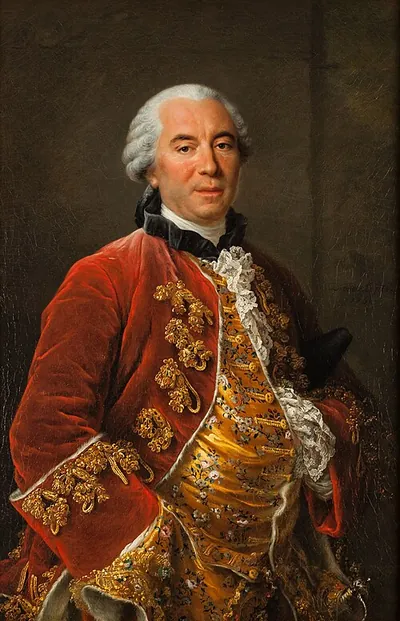 Georges-Louis Leclerc, Comte de Buffon1707–1788 · Biology
 Jean-Baptiste de Lamarck1744–1829 · Biology
 Edward Jenner1749–1823 · Biology
