
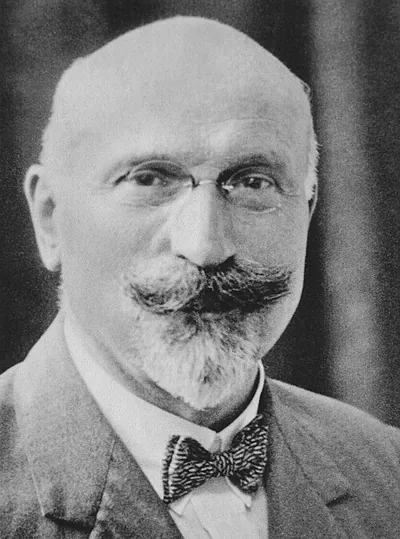
Cornelis Lely
Dutch civil engineer and politician, Minister of Transport and Water Management and Governor of Suriname · 1854–1929
- Born
- September 23, 1854
- Died
- January 22, 1929
- Country
- Kingdom of the Netherlands
- Section
- Engineering and construction
Biography
Cornelis Lely (Amsterdam, 23 September 1854 – The Hague, 22 January 1929) was a Dutch civil engineer and politician of the Liberal Union. He served as Minister of Transport and Water Management and as Governor of Suriname. He lived through the second half of the nineteenth century and the early decades of the twentieth, when the Netherlands, a country much of which had been reclaimed from the sea, depended on dikes and drainage works to keep out floods. His importance lies in the plan that reshaped the map of his country: he turned a large marine bay into a freshwater lake and opened up vast tracts of former seabed as dry land.
Lely was born in Amsterdam, the son of a trader in oilseeds, the raw materials pressed to make vegetable oils. He attended the Hogere Burgerschool, a secondary school with a practical and scientific orientation, and then the Polytechnic School of Delft, one of the country's main centres for training engineers. He graduated as a civil engineer in 1875. Civil engineering deals with public works such as roads, harbours, canals and dikes. His technical training stayed with him throughout his career, even when he held political office.
The great challenge of his working life was the Zuiderzee, a wide inlet of the North Sea that cut deep into the country and often flooded the surrounding coasts. Between 1886 and 1891 Lely led the technical team that studied whether the inlet could be closed off. A closing dike is a long barrier that separates the sea from an inland area. Once it is in place, the water inside can be drained or replaced, and the land that emerges can be farmed or built on. Lely's proposal, later approved by a state commission, was to turn the Zuiderzee into a freshwater lake and reclaim large areas of the old seabed.
Lely served three separate terms as Minister of Transport and Water Management: from 1891 to 1894, from 1897 to 1901, and from 1913 to 1918. From that post he pressed hard for his own schemes. In 1898, as minister, he put into effect a law on local railways and tramways, which played a significant part in developing the Dutch countryside by linking villages with markets. In 1895 he became a member of the Royal Netherlands Academy of Arts and Sciences, a distinguished body of scholars and artists.
The Zuiderzee project did not move quickly. It was shelved during the First World War, and some fishermen judged that the work would cost too much. That opposition pushed Lely into active politics. His persistence, together with severe flooding along the Zuiderzee shores in 1916, revived the debate. The Dutch parliament passed the law creating the Zuiderzee Works on 14 June 1918, using Lely's plan, and work began in 1920. The dam that links North Holland with the province of Friesland, the Afsluitdijk, was at the time of its construction the largest dam and causeway in the world, and it is the most visible result of that scheme. Its completion is generally dated to 1932.
Between 1902 and 1905 Lely was Governor of Suriname, then a Dutch colony on the north coast of South America. There he drove forward the Lawa Railway, which ran from Paramaribo to Benzdorp. The line crossed an area that had little transport at the time. In 1905 the Surinamese village of Kofi Djompo was renamed Lelydorp in his honour, since the new railway passed through the area. Most of the railway has since disappeared, but Lelydorp survives and is today the capital of Wanica District.
The sources say little about Lely's private life, so his story is best known through his public work, his technical role and the posts he held. His name remains very present in the Netherlands. The city of Lelystad, capital of the province of Flevoland and built on one of the polders reclaimed from the former gulf, bears his name. The flags of the province and of the city both carry a white fleur-de-lys to recognise his contribution. In Amsterdam a major thoroughfare, the Cornelis Lelylaan, is named after him, and Lelylaan station, one of the city's main railway stations, stands on it. A statue of him by Mari Andriessen stands at the western end of the Afsluitdijk and was unveiled on 23 September 1954, the hundredth anniversary of his birth. His legacy is that of an engineer who turned a long-standing flood problem into a new national landscape.
Main contributions
- 1875Graduation as a civil engineer from the Polytechnic School of Delft, the technical foundation of his whole career.
- 1886Leadership of the technical team, between 1886 and 1891, that studied closing off the Zuiderzee with a dam.
- 1898Law on local railways and tramways, which improved transport between villages and helped develop the Dutch countryside.
- 1902Governorship of Suriname, from 1902 to 1905, during which he initiated and built the Lawa Railway.
- 1918Law of 14 June creating the Zuiderzee Works, based on Lely's plan and passed by parliament.
- 1932Completion of the Afsluitdijk, the dam that closed off the Zuiderzee, then the largest dam and causeway in the world.
Trivia and anecdotes
A village with a new name
In 1905 the Surinamese village of Kofi Djompo was renamed Lelydorp in his honour, because the railway he promoted ran through the area. It still exists today as the capital of a district.
A statue for the centenary
Lely's statue at the end of the Afsluitdijk was unveiled on 23 September 1954, exactly one hundred years after his birth. A replica stands in the centre of Lelystad.
Their contemporaries
While Cornelis Lely was alive (1854–1929)…
Alive at the same time
Discovered or invented in those years
- 1859EvolutionThe process by which the heritable traits of living populations change over generations, explaining the diversity of life from common ancestors.
- 1869Periodic tableAn arrangement of the chemical elements into rows (periods) and columns (groups), ordered by atomic number, that reveals recurring chemical behaviour and lets scientists predict properties.
- 1876TelephoneA device that carries the human voice over distance by turning sound into electrical signals and back into sound at the other end of the line.
- 1884CarA road vehicle with four wheels and its own engine, mainly built to carry people.
- 1903AirplaneA fixed-wing aircraft, heavier than air, powered by engines or rockets, that stays aloft because its wings generate lift.
- 1925TelevisionA system that sends moving pictures and sound over distance and shows them on a receiver, the television set.
 John Browning1855–1926 · Engineering and construction
 Leonardo Torres Quevedo1852–1936 · Engineering and construction
 M. Visvesvaraya1860–1962 · Engineering and construction
 Emily Warren Roebling1843–1903 · Engineering and construction
 Sakichi Toyoda1867–1930 · Engineering and construction
 Robert Maillart1872–1940 · Engineering and construction
