Diego de Pantoja
Spanish Jesuit missionary in China, collaborator of Matteo Ricci and astronomer at the Ming court · 1571–1618
- Born
- 1571
- Died
- 1618
- Country
- Spain
- Section
- Astronomy and space
Biography
Diego de Pantoja was a Spanish Jesuit missionary who worked in China at the end of the sixteenth and the beginning of the seventeenth century. He is best known as one of the closest companions of Matteo Ricci, with whom he reached the imperial capital, and for helping Europeans learn more about the country.
Pantoja was born in Valdemoro, near Madrid, in April 1571. At fourteen he was studying at the University of Alcalá, where he first encountered the Jesuits. In 1589 he began his novitiate at Villarejo de Fuentes, in Cuenca, and then returned to Alcalá to study theology. There he formed a close bond with Luis de Guzmán, the community's superior, who was writing a history of Jesuit missions in Asia. Pantoja very likely read Juan González de Mendoza's book on China, published in 1586, one of the first in Spanish devoted to that country.
He set out for the East in 1596. After a stop in Goa he reached Macau in 1597 and studied at St. Paul's College. He was first assigned to Japan, but the plan was dropped because of persecution of Christians there. In 1599 he entered China secretly with the Italian Lazzaro Cattaneo, slipping in during a trade fair in Canton, since the Ming dynasty barred foreigners. In March 1600 they reached Nanjing and joined Ricci. Ricci believed that converting the ruling class, beginning with the emperor, was the way to reach a state as centralised as China, so he was preparing a gift-laden journey to the court.
Pantoja and Ricci travelled up the Grand Canal and arrived in Beijing on 24 January 1601. He spent around seventeen years there. He worked as a musician, as an astronomer helping to correct the calendar, and as a geographer calculating latitudes. He obtained land for a Jesuit cemetery. In 1614 he published the Qike, a work on the ethics and culture of Catholicism written for Chinese readers.
His final years were difficult. Tensions between the court and the missionaries, fuelled by Chinese astronomers who rivalled them, led to a trial in March 1617 and to the expulsion of Pantoja and his colleague Sabatino de Ursis. He settled in Macau and died there on 9 July 1618, aged 47.
His legacy is remembered in the exchanges between Spain and China. In 2018 the government of the People's Republic of China declared a Diego de Pantoja Year to mark the four hundredth anniversary of his death, at the proposal of the Instituto Cervantes.
Main contributions
- 1601Arrival in Beijing with Matteo Ricci, which allowed him to live at the imperial court, something few Europeans had achieved until then.
- 1614Qike, a work in Chinese explaining the ethics and culture of Catholicism to Chinese readers.
- Work on correcting the Chinese calendar, in which he took part as an astronomer at court.
- Work on calculating latitudes and on cartography alongside Ricci, to represent Chinese territory more accurately.
Trivia and anecdotes
A Chinese name
He took the Chinese name Pang Di'e, formed from the first syllable of his surname and the first two of his given name, a common pattern for foreigners working in China.
The Forbidden City
According to the sources, he was the first Westerner to enter the Forbidden City, though this claim is not documented in further detail.
Their contemporaries
While Diego de Pantoja was alive (1571–1618)…
Alive at the same time
Discovered or invented in those years
- 1590MicroscopeAn instrument that magnifies objects too small to be seen with the naked eye, usually using lenses, although versions using electron beams or probes also exist.
- 1593ThermometerA device that measures temperature, that is, how hot or cold an object is.
- 1596ToiletA sanitary fixture that collects urine and feces and sends them to a drainage system, with a water trap that stops sewer smells from rising into living spaces.
- 1608TelescopeAn optical instrument that gathers electromagnetic radiation, mainly visible light, to see distant objects in far more detail than the naked eye can.
- 1609Kepler's laws of planetary motionThree mathematical rules describing how planets move around the Sun: in ellipses, at varying speeds, and with a fixed link between orbital period and distance.
- 1614LogarithmA mathematical function giving the exponent to which a fixed base must be raised to produce a given number.
 Johannes Kepler1572–1630 · Astronomy and space
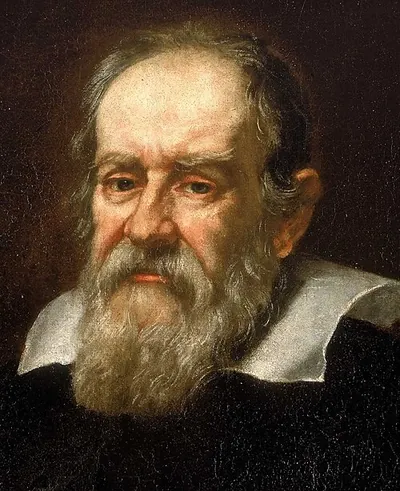 Galileo Galilei1564–1642 · Astronomy and space
 Tycho Brahe1546–1601 · Astronomy and space
 John Flamsteed1646–1720 · Astronomy and space
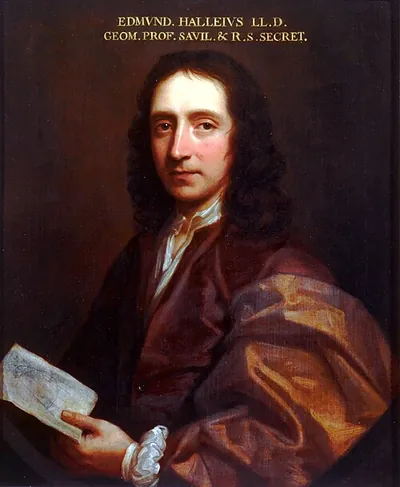 Edmond Halley1656–1742 · Astronomy and space
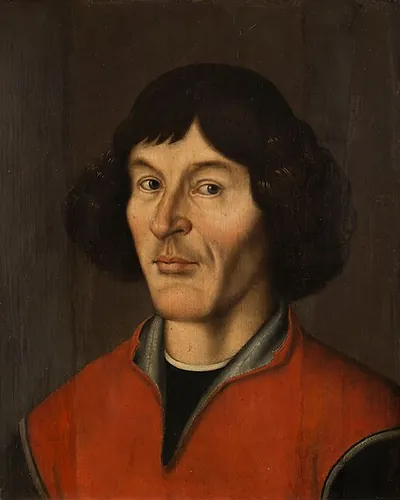 Nicolaus Copernicus1473–1543 · Astronomy and space