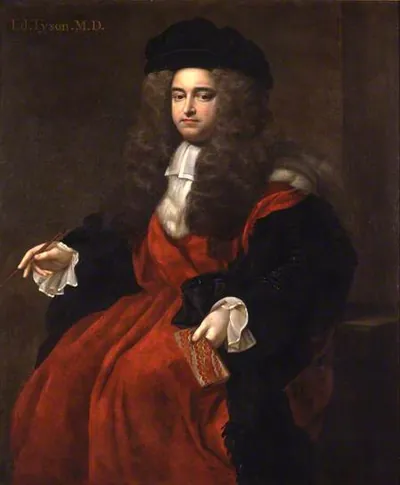
Edward Tyson
English physician and anatomist, regarded as one of the founders of comparative anatomy · 1650–1708
- Born
- 1650
- Died
- August 1, 1708
- Country
- Kingdom of Great Britain
- Section
- Biology
Biography
Edward Tyson (Clevedon, Somerset, c. 1650 - 1708) was an English physician and anatomist, commonly regarded as a founder of comparative anatomy, the field that compares the bodily structures of different species. He worked in the later seventeenth century, when science was beginning to organise itself into academies and learned societies. His importance lies in using the dissection of animals to understand the human body more clearly. The exact date of his birth is uncertain: some sources give 1650 and others 1651.
Tyson studied arts at Oxford, taking his bachelor's degree in 1670 and his master's in 1673. He later earned a medical doctorate from Cambridge, though accounts differ on whether this came in 1677 or 1678. He was admitted to the London College of Physicians in 1680 and was elected a Fellow of the Royal Society in 1679, the country's leading scientific society. His training combined academic medicine with the experimental culture of London, where direct observation and dissection were gaining ground.
In 1684 he was appointed physician and governor of Bethlem Hospital, the first mental hospital in Britain. The institution had a reputation as something close to a show, with visitors paying to look at the patients, and Tyson is credited with turning it towards caring for those inside. The post gave him a steady clinical position, although his name is remembered mainly for his anatomical work.
His anatomical research began with animals found near the coast. In 1680 he studied a porpoise and established that it was a mammal rather than a fish, despite its resemblance to one. He also noted that the folds of its brain were closer to those of land quadrupeds than to those of fish. Comparing organs across species in this way, rather than studying each animal in isolation, is the basis of comparative anatomy.
In 1683 he dissected a timber rattlesnake and produced one of the earliest and most accurate accounts of the internal anatomy of snakes. He also described the loreal pits, small openings between the eye and the mouth of pit vipers. Tyson thought they served hearing, not recognising that they sense heat, a mistake understandable given the instruments of his day.
His best-known work followed his 1698 dissection of a chimpanzee displayed at the London docks. He compared its anatomy with those of monkeys, apes and humans, and concluded that the chimpanzee had more in common with man than with monkeys, particularly in its brain. The results appeared in a book titled Orang-Outang, sive Homo Sylvestris, which was republished in 1894 with an introduction by Bertram Windle.
Tyson died in 1708 and was buried at St Dionis Backchurch in London. His legacy lies chiefly in method: comparing the bodies of different species to reveal relationships and functions. His dissections anticipated debates about the place of humans among the primates that continued through the eighteenth century and beyond.
Main contributions
- 1680Study of a porpoise, which he identified as a mammal rather than a fish, based on its internal anatomy.
- 1683Dissection of a timber rattlesnake, with one of the earliest and most accurate descriptions of the internal anatomy of snakes.
- 1683Description of the loreal pits of pit vipers, which he wrongly took to be hearing organs.
- 1684Appointment as physician and governor of Bethlem Royal Hospital, the first mental hospital in Britain, whose care of patients he helped to reform.
- 1698Dissection of a chimpanzee and the book Orang-Outang, sive Homo Sylvestris, in which he argued that the chimpanzee is closer to humans than to monkeys.
Trivia and anecdotes
A hospital that was almost a spectacle
Before Tyson's reforms, Bethlem admitted paying visitors who came to observe the patients, a practice hard to imagine today.
A book reissued almost two centuries later
His study of the chimpanzee was republished in 1894, with an introduction by Bertram Windle and a short biography of its author.
A mistake about heat
Tyson believed the loreal pits of snakes were used for hearing, when they actually detect the heat of prey.
Their contemporaries
While Edward Tyson was alive (1650–1708)…
Alive at the same time
Discovered or invented in those years
- 1665CellThe smallest unit of matter that can be considered alive: a compartment enclosed by a membrane that holds genetic material and carries out the functions of life on its own.
- 1676BacteriaSingle-celled prokaryotic microorganisms without a defined nucleus, forming one of the three great domains of life.
- 1687GravityThe attraction that every body with mass exerts on every other, responsible for objects falling and planets circling the Sun.
- 1687ForceA vector quantity that changes the motion of a body or deforms it, measured in newtons.
- 1687Newton's laws of motionThree principles linking the motion of a body to the forces acting on it, the foundation of classical mechanics.
- 1700PianoA keyboard instrument in which each key sets a felt-covered hammer moving to strike a tensioned string, letting the player control loudness through touch.
 Antonie van Leeuwenhoek1632–1723 · Biology
 Marcello Malpighi1628–1694 · Biology
 Carl Linnaeus1707–1778 · Biology
 Georges-Louis Leclerc, Comte de Buffon1707–1788 · Biology
 Jean-Baptiste de Lamarck1744–1829 · Biology
 Edward Jenner1749–1823 · Biology
