
Eleanor Anne Ormerod
English entomologist and a pioneer of agricultural entomology · 1828–1901
- Born
- May 11, 1828
- Died
- July 19, 1901
- Country
- United Kingdom of Great Britain and Ireland
- Section
- Biology
Biography
Eleanor Anne Ormerod (Gloucestershire, 1828 - St Albans, 1901) was an English entomologist who helped define agricultural entomology, the branch that studies insects that either help or harm crops. She worked in the Victorian era, when women had very little access to scientific institutions. Her significance lies in putting knowledge about insects at the service of British farmers.
She was born into a cultured family: her mother was a botanical illustrator, and her father, George Ormerod, a historian and antiquary, wrote a history of Cheshire. While her brothers attended Rugby School, she was taught at home. Insects fascinated her from childhood, and the large family estate gave her plenty of chances to observe them. In 1852 a rare insect sent her to a manual on British beetles, and around 1863 she bought a microscope to look more closely.
She studied agriculture and became a local authority on it. In 1868 the Royal Horticultural Society began gathering a collection of farm pests for practical use, and she contributed greatly, earning the society's Flora medal. Her most original contribution came in 1877, with a pamphlet of questions about harmful insects that she sent to interested people. Those who received it returned the results of their own observations, and from this material she produced a series of annual reports. Her method was, to a large extent, a network of correspondents.
In 1882 she was appointed consulting entomologist to the Royal Agricultural Society of England, a post she held until 1892, and for several years she lectured on scientific entomology at the Royal Agricultural College in Cirencester. She received no pay for her work. She promoted Paris green, an arsenic-based insecticide later recognised as dangerous. In 1897, together with W. B. Tegetmeier, she called for the extermination of the house sparrow, a stance that drew strong opposition, most vocally from Edith Carrington.
After her father's death she moved with her sisters to Torquay and later to Isleworth, near Kew Gardens, where she was close friends with Joseph Hooker, the garden's director. In 1887 she moved to St Albans with her sister Georgiana, a scientific illustrator, and she died there in 1901 after a kidney illness. In 1900 the University of Edinburgh awarded her an honorary doctorate, the first the university had given to a woman.
Her manuals remained in use for decades. In 1924 Virginia Woolf wrote an essay about her, her portrait hangs in Old College in Edinburgh, and her name was given to the RepRap 3D printing project. Her enthusiasm for chemical insecticides is viewed with more caution today, although her method of gathering data from across the country was pioneering.
Main contributions
- 1877A questionnaire pamphlet on harmful insects that became the basis for her annual reports.
- 1881A special report on the onion fly, a crop pest.
- 1890A manual of injurious insects, with methods of prevention and treatment for crops, forest trees and fruit.
- 1891A study of Paris green, its uses and how to apply it to destroy orchard moth caterpillars.
- 1898A handbook of insects harmful to orchards and bush fruit.
- 1900A work on flies harmful to livestock, covering their life cycles and how to prevent them.
Trivia and anecdotes
An essay by Virginia Woolf
In 1924 the writer Virginia Woolf devoted an essay to Ormerod, titled Miss Ormerod.
A name on a 3D printer
Ormerod's name is commemorated in the RepRap 3D printing project, alongside those of several other biologists.
A weather diary
In 1880 she published, as The Cobham Journals, a private diary of weather and plant observations kept by Caroline Molesworth between 1825 and 1850.
Their contemporaries
While Eleanor Anne Ormerod was alive (1828–1901)…
Alive at the same time
Discovered or invented in those years
- 1846NeptuneThe eighth and most distant planet of the Solar System, an ice giant found through mathematical prediction before any direct sighting.
- 1859EvolutionThe process by which the heritable traits of living populations change over generations, explaining the diversity of life from common ancestors.
- 1869Periodic tableAn arrangement of the chemical elements into rows (periods) and columns (groups), ordered by atomic number, that reveals recurring chemical behaviour and lets scientists predict properties.
- 1869Deoxyribonucleic acidA double-stranded molecule that carries the genetic instructions of nearly all living things and many viruses.
- 1876TelephoneA device that carries the human voice over distance by turning sound into electrical signals and back into sound at the other end of the line.
- 1884CarA road vehicle with four wheels and its own engine, mainly built to carry people.
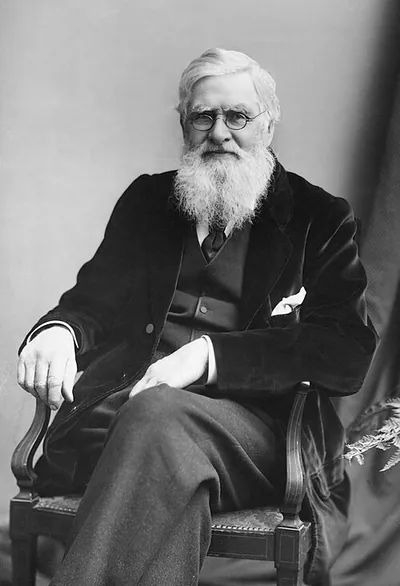 Alfred Russel Wallace1823–1913 · Biology
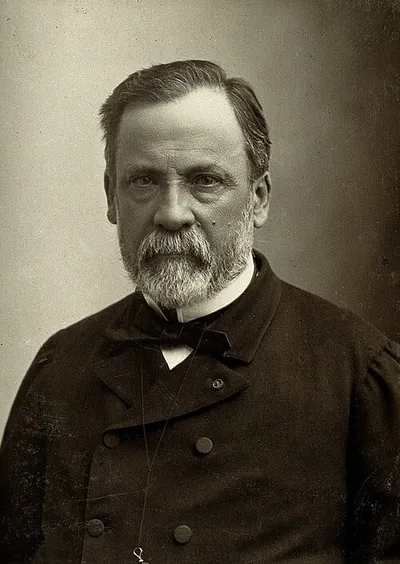 Louis Pasteur1822–1895 · Biology
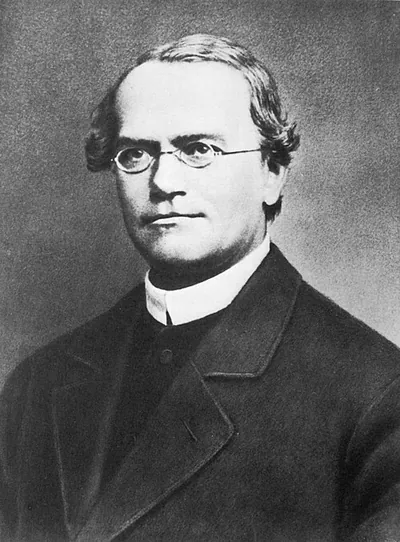 Gregor Mendel1822–1884 · Biology
 Robert Koch1843–1910 · Biology
 Camillo Golgi1843–1926 · Biology
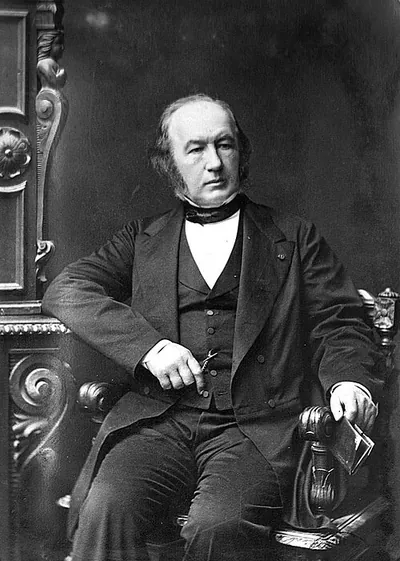 Claude Bernard1813–1878 · Biology
