
Ellen Churchill Semple
American geographer, pioneer of human geography and first female president of the Association of American Geographers · 1863–1932
- Born
- January 8, 1863
- Died
- May 8, 1932
- Country
- United States
- Section
- Earth sciences
Biography
Ellen Churchill Semple (Louisville, 1863 – West Palm Beach, 1932) was an American geographer who helped establish geography as an academic discipline in the United States. She was the first woman to lead the Association of American Geographers, serving from 1921 to 1922. Her name is linked to anthropogeography, the study of how human societies relate to their environment, and to the long debate over environmental determinism.
Born in Louisville, Kentucky, she was the youngest of five children of Alexander Bonner Semple and Emerine Price. Her mother guided her early education, supplemented by private tutors. She studied at Vassar College, graduating as the top student of her class, and became interested in geography after encountering the work of the German geographer Friedrich Ratzel while in London. She travelled to Leipzig to study with him. As a woman she was barred from enrolling, but she obtained permission to attend his lectures, becoming the only woman among about five hundred male students. She worked with him for years and published papers in American and European journals, although she never received a degree from that university.
Her academic career was uneven. She taught at the University of Chicago from 1906 to 1920 and lectured at Oxford in 1912 and 1922. Her first permanent academic post came in 1922 at Clark University, where she became the first female faculty member; her salary, however, remained markedly lower than that of her male colleagues. Her two books, American History and its Geographic Conditions (1903) and Influences of Geographic Environment (1911), were widely used as textbooks in American geography and history courses in the early twentieth century.
Her best-known idea holds that human activity is mainly shaped by the physical environment. Semple built it on the ideas of Darwin and Ratzel and made them accessible to English-speaking readers. Over time she qualified this position, and after the First World War environmental determinism lost its standing in the social sciences. Critics argue that her approach echoed the notion that racial differences were explained by nature, though some recent scholars have reexamined her work for anticipating debates now central to political ecology.
Between 1911 and 1912 she undertook an eighteen-month journey through Asia, the Middle East and Europe, spending three months in Japan thanks to her Vassar classmate Ōyama Sutematsu. She recorded housing, livelihoods and everyday customs, a practice unusual among geographers of her day. She died in Florida in 1932 and was buried in Louisville. Her legacy endures in modern human geography, and an elementary school in her hometown bears her name.
Main contributions
- 1903American History and its Geographic Conditions: a textbook on how the land shaped the history of the United States.
- 1911Influences of Geographic Environment: a work dividing the world into environmental types and analysing four ways the physical setting affects people.
- 1914Cullum Geographic Medal, awarded by the American Geographical Society for her contributions to anthropogeography.
- 1921First woman president of the Association of American Geographers, a post she held until 1922.
Trivia and anecdotes
An eighteen-month journey
Between 1911 and 1912 she travelled through Asia, the Middle East and parts of Europe, spending three months in Japan, an unusual kind of fieldwork for her time.
A student without a degree
She attended Ratzel's lectures in Leipzig as the only woman among about five hundred students, yet never earned a degree from the university.
Their contemporaries
While Ellen Churchill Semple was alive (1863–1932)…
Alive at the same time
Discovered or invented in those years
- 1869Periodic tableAn arrangement of the chemical elements into rows (periods) and columns (groups), ordered by atomic number, that reveals recurring chemical behaviour and lets scientists predict properties.
- 1869Deoxyribonucleic acidA double-stranded molecule that carries the genetic instructions of nearly all living things and many viruses.
- 1876TelephoneA device that carries the human voice over distance by turning sound into electrical signals and back into sound at the other end of the line.
- 1884CarA road vehicle with four wheels and its own engine, mainly built to carry people.
- 1903AirplaneA fixed-wing aircraft, heavier than air, powered by engines or rockets, that stays aloft because its wings generate lift.
- 1925TelevisionA system that sends moving pictures and sound over distance and shows them on a receiver, the television set.
 Vladimir Vernadsky1863–1945 · Earth sciences
 Vladimir A. Obruchev1863–1956 · Earth sciences
 Vilhelm Bjerknes1862–1951 · Earth sciences
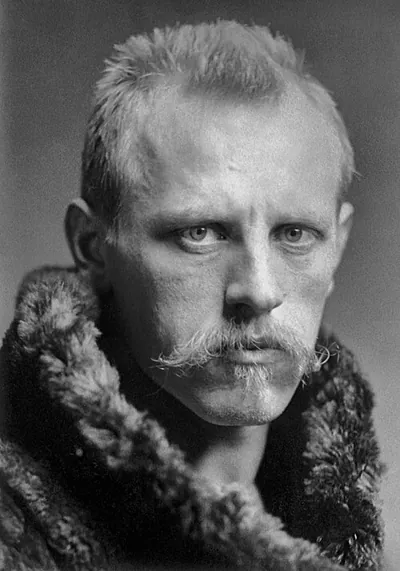 Fridtjof Nansen1861–1930 · Earth sciences
 Andrija Mohorovičić1857–1936 · Earth sciences
 Henry Fairfield Osborn1857–1935 · Earth sciences
