
Ernst Chladni
German physicist and musician, regarded as the founder of acoustics and a pioneer in the scientific study of meteorites · 1756–1827
- Born
- November 30, 1756
- Died
- April 3, 1827
- Country
- Kingdom of Prussia
- Section
- Physics
Biography
Ernst Florenz Friedrich Chladni (Wittenberg, 1756 – Breslau, 1827) was a German physicist and musician who worked in the late Enlightenment, when experimental physics was taking shape. He is remembered for two main contributions: his research on vibration and sound, which earned him the label father of acoustics, and his argument that meteorites come from outer space, an idea that many of his contemporaries found far-fetched.
Chladni came from a family of lawyers, theologians and university professors. His ancestors had left Kremnica, then in the Kingdom of Hungary and now in Slovakia, so he has been claimed as German, Hungarian and Slovak. His great-grandfather, a Lutheran clergyman, had fled the town in 1673 during the Counter-Reformation, and several relatives later held chairs at the University of Wittenberg. His father, a law professor and university rector, wanted him to become a lawyer and disapproved of his interest in science. An only child, Chladni studied law and philosophy in Wittenberg and Leipzig, earning a law degree at Leipzig in 1782.
That same year his father died, and Chladni turned to physics in earnest. From 1783 to 1792 he taught law, mathematics and natural sciences at Wittenberg, and it was there that he began his first acoustic experiments. His best-known achievement was a method for making the ways a rigid surface vibrates visible. A violin bow drawn along the edge of a metal plate dusted with sand makes the plate vibrate, and the sand gathers along the lines that stay still, called nodal lines, forming geometric patterns now known as Chladni figures. Robert Hooke had seen similar patterns on glass plates in 1680 and reported them to the Royal Society, but the work was not followed up. Chladni published his technique in 1787, and it became far better known.
His demonstrations brought him wide attention and took him on tours across Europe. In 1808 he showed his patterns at the Paris Academy of Sciences, before leading French scientists and Napoleon, who offered a prize for a mathematical explanation. Sophie Germain's entry, though rejected because of errors, was the only one that took the right approach. Chladni also loved musical instruments. Inspired by Benjamin Franklin's glass harmonica, he invented the euphon in 1791, a set of glass rods, and the clavicylinder in 1799. The euphon is the direct ancestor of the Cristal Baschet, which is still made today. In theory, he derived a simple algebraic rule, Chladni's law, for estimating the natural frequencies of vibrating plates and other bodies. He also estimated the speed of sound in various gases by filling an organ pipe with each one and listening to the tone it produced, building on measurements of the speed of sound in air that Pierre Gassendi had begun in 1635.
His interest in meteorites grew out of a conversation with Georg Christoph Lichtenberg about a fireball that Lichtenberg was said to have seen over Göttingen in November 1791. Chladni collected reports of similar events across Europe and North America over the previous century and concluded that falling masses of iron and stone were real. In 1794 he published the book in which he argued that meteorites were of extraterrestrial origin, perhaps material that never joined a larger body or debris from the formation and destruction of planets. This clashed with the common belief that such stones were volcanic, and with the idea that beyond the Moon there was nothing but stars and planets. Lichtenberg and other physicists ridiculed the book, but it stirred curiosity. In 1795 a stone fell in Yorkshire, England, and the chemist Edward Howard and the mineralogist Jacques de Bournon analysed it and judged a space origin likely. In 1803 the physicist Jean-Baptiste Biot was sent by the French government to investigate a meteor shower at L'Aigle, and his lively report persuaded many more people to take Chladni's ideas seriously.
For decades Chladni kept recording meteorite falls and built a collection of samples, which he donated in 1827 to the Mineralogical Museum of Berlin University; it is now held by the Museum of Natural History of Humboldt University. A mineral described in 1993 from an iron meteorite was named in his honour, and the lunar crater Chladni has borne his name since 1935. He died in Breslau, then in the Kingdom of Prussia and today Wrocław in Poland, on 3 April 1827. His legacy is twofold: he laid the foundations of experimental acoustics, and with his 1794 book he opened the way to modern meteorite research, a field some regard him as having founded, though others are more cautious about his role.
Main contributions
- 1787Chladni figures: a method for making the vibration modes of a plate visible by bowing it and using sand that marks its still lines.
- 1791Euphon: an instrument of glass rods, the direct ancestor of the Cristal Baschet.
- 1794Proposal that meteorites come from outer space, set out in his book on the Pallas iron and related phenomena.
- 1799Clavicylinder: a keyboard instrument with a rubbed glass cylinder, inspired by Hooke's older musical cylinder.
- 1802Chladni's law: a simple algebraic relation for approximating the natural frequencies of freely vibrating plates and other bodies.
- 1827Donation of his meteorite collection to the Mineralogical Museum of Berlin University.
Trivia and anecdotes
Mocked by colleagues
His meteorite book was first ridiculed by contemporary physicists, Lichtenberg among them, the very man whose report had sparked his interest.
A crater in his name
The lunar crater Chladni has been named after him since 1935.
Their contemporaries
While Ernst Chladni was alive (1756–1827)…
Alive at the same time
Discovered or invented in those years
- 1766HydrogenThe lightest and most abundant chemical element in the universe, atomic number 1, which under normal conditions is a colourless, odourless and highly flammable gas.
- 1772NitrogenChemical element with atomic number 7, a colourless, odourless gas that makes up about 78% of Earth's air and is an essential part of proteins and nucleic acids.
- 1774OxygenA colorless, odorless gas, symbol O and atomic number 8, that forms the dioxygen in air and is essential for respiration in most living things.
- 1781UranusThe seventh planet from the Sun, an ice giant discovered by William Herschel in 1781, the first planet found with a telescope.
- 1803AtomThe basic unit of a chemical element: a nucleus of protons and usually neutrons surrounded by a cloud of electrons.
- 1821ElectricityThe set of physical phenomena linked to the presence and movement of electric charge, and one of the most versatile forms of energy in modern life.
 Thomas Young1773–1829 · Physics
 André-Marie Ampère1775–1836 · Physics
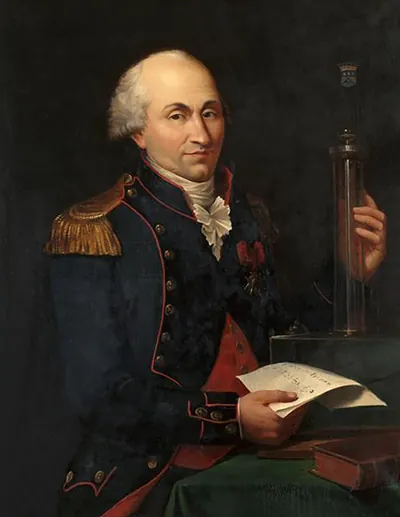 Charles-Augustin de Coulomb1736–1806 · Physics
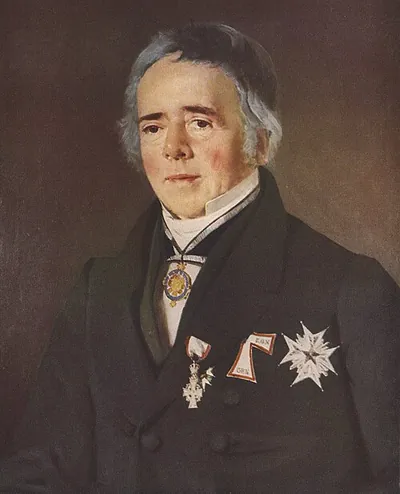 Hans Christian Ørsted1777–1851 · Physics
 Henry Cavendish1731–1810 · Physics
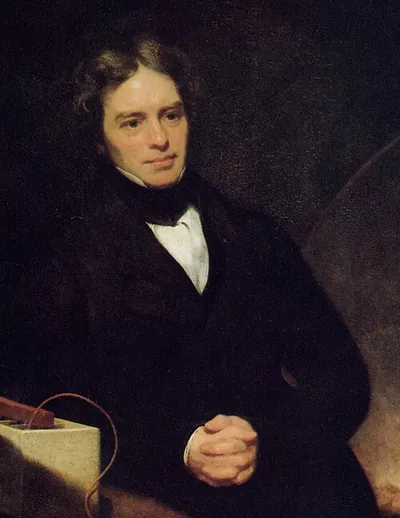 Michael Faraday1791–1867 · Physics
