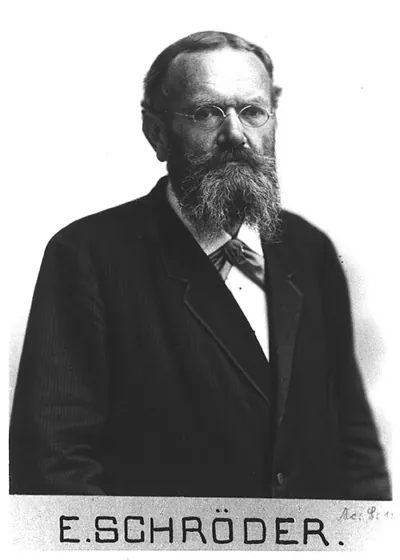
Ernst Schröder
German mathematician, a leading figure in algebraic logic and the history of mathematical logic · 1841–1902
- Born
- November 25, 1841
- Died
- June 16, 1902
- Country
- Grand Duchy of Baden
- Section
- Mathematics
Biography
Ernst Schröder (born Mannheim, 25 November 1841 – died Karlsruhe, 16 June 1902) was a German mathematician whose name is chiefly linked to algebraic logic, the branch of logic that expresses reasoning through symbols and operations resembling those of algebra. He is a major figure in the history of mathematical logic, a term he helped to establish, and his work formed a bridge between the logicians of the nineteenth century and the discipline as it took shape in the twentieth.
Schröder studied mathematics at Heidelberg, Königsberg and Zürich, where his teachers included Otto Hesse, Gustav Kirchhoff and Franz Neumann. After a few years of school teaching, he moved to the Technische Hochschule in Darmstadt in 1874, and two years later he took up a mathematics chair at the Karlsruhe Polytechnic, where he remained for the rest of his life. He never married.
Schröder's first work on algebra and logic was done before he had read the British logicians George Boole and Augustus De Morgan. His sources were instead German writers such as Ohm, Hankel and the brothers Hermann and Robert Grassmann, who worked on combinatorial algebra and algebraic analysis. In 1873 he studied Boole and De Morgan, and later he absorbed ideas from Charles Peirce, among them subsumption (the relation by which one concept falls under another) and quantification (the way of expressing phrases such as "all" or "some"). His contributions also reached into pure mathematics, including algebra, set theory, lattice theory, the theory of order and ordinal numbers.
In 1898 Schröder, together with Georg Cantor, co-discovered the Cantor–Bernstein–Schröder theorem, which gives a condition under which two sets can be said to have the same size. The proof Schröder published contained a flaw, which Felix Bernstein later corrected in his doctoral dissertation. In 1877 he wrote a concise account of Boole's ideas on algebra and logic that did much to make Boole's work known to readers on the European continent. Unlike Boole, Schröder fully appreciated duality, the principle that pairs each statement in a theory with another obtained by swapping certain operations. John Venn and Christine Ladd-Franklin both cited this short book with approval, and Peirce used it as a teaching text at Johns Hopkins University.
His masterwork, the Lectures on the Algebra of Logic, appeared in three volumes between 1890 and 1905, paid for by the author himself. The second volume has two parts, and the second was published posthumously, edited by Eugen Müller. It is a comprehensive and scholarly survey of algebraic logic at the close of the nineteenth century, in which Schröder extended Boole's algebra into a calculus of relations, treating the composition of relations as a kind of multiplication. The style is elaborate, and only a small part has been translated into English.
Schröder's influence was felt first in the predicate calculus, the system that handles quantification, largely because he spread Peirce's work on the subject. Historians regard his impact as at least as great as that of Frege or Peano. The relational concepts that run through Whitehead and Russell's Principia Mathematica owe much to the Lectures, which the authors cite directly. For much of the twentieth century, however, histories of logic tended to celebrate Frege and play down Schröder, an imbalance that later writers, such as Hilary Putnam, have sought to correct.
Main contributions
- 1877A concise exposition of Boole's ideas on algebra and logic, which helped introduce Boole's work to continental European readers.
- 1890Lectures on the Algebra of Logic, a three-volume treatise (1890–1905) systematizing algebraic logic of its time.
- 1898Co-discovery, with Georg Cantor, of the Cantor–Bernstein–Schröder theorem on when two sets have the same size.
Teachers and students
Their contemporaries
While Ernst Schröder was alive (1841–1902)…
Alive at the same time
Discovered or invented in those years
- 1846NeptuneThe eighth and most distant planet of the Solar System, an ice giant found through mathematical prediction before any direct sighting.
- 1859EvolutionThe process by which the heritable traits of living populations change over generations, explaining the diversity of life from common ancestors.
- 1869Periodic tableAn arrangement of the chemical elements into rows (periods) and columns (groups), ordered by atomic number, that reveals recurring chemical behaviour and lets scientists predict properties.
- 1869Deoxyribonucleic acidA double-stranded molecule that carries the genetic instructions of nearly all living things and many viruses.
- 1876TelephoneA device that carries the human voice over distance by turning sound into electrical signals and back into sound at the other end of the line.
- 1884CarA road vehicle with four wheels and its own engine, mainly built to carry people.
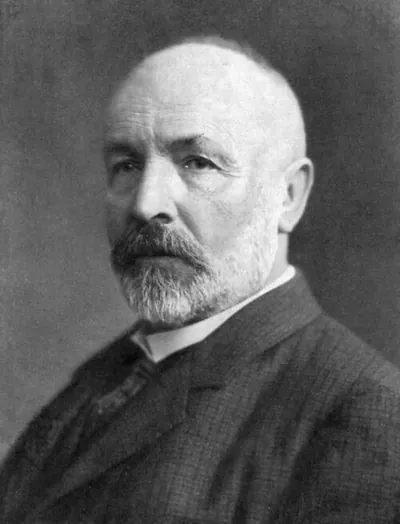 Georg Cantor1845–1918 · Mathematics
 Felix Klein1849–1925 · Mathematics
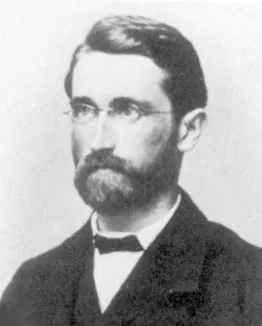 Richard Dedekind1831–1916 · Mathematics
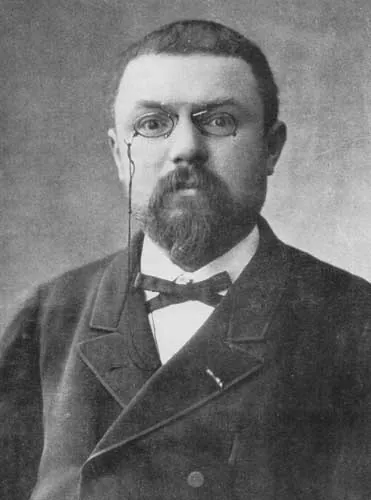 Henri Poincaré1854–1912 · Mathematics
 Bernhard Riemann1826–1866 · Mathematics
 Giuseppe Peano1858–1932 · Mathematics
