
Frank Shuman
American engineer and inventor, pioneer of solar thermal energy · 1862–1918
- Born
- January 23, 1862
- Died
- April 28, 1918
- Country
- United States
- Section
- Energy
Biography
Frank Shuman (Brooklyn, 1862 - Tacony, Philadelphia, 1918) was an American engineer and inventor who spent much of his career trying to harness sunlight to drive steam engines. He lived in the years when coal was king and oil was beginning to challenge it, and he is remembered for building, in the early twentieth century, one of the first solar thermal power plants.
Born in Brooklyn, he left university at 18 to work as a chemist at a dye factory in West Virginia. In 1891 he moved to Philadelphia to join his uncle, Frank Schumann, who ran a metalworking firm and asked him to find a way to coat the statue of William Penn on top of City Hall with a protective layer of aluminium.
His first patents concerned glass. In 1892 he registered wired glass, sheets with a metal mesh inside that kept them from shattering into sharp shards. In 1914 he developed laminated safety glass, made of layers bonded together. In 1916 he patented a danger signal for railway crossings and suggested that liquid oxygen or liquid air could power a submarine.
His solar interest took concrete form in 1897, when he built an engine that focused sunlight with mirrors onto boxes filled with ether, a liquid that boils at a lower temperature than water. The vapour it produced drove a small toy steam engine that ran for more than two years on sunny days beside a pond at his house. It proved the principle, but ether was no use on a large scale.
In 1908 he founded the Sun Shine Power Company to build bigger plants. Working with his technical adviser A.S.E. Ackermann and the British physicist Charles Vernon Boys, he improved the collectors so they could heat water instead of ether. He also designed a low-pressure turbine, since the engines of the day were made for steam rather than for water warmed by the sun. The complete system was patented in 1912.
Between 1912 and 1913 he built a plant at Maadi, near Cairo, with semicircular troughs that concentrated sunlight onto black pipes. The heat drove a 60 to 70 horsepower engine that pumped about 6,000 gallons of water a minute from the Nile onto cotton fields. World War I destroyed the installation and it was never rebuilt, and cheap oil later dampened interest in solar power until the 1970s.
He died at home in Tacony in 1918. His house and laboratories still stand, now converted into an apartment building and garages, and since October 2019 they have been listed on the historic register, so they cannot be demolished or significantly altered without permission. His legacy combines safety glass with an early argument for solar energy.
Main contributions
- 1892Wired glass: safety glass with an internal metal mesh that keeps it from shattering into shards.
- 1897Ether solar engine: mirrors focus sunlight onto boxes of ether, whose vapour drives a toy steam engine.
- 1912Low-pressure solar steam system: collectors that heat water and a turbine built for it, patented as a whole.
- 1913Maadi plant: one of the first large solar thermal installations, with trough collectors that pumped Nile water.
- 1914Laminated safety glass: layers of glass bonded around an interlayer that holds the fragments together.
- 1916Railway danger signal: a warning device for level crossings, patented by Shuman.
Trivia and anecdotes
A toy engine powered by the sun
The small 1897 steam engine ran for over two years on sunny days beside the pond at his house.
An artwork about his project
At the Cairo Biennial of 2008-09, the Swiss artists Christina Hemauer and Roman Keller rebuilt two segments of his solar engines for the piece No1 Sun Engine.
Related discoveries and inventions
- —Solar thermal energyUsing sunlight to produce heat for cooking, water and building heating, cooling, drying or electricity generation.
Their contemporaries
While Frank Shuman was alive (1862–1918)…
Alive at the same time
Discovered or invented in those years
- 1869Periodic tableAn arrangement of the chemical elements into rows (periods) and columns (groups), ordered by atomic number, that reveals recurring chemical behaviour and lets scientists predict properties.
- 1869Deoxyribonucleic acidA double-stranded molecule that carries the genetic instructions of nearly all living things and many viruses.
- 1876TelephoneA device that carries the human voice over distance by turning sound into electrical signals and back into sound at the other end of the line.
- 1884CarA road vehicle with four wheels and its own engine, mainly built to carry people.
- 1897ElectronA negatively charged subatomic particle found in every atom, and key to electricity and chemical bonding.
- 1903AirplaneA fixed-wing aircraft, heavier than air, powered by engines or rockets, that stays aloft because its wings generate lift.
 Charles Proteus Steinmetz1865–1923 · Energy
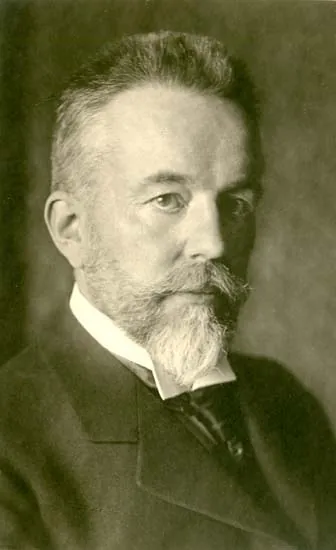 Aurel Stodola1859–1942 · Energy
 Rudolf Diesel1858–1913 · Energy
 Mihajlo Pupin1858–1935 · Energy
 William Stanley1858–1916 · Energy
 Nikola Tesla1856–1943 · Energy
