
Frederick W. Lanchester
British engineer and polymath, a pioneer of the motor car and of aerodynamics, and co-founder of operations research · 1868–1946
- Born
- October 23, 1868
- Died
- March 8, 1946
- Country
- United Kingdom, United Kingdom of Great Britain and Ireland
- Section
- Transport
Biography
Frederick William Lanchester (London, 1868 – Birmingham, 1946) was a British engineer and polymath whose work ranged across automotive engineering, aerodynamics and operations research, a field he helped to create. He lived through the turn from the nineteenth to the twentieth century, when the motor car was moving from a curiosity for a few people to a major industry. He matters because, alongside Harry Ricardo and Henry Royce, he is usually counted as one of the three founders of the British motor industry.
He was the son of Henry Jones Lanchester, an architect, and Octavia, a teacher. He was the fourth of eight children, and two of his brothers, George and Frank, later worked with him in his companies. When he was a year old the family moved to Brighton. He attended a boarding school where he did not stand out, and he later joked that it seemed Nature was conserving his energy. He won a scholarship to the Hartley Institution in Southampton and, after three years, another to Kensington College, now part of Imperial College. He added evening classes at the Finsbury Technical School, but he left without any formal qualification. In 1888 he took a post at the Patent Office as a draughtsman, earning three pounds a week, and he registered his first patent, an isometrograph, an instrument for drawing hatching and shading.
Late that year he joined the Forward Gas Engine Company in Birmingham as assistant works manager. His contract said that any technical improvement he made would belong to the firm, but he had that clause struck out before signing. In 1889 he invented a pendulum governor, a device that kept an engine's speed steady, and he received a royalty of ten shillings for each one fitted to a Forward engine. In 1890 he patented a pendulum accelerometer, which measured the acceleration and braking of road and rail vehicles. After his superior died he was promoted, and he designed a larger and more powerful gas engine with horizontal opposed valves. It was economical to run, though it delivered modest power. That same year he sold the rights to a starting device to the Crossley Gas Engine Company. In a rented workshop he built a single-cylinder engine of about 3 horsepower that drove a dynamo to light the office. In 1893 he handed his post to his brother George, weary of the clash between his job and his own research.
Around then he developed an engine running on benzene and a wick carburettor, in which fuel was drawn into a set of wicks and evaporated into the air stream. He patented this in 1905. He fitted the engine to a flat-bottomed launch driven by a stern paddle wheel, which he built in the garden of his home at Olton. In 1904 it was launched on Salter's slipway in Oxford, and it is generally regarded as the first motorboat built in Britain. The next logical step was road transport. He designed a four-wheeled vehicle powered by a twin-crankshaft engine, with the two cranks turning in opposite directions to reduce vibration, and air-cooled through vanes on the flywheel. Its epicyclic gearbox, a type of planetary gear set, gave two forward speeds and reverse, and drove the rear wheels by chain. The car was finished in 1895 and first ran in 1896, but the trials were disappointing because it lacked power and its transmission gave trouble. He then built a 8-horsepower horizontally opposed twin and redesigned the transmission. To finance his research he sold his house.
From 1892 he also studied aeronautics. He watched gulls gliding on air currents and measured birds to find where their centre of gravity sat relative to their centre of lift. From this he built a theory of flight based on the circulation of air around a wing, which led to the theory of aerofoil profiles. He tested it on models in 1894 and in 1897 read a paper to the Physical Society. It was rejected, since it ran ahead of what the technology could do. He realised that flight would need engines far more powerful for their weight, and for the next decade he concentrated on cars.
His second car, with a cantilever suspension of his own design, won a gold medal for design and performance at Richmond in 1898, and became known as the Gold Medal Phaeton. In December 1899 he and his brothers formed the Lanchester Engine Company, based in the Armourer Works at Sparkbrook, Birmingham. There he designed a ten-horsepower twin and patented a machine for cutting the worm gears of the transmission, which the company used for twenty-five years. He also introduced splined shafts in place of keys. His car put the engine between the front seats and used a braking system working on the clutch, an early form of disc brake that he patented in 1902. Lanchester became a friend of Rudyard Kipling, to whom he sent test models. The company sold about 350 cars but went bankrupt in 1904 because of failures by its board. Lanchester resigned in 1910, tired of the new management, and became a part-time technical consultant.
In 1907 he published Aerial Flight in two volumes, with a model of the vortices shed behind a wing and the first physical description of lift and drag. That year he also patented a torsional vibration damper for the crankshaft, although Henry Royce had earlier tackled the same problem. He was elected a Fellow of the Royal Society in 1922, and in 1925 he founded a company for industrial research, though the Great Depression undermined it. His health declined in the 1930s, and he was eventually diagnosed with Parkinson's disease. He spent his last years in straitened circumstances and died at his home, Dyott End, in 1946. His legacy lies in wing theory, in the crankshaft damper and transmission ideas, and in his place as one of the founders of the British motor industry.
Main contributions
- 1889Pendulum governor: a device that keeps an engine's rotation speed steady.
- 1890Pendulum accelerometer: an instrument that measures the acceleration and braking of vehicles.
- 1895Lanchester's first four-wheeled car, with a twin-crankshaft engine and an epicyclic gearbox.
- 1897Circulation theory of lift, presented to the Physical Society, which led to aerofoil theory.
- 1902Patented disc brake that worked on the car's clutch.
- 1905Wick carburettor, in which fuel evaporated from wicks before mixing with air.
- 1907Torsional crankshaft damper, and the book Aerial Flight, with the first physical description of lift and drag.
Trivia and anecdotes
A clause struck out
Before signing his first job, Lanchester had the clause giving the firm all his technical improvements removed.
A poet under a pseudonym
Besides being an engineer, he published two volumes of poetry under the pseudonym Paul Netherton-Herries.
Cars for Kipling
His friendship with the writer Rudyard Kipling led him to send experimental car models for him to test.
Their contemporaries
While Frederick W. Lanchester was alive (1868–1946)…
Alive at the same time
Discovered or invented in those years
- 1869Periodic tableAn arrangement of the chemical elements into rows (periods) and columns (groups), ordered by atomic number, that reveals recurring chemical behaviour and lets scientists predict properties.
- 1876TelephoneA device that carries the human voice over distance by turning sound into electrical signals and back into sound at the other end of the line.
- 1884CarA road vehicle with four wheels and its own engine, mainly built to carry people.
- 1903AirplaneA fixed-wing aircraft, heavier than air, powered by engines or rockets, that stays aloft because its wings generate lift.
- 1925TelevisionA system that sends moving pictures and sound over distance and shows them on a receiver, the television set.
- 1945ComputerA programmable machine that takes in data, processes it by following stored instructions, and produces results, able to switch tasks simply by running different software.
 Wilbur Wright1867–1912 · Transport
 Orville Wright1871–1948 · Transport
 Louis Blériot1872–1936 · Transport
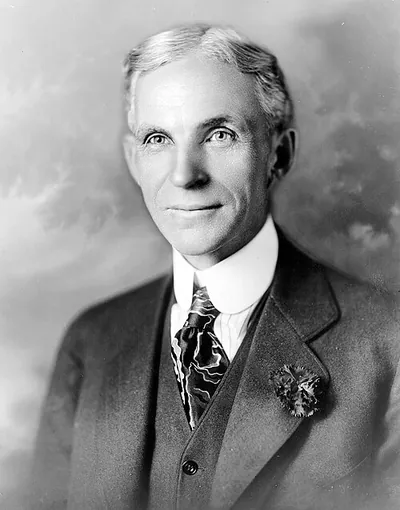 Henry Ford1863–1947 · Transport
 Alberto Santos-Dumont1873–1932 · Transport
 Henry Royce1863–1933 · Transport
