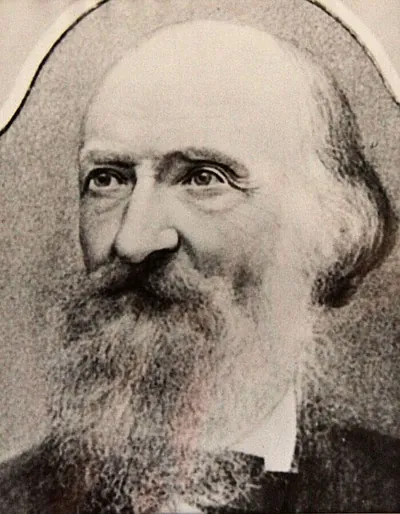
Fritz Müller
German naturalist and biologist who emigrated to Brazil and became one of Darwin's early supporters · 1822–1897
- Born
- March 31, 1822
- Died
- May 21, 1897
- Country
- Brazil, Kingdom of Prussia
- Section
- Biology
Biography
Johann Friedrich Theodor Müller, known as Fritz Müller, was a German naturalist and biologist who spent most of his working life in southern Brazil. There he studied the natural history of the Atlantic forest and became one of the earliest advocates of Darwin's ideas outside Britain. His work combined close observation of insects, plants and crustaceans with the central question of his age: how living things change over time. Sources differ on his year of birth, 1821 or 1822; this entry uses 1822, the date given in the reference record.
He was born in the village of Windischholzhausen, near Erfurt in Thuringia, the son of a clergyman. He studied at the universities of Berlin, where he earned a degree in botany, and Greifswald, where he completed a doctorate in biology. He then chose to study medicine. During these studies he began to question religion, and in 1846 he declared himself an atheist and joined the Free Congregations, secular groups that also supported free love. He never graduated, because he refused to swear the final oath, which contained the words so help me God and his sacred Gospel.
The failure of the Prussian Revolution of 1848 alarmed him, both for his safety and for his career. In 1852 he emigrated to Brazil with his brother August and their wives, to join the colony that Hermann Blumenau was founding in the state of Santa Catarina. There he worked as a farmer, doctor, teacher and naturalist. He studied the subtropical Atlantic forest around the valley of the Itajaí River. He won an official teaching post and spent a decade teaching mathematics at a college in Desterro, today Florianópolis. When the Jesuits took over the college, he returned to the Itajaí valley, where for nine years he carried out botanical research and advised farmers. In 1876 he was appointed travelling naturalist to the National Museum in Rio de Janeiro. Many naturalists worked in South America in the nineteenth century, but he was the only one who settled in Brazil for the rest of his life.
He published more than seventy papers in English, Portuguese and German on entomology, marine biology and botany. His best-known finding is Müllerian mimicry. This is the resemblance between two or more unpleasant species that predators can learn to avoid, so that a bird which learns to leave one of them alone learns to leave all of them alone. The butterflies he studied had bright colours that advertised their bad taste, a pattern biologists call aposematic or warning coloration. Müller and other naturalists argued that such resemblance could only arise through natural selection. He also showed that small bodies at the base of the leaf stalks of the Cecropia tree serve as food for Azteca ants, which in return live in the hollow stems and defend the tree.
His botanical work was fuelled by Darwin's books. After The Fertilisation of Orchids appeared in 1862, he spent years studying orchids and sent his observations to his brother Hermann and to Darwin, who used some of them in the second edition of 1877. In 1867 he wrote Darwin a letter listing forty genera of climbing plants, classified by the way they climb. His major defence of evolution was Für Darwin, published in 1864. In it he argued that natural selection was the correct explanation for evolution, and that Brazilian crustaceans and their larvae could be shaped by adaptations at any stage of growth. Darwin had the book translated privately for his own use, and in 1869 W. S. Dallas published an English edition with extra material by Müller.
His most influential contribution was evolutionary embryology, which seeks to reconstruct kinship between groups of animals by studying how their embryos develop. He compared the embryonic stages of crustaceans and proposed that a larva called the nauplius was the common starting point for the whole group. He also argued that natural selection acted on larvae as well as adults, so embryonic development could not be an exact replay of the species' history. Ernst Haeckel later organised and systematised these ideas in his General Morphology, where he presented the so-called recapitulation theory, although Müller had already set out the essentials. According to the historian Gilbert, his work also contains the seeds of later ideas such as canalisation, developmental constraints and punctuated equilibrium. In 1880 he proposed a threefold parallel between ontogeny, the development of an individual, phylogeny, the evolutionary history of a species, and regeneration.
Müller died in 1897. A statue of him was erected in Blumenau in 1929. Müllerian mimicry carries his name, and his correspondence with Darwin, Alexander Agassiz, Ernst Krause and Haeckel shows how active he remained in the evolutionary debate from a remote corner of South America.
Main contributions
- 1864Für Darwin: a book defending evolution by natural selection with evidence drawn from the embryonic development of crustaceans.
- 1867Classification of climbing plants: a letter to Darwin listing forty genera sorted by their method of climbing.
- 1880Threefold parallel: a proposed link between ontogeny, phylogeny and regeneration.
- Evolutionary embryology: the study of embryonic development to reconstruct relationships between animal groups, with the nauplius larva as the common origin of crustaceans.
- Müllerian mimicry: resemblance between unpalatable species that protects them jointly, because predators learn to recognise the shared warning pattern.
- Müllerian bodies: small structures on the Cecropia tree that feed Azteca ants, which in return defend the plant.
Trivia and anecdotes
A degree he never received
He refused to swear the final graduation oath, which mentioned God and the Gospel, and so he never received his medical degree.
A private translation
Darwin had Für Darwin translated privately for his own use, before the English edition appeared in 1869.
A statue in Blumenau
In 1929 a statue was raised in his honour in Blumenau, the town where he spent much of his life in Brazil.
Their contemporaries
While Fritz Müller was alive (1822–1897)…
Alive at the same time
Discovered or invented in those years
- 1846NeptuneThe eighth and most distant planet of the Solar System, an ice giant found through mathematical prediction before any direct sighting.
- 1859EvolutionThe process by which the heritable traits of living populations change over generations, explaining the diversity of life from common ancestors.
- 1869Periodic tableAn arrangement of the chemical elements into rows (periods) and columns (groups), ordered by atomic number, that reveals recurring chemical behaviour and lets scientists predict properties.
- 1869Deoxyribonucleic acidA double-stranded molecule that carries the genetic instructions of nearly all living things and many viruses.
- 1876TelephoneA device that carries the human voice over distance by turning sound into electrical signals and back into sound at the other end of the line.
- 1884CarA road vehicle with four wheels and its own engine, mainly built to carry people.
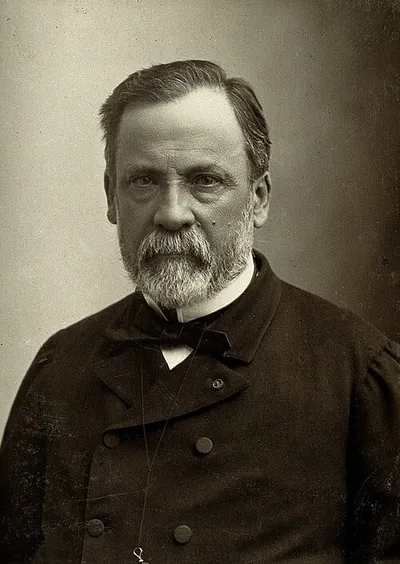 Louis Pasteur1822–1895 · Biology
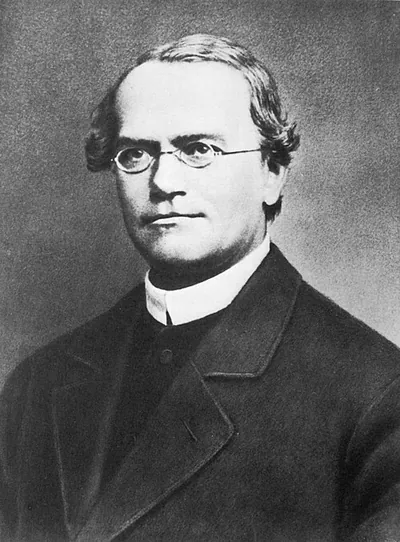 Gregor Mendel1822–1884 · Biology
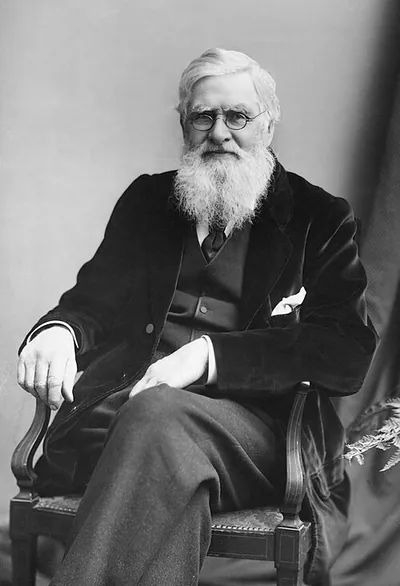 Alfred Russel Wallace1823–1913 · Biology
 Claude Bernard1813–1878 · Biology
 Theodor Schwann1810–1882 · Biology
 Charles Darwin1809–1882 · Biology
