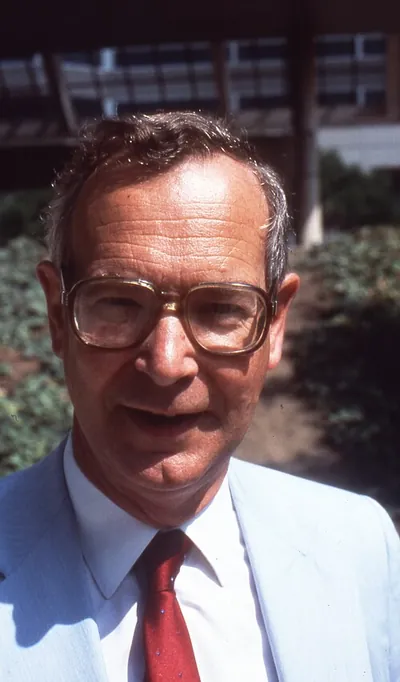
Gustav Andreas Tammann
Swiss astronomer of German birth, specialist in galaxies, supernovae and the expansion of the universe · 1932–2019
- Born
- July 24, 1932
- Died
- January 6, 2019
- Country
- Germany
- Section
- Astronomy and space
Biography
Gustav Andreas Tammann was a Swiss astronomer of German birth, born in Göttingen on 24 July 1932 and died on 6 January 2019. He directed the Astronomical Institute of the University of Basel for much of his career. His work focused on measuring the distances to galaxies and the speed at which the universe is expanding, two central questions of modern cosmology.
He was the grandson of the physical chemist Gustav Tammann, and the family name became linked with astronomy in Basel. He studied astronomy in Basel, Switzerland, and in Göttingen, Germany, where he had been born. His training drew him early toward the objects that let astronomers measure distances across the cosmos, a field that was advancing quickly thanks to large telescopes.
In 1963 he began a long working partnership with Allan Sandage, an American astronomer based at the Mount Wilson and Palomar observatories in California. Together they studied the Hubble constant, a number that describes how fast galaxies recede in relation to their distance. Measuring that value requires knowing how far away galaxies really are, and that is where the difficulty lies.
To tackle it, Tammann relied on supernovae, stellar explosions that can briefly outshine an entire galaxy. Some of them behave as what astronomers call standard candles, objects whose true brightness is known or can be calculated. By comparing that true brightness with how bright they look from Earth, it is possible to work out the distance, much as you can judge how far away a lamp of known power is by how dim it looks.
His academic career moved forward alongside his research. In 1972 he became a professor at the University of Hamburg, and from 1977 until his retirement he was a professor and head of the Astronomical Institute in Basel. He served on the Space Telescope Advisory Team of the European Space Agency and on the Council of the European Southern Observatory, and he chaired the International Astronomical Union commission on galaxies, from which he helped steer scientific debate on these systems.
His contributions were recognised by several institutions. In 1991 he became a full member of the Academia Europaea, and in 1993 a corresponding member of the Heidelberg Academy of Sciences and Humanities. In 2000 he received the Albert Einstein Medal, awarded for work related to Einstein, and the Tomalla Prize, for his efforts in measuring the expansion rate of the universe and especially for his pioneering use of supernovae. In 2005 he was awarded the Karl Schwarzschild Medal. He also wrote for general readers, including a 1985 book about Halley's Comet.
His legacy lies mainly in method. Using supernovae as distance markers and debating the value of the Hubble constant remain part of the work of cosmologists. An asteroid, 18872 Tammann, carries his name in tribute to his career.
Main contributions
- 1963Partnership with Allan Sandage: start of a long joint study of galaxy distances and motion, carried out at observatories in California.
- 1985Book on Halley's Comet, a popular work about this celestial body.
- 2000Tomalla Prize for measuring the expansion rate of the universe using supernovae, work regarded as pioneering.
- Study of the Hubble constant: a figure linking how fast galaxies recede to how far away they are, which measures the expansion of the universe.
- Use of supernovae as standard candles: using stellar explosions of known brightness to calculate cosmic distances.
Trivia and anecdotes
A family of scientists
He was the grandson of the physical chemist Gustav Tammann, linking him to a scientific tradition within his own family.
An asteroid bearing his name
The asteroid 18872 Tammann commemorates his contribution to astronomy.
Their contemporaries
While Gustav Andreas Tammann was alive (1932–2019)…
Alive at the same time
Discovered or invented in those years
- 1932NeutronA subatomic particle with no net electric charge, found in the nucleus of almost every atom alongside protons.
- 1945ComputerA programmable machine that takes in data, processes it by following stored instructions, and produces results, able to switch tasks simply by running different software.
- 1969InternetA global network of interconnected computer networks that communicate using the TCP/IP protocol suite.
- 1971EmailA network service that lets users send and receive digital messages through addressed mailboxes, much like postal mail but electronic.
- 1973Mobile phoneA handheld wireless phone that lets people make and receive calls while moving across a cellular network area.
- 1989World Wide WebA system of linked documents and resources, connected by hyperlinks and accessed over the Internet with web browsers.
 Arno Allan Penzias1933–2024 · Astronomy and space
 Riccardo Giacconi1931–2018 · Astronomy and space
 Yuri Gagarin1934–1968 · Astronomy and space
 Neil Armstrong1930–2012 · Astronomy and space
 Carl Sagan1934–1996 · Astronomy and space
 Frank Drake1930–2022 · Astronomy and space
