
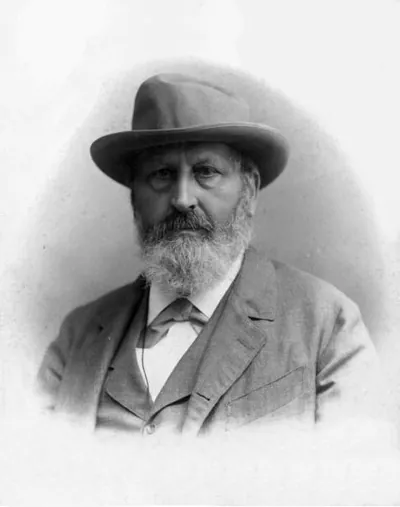
Henrik Mohn
Norwegian meteorologist and astronomer who helped establish meteorological research in Norway · 1835–1916
- Born
- May 15, 1835
- Died
- September 12, 1916
- Country
- Norway
- Section
- Earth sciences
Biography
Henrik Mohn (15 May 1835 – 12 September 1916) was a Norwegian astronomer and meteorologist who laid the foundations of systematic weather research in his country. As a university professor and long-serving director of the Norwegian Meteorological Institute, he helped turn the study of weather into a discipline built on physical and mathematical methods, and his name remains linked to the history of polar exploration.
Mohn was born in Bergen to Albert Henrik Mohn and Ida Neumann, and his family had close ties to the Church: his maternal grandfather was a bishop. He finished school at Bergen Cathedral School in 1852 and enrolled at the Royal Frederick University in Christiania, now Oslo. He first studied theology, but switched to physics after attending lectures on the subject. He went on to astronomy and mineralogy, graduating in the latter in 1858. To help his own learning he built a telescope himself, a sign of his hands-on approach.
In 1860 he was hired as a research fellow in astronomy, having written a well-regarded paper on the orbits of comets that same year. In 1861, when the long-serving professor Christopher Hansteen retired from active teaching, Mohn took over the city astronomical observatory. In that post his interest in the weather grew. His first article on the subject, a study of storms in Christiania between 1837 and 1863, appeared in 1863 in the journal Polyteknisk Tidsskrift, which he had edited from 1859 to 1862.
He helped found the Norwegian Meteorological Institute in 1866 and led it from the very beginning until 1913, while also serving as a professor at the university. His book Om Vind og Veir. Meteorologiens Hovedresultater, published in 1872, was translated into seven languages and became an international reference. His major work, Études sur les mouvements de l'atmosphère, was written between 1876 and 1880 with the mathematician Cato Maximilian Guldberg. The two men used hydrodynamics, the study of how fluids move, and thermodynamics, the science of heat and energy, to describe and explain weather phenomena through physical laws.
Mohn also supported polar exploration. He took part in the North Sea Expedition from 1876 to 1878 and supplied meteorological equipment for several Arctic expeditions. He developed a theory of polar drift, the slow movement of sea ice carried by currents, which the explorer Fridtjof Nansen used during the Fram Expedition of 1893 to 1896, when he tried to reach the North Pole. Nansen later named the Mohn Islands, an archipelago in the Kara Sea, in his honour.
His personal life included two marriages. In 1863 he married Louise Nicoline Rieck, who died later, and in 1871 he married Julie Birgitte Dyblie. He also kept up a childhood interest in amateur painting. One of his paintings of the island of Jan Mayen was later used for a Norwegian stamp issued in 1957.
In his later years he published annual climate tables, and after his retirement in 1913 he produced a study of the meteorological observations from the Amundsen South Pole Expedition in 1915. He had been a member of the Norwegian Academy of Science and Letters since 1861 and of the Royal Norwegian Society of Sciences and Letters since 1870, and he received the Commander First Class of the Order of St. Olav in 1915. He died in Oslo in 1916. His legacy lives on in Norwegian meteorology, in Arctic mapping and in the Mohn Prize for Arctic research, awarded every two years in his honour.
Main contributions
- 1863His first meteorological article, on storms in Christiania between 1837 and 1863.
- 1866Founding of the Norwegian Meteorological Institute, which he directed from the start.
- 1872Om Vind og Veir: a book summarising the main results of meteorology at the time, translated into seven languages.
- 1880Études sur les mouvements de l'atmosphère, written with Cato Guldberg, which explains weather using hydrodynamics and thermodynamics.
- 1893Polar drift theory, used by Fridtjof Nansen on the Fram Expedition to describe how Arctic sea ice moves.
- 1915A study of the meteorological observations from the Amundsen South Pole Expedition.
Trivia and anecdotes
A painting on a stamp
One of his paintings of Jan Mayen was used for a Norwegian stamp issued in 1957.
A telescope of his own
He built his own telescope to help him learn astronomy while still a student.
Their contemporaries
While Henrik Mohn was alive (1835–1916)…
Alive at the same time
Discovered or invented in those years
- 1846NeptuneThe eighth and most distant planet of the Solar System, an ice giant found through mathematical prediction before any direct sighting.
- 1859EvolutionThe process by which the heritable traits of living populations change over generations, explaining the diversity of life from common ancestors.
- 1869Periodic tableAn arrangement of the chemical elements into rows (periods) and columns (groups), ordered by atomic number, that reveals recurring chemical behaviour and lets scientists predict properties.
- 1876TelephoneA device that carries the human voice over distance by turning sound into electrical signals and back into sound at the other end of the line.
- 1884CarA road vehicle with four wheels and its own engine, mainly built to carry people.
- 1903AirplaneA fixed-wing aircraft, heavier than air, powered by engines or rockets, that stays aloft because its wings generate lift.
 Ferdinand von Richthofen1833–1905 · Earth sciences
 Adolf Erik Nordenskiöld1832–1901 · Earth sciences
 Eduard Suess1831–1914 · Earth sciences
 Paul Vidal de La Blache1845–1918 · Earth sciences
 Wladimir Köppen1846–1940 · Earth sciences
 William Morris Davis1850–1934 · Earth sciences
