
Hugo Schiff
German-born chemist who discovered Schiff bases and developed the Schiff test for aldehydes · 1834–1915
- Born
- April 26, 1834
- Died
- September 8, 1915
- Country
- Kingdom of Prussia, Kingdom of Italy
- Section
- Chemistry
Biography
Hugo Schiff (Frankfurt am Main, 1834 - Florence, 1915) was a German-born chemist who spent most of his career in Italy. He lived in the second half of the nineteenth century, when organic chemistry, the study of carbon-based compounds, was taking shape, and his name is attached to reactions and compounds that still appear in laboratory manuals.
He came from a Jewish merchant family, and his brother Moritz later became a physiologist. Schiff studied in Göttingen under Friedrich Wöhler, one of the most influential chemists of his day, and completed his doctorate in 1857 with a thesis on naphthyl and phenyl derivatives, compounds related to aromatic hydrocarbons. That same year, political unrest in Germany led him to move to Switzerland and the University of Bern. He supported socialism and reportedly corresponded with Karl Marx and Friedrich Engels. He is also said to have co-founded the Italian socialist newspaper L'Avanti in 1894.
In 1863 he settled in Italy, taking positions in Pisa and at the Natural History Museum in Florence. In 1870 he co-founded, with Stanislao Cannizzaro, the journal Gazzetta Chimica Italiana, a forum for chemical research in the country. In 1877 he became a professor of general chemistry in Turin, and in 1879 he returned to Florence as a professor at what would later become the University of Florence, where he founded its Chemical Institute.
His work focused on aldehydes, compounds containing a carbonyl group, meaning a carbon atom joined by a double bond to an oxygen atom. He discovered Schiff bases, also called imines, which form when an amine reacts with an aldehyde or a ketone and water is released. He also devised a colour reaction for detecting aldehydes, known as the Schiff test. His research extended to amino acids, the building blocks of proteins, and he is credited with the Biuret reagent, used to detect proteins.
Schiff died in Florence in 1915. His legacy lives on in the Schiff test and Schiff bases, which remain in use in organic chemistry, and in the University of Florence, which still honours him with a facility bearing his name.
Main contributions
- 1870Gazzetta Chimica Italiana: a scientific journal co-founded with Stanislao Cannizzaro.
- 1876Introduction to the Study of Chemistry: a lecture series published in Italian and German.
- Schiff bases (imines): compounds formed when an amine reacts with an aldehyde or ketone, releasing water.
- Schiff test: a colour reaction used to detect aldehydes.
- Biuret reagent: a reagent linked to his work, used to detect proteins.
Teachers and students
Trivia and anecdotes
Correspondence with Marx and Engels
He reportedly corresponded with Karl Marx and Friedrich Engels because of his socialist views, though this is not fully confirmed.
A physiologist brother
He was the brother of the physiologist Moritz Schiff, in a family of Jewish merchants.
Their contemporaries
While Hugo Schiff was alive (1834–1915)…
Alive at the same time
Discovered or invented in those years
- 1846NeptuneThe eighth and most distant planet of the Solar System, an ice giant found through mathematical prediction before any direct sighting.
- 1859EvolutionThe process by which the heritable traits of living populations change over generations, explaining the diversity of life from common ancestors.
- 1869Periodic tableAn arrangement of the chemical elements into rows (periods) and columns (groups), ordered by atomic number, that reveals recurring chemical behaviour and lets scientists predict properties.
- 1876TelephoneA device that carries the human voice over distance by turning sound into electrical signals and back into sound at the other end of the line.
- 1884CarA road vehicle with four wheels and its own engine, mainly built to carry people.
- 1903AirplaneA fixed-wing aircraft, heavier than air, powered by engines or rockets, that stays aloft because its wings generate lift.
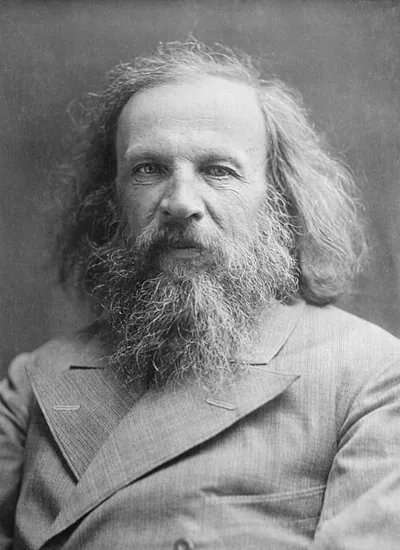 Dmitri Mendeleev1834–1907 · Chemistry
 Alfred Nobel1833–1896 · Chemistry
 Adolf von Baeyer1835–1917 · Chemistry
 August Kekulé1829–1896 · Chemistry
 James Crafts1839–1917 · Chemistry
 Stanislao Cannizzaro1826–1910 · Chemistry
