
Ivan Sechenov
Russian physiologist and medical scientist, a pioneer of objective psychology and a forerunner of reflexology · 1829–1905
- Born
- August 13, 1829
- Died
- November 15, 1905
- Country
- Russian Empire
- Section
- Biology
Biography
Ivan Mikhailovich Sechenov (1829-1905) was a Russian physiologist and doctor who set out to study the mind with the same experimental methods used in the study of the body. He worked in nineteenth-century Russia, when science was becoming organised around laboratories and universities. His work is now a landmark in the history of psychology, because it helped establish a way of studying behaviour based on what can be observed and measured.
He was born in the village of Tepli Stan, today known as Sechenovo, in what is now the Nizhny Novgorod region. His father was a nobleman and his mother a peasant. He was taught at home by private tutors and had mastered German and French while still a child. At fourteen he entered the St Petersburg Military Engineering School. After his military training he turned to medicine and enrolled at Moscow University, where he received a thorough grounding in both basic and clinical sciences. Sources differ on the exact year he completed his medical degree, with dates around 1856 and 1860 both given.
His training continued abroad between 1856 and 1862. He worked in the laboratories of Johannes Muller, Emil du Bois-Reymond and Hermann von Helmholtz in Berlin, Carl Ludwig in Vienna, Felix Hoppe-Seyler in Leipzig and Claude Bernard in Paris. From them he learned to rely on controlled experiments. Helmholtz showed him a model of rigour, while Ludwig and Bernard taught him to study the workings of the body through careful measurement.
Back in Russia he became a professor at the Medical Surgery Academy in St Petersburg, where he taught from 1860 to 1870. There he founded the first Russian school of physiology. He resigned in protest when the academy rejected Ilya Mechnikov, who later won the Nobel Prize. He then held chairs in Odessa, St Petersburg and Moscow, and for a time worked in the chemist Dmitri Mendeleev's laboratory.
His central interest was the working of the brain. He studied reflexes, the automatic responses of the body to a stimulus. Some are involuntary, such as blinking when something approaches the eye, while others depend on the will. Working with frogs, he measured how quickly these responses occurred and observed that the brain can inhibit reflexes generated in the spinal cord. From this he concluded that mental activity could be explained as a balance of excitation and inhibition, a view that was radical for its time. He also showed that brain activity is accompanied by electric currents, which led him toward electrophysiology.
His book Reflexes of the Brain, published in 1863, argued that psychology should be studied with scientific methods rather than through introspection alone. The views brought him trouble. In 1866 the censorship committee in St Petersburg accused him of spreading materialism and undermining Christian morality, although he never left Russia. His ideas influenced Vladimir Bekhterev and Ivan Pavlov, whom many later called the father of Russian physiology and scientific psychology. Through these figures his ideas reached American psychology, where John B. Watson incorporated them into behaviourism, although historians debate how much Bekhterev owed to Sechenov.
In his later years he turned to the physiology of work, studying the physiological limits that should shape the length of the working day and the role of the nervous system in human movement at work. In 1904 he was elected an honorary member of the Russian Academy of Sciences. He died in 1905.
His legacy lives on in many places. A physiology institute in Leningrad, the Moscow Medical Academy and a district of the Nizhny Novgorod region all took his name, and a lunar crater and an asteroid are named after him. He is remembered as one of the scientists who argued that the mind could be studied with the same objectivity as any other natural phenomenon.
Main contributions
- 1860An early study of the physiological effects of alcohol, titled Some Facts for the Future Study of Intoxication.
- 1863Reflexes of the Brain, in which he proposes that mental activity can be explained through reflexes of the brain.
- 1866Physiology of the Nervous System, a synthesis of how the nerves and spinal cord function.
- 1873The essay Who and How Should Develop Psychology, which argues for an objective and experimental study of the mind.
- 1889Sechenov's equation, which describes how the solubility of gases in liquids falls when salts are dissolved in them.
- 1897A study of the physiological criteria for setting the length of the working day.
- 1901An essay on human movement at work, analysing the role of the nervous system in manual skill.
Teachers and students
Studied under:
Taught:
Trivia and anecdotes
An accusation of materialism
In 1866 the St Petersburg censorship committee accused him of spreading materialism, but Sechenov never left Russia.
Pavlov's praise
Ivan Pavlov called him the father of Russian physiology and scientific psychology, a tribute from his most famous successor.
Their contemporaries
While Ivan Sechenov was alive (1829–1905)…
Alive at the same time
Discovered or invented in those years
- 1846NeptuneThe eighth and most distant planet of the Solar System, an ice giant found through mathematical prediction before any direct sighting.
- 1859EvolutionThe process by which the heritable traits of living populations change over generations, explaining the diversity of life from common ancestors.
- 1869Periodic tableAn arrangement of the chemical elements into rows (periods) and columns (groups), ordered by atomic number, that reveals recurring chemical behaviour and lets scientists predict properties.
- 1876TelephoneA device that carries the human voice over distance by turning sound into electrical signals and back into sound at the other end of the line.
- 1884CarA road vehicle with four wheels and its own engine, mainly built to carry people.
- 1903AirplaneA fixed-wing aircraft, heavier than air, powered by engines or rockets, that stays aloft because its wings generate lift.
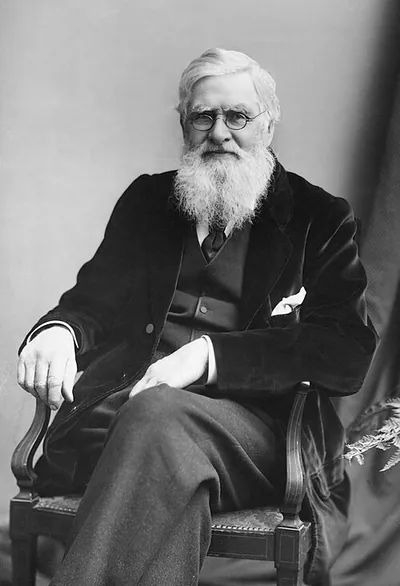 Alfred Russel Wallace1823–1913 · Biology
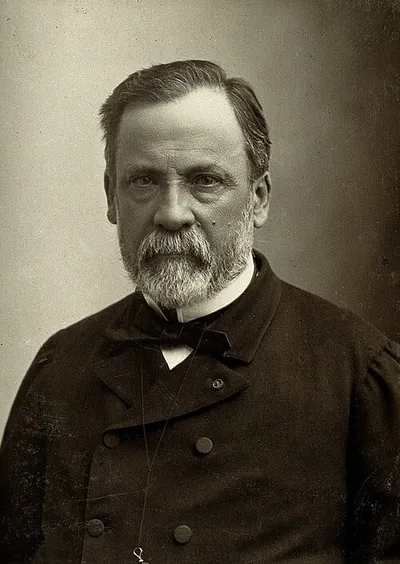 Louis Pasteur1822–1895 · Biology
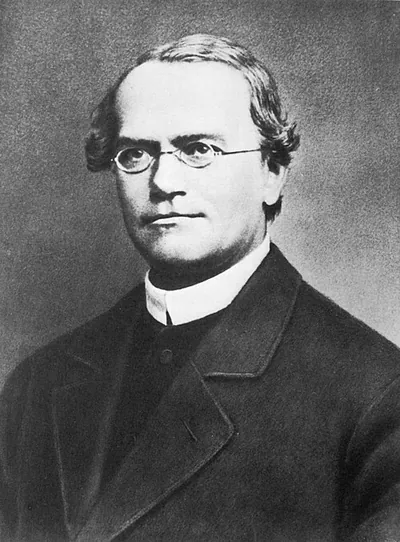 Gregor Mendel1822–1884 · Biology
 Robert Koch1843–1910 · Biology
 Camillo Golgi1843–1926 · Biology
 Élie Metchnikoff1845–1916 · Biology
