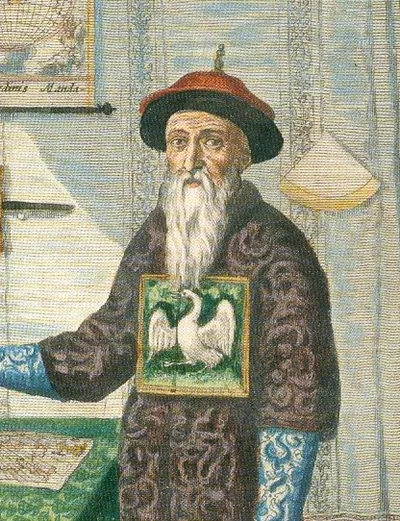
Johann Adam Schall von Bell
German Jesuit astronomer and missionary, adviser to the Shunzhi Emperor of the Qing dynasty in China · 1592–1666
- Born
- May 1, 1592
- Died
- August 15, 1666
- Country
- Germany
- Section
- Astronomy and space
Biography
Johann Adam Schall von Bell (1591-1666) was a German Jesuit, astronomer and instrument-maker who spent most of his life in China. He matters because he linked European astronomy with the imperial court during the transition from the Ming to the Qing dynasty, a period of deep political upheaval.
He was born in Cologne to a noble family, although some accounts place his birth in nearby Lüftelberg. The data sheet gives 1592 as his birth year, but the date most often cited is 1 May 1591. He studied at the Jesuit school in Cologne, then moved to Rome, where he learned mathematics and astronomy at the Collegium Germanicum. He joined the Society of Jesus in 1611 and continued his studies at the Gregorianum.
In 1618 he sailed for Asia on a Portuguese ship with a group of missionaries led by Nicolas Trigault. The following year they reached Macau, the Portuguese trading port, where he spent time learning Chinese. His missionary work inside China began in 1622, and its results are described as modest. That same year he helped defend Macau against a Dutch invasion, and he is said to have personally captured a Dutch captain, a claim that is hard to verify.
In 1630 he was sent to Beijing with Giacomo Rho to carry on a calendar reform begun by Johann Schreck, who had recently died. Working with Xu Guangqi, he helped produce a revised calendar named the Chongzhen calendar after the last Ming emperor. Its main gain was more accurate predictions of solar and lunar eclipses, a matter of political weight, since announcing eclipses was an imperial duty. After Xu died, Schall led the requiem and arranged for his body to be shipped to his family in Shanghai. It is also said that the Jesuit foundry in Beijing cast around five hundred cannon for the Ming, a figure that should be treated cautiously.
After the Ming fell and the Qing took power in 1644, he won the trust of the young Shunzhi Emperor, who made him a mandarin and placed him in charge of the Imperial Observatory and the Tribunal of Mathematics. From that post he secured permission for the Jesuits to build churches and preach across the country. He is indirectly credited with baptising some 500,000 Chinese within fourteen years, a number that is hard to check.
His standing weakened after the emperor died in 1661. In 1664 the astronomer Yang Guangxian and Muslim astronomers accused him of plotting rebellion and of miscalculating the time and place of a funeral, which they claimed had contributed to the death of an imperial consort. He was jailed with other Jesuits, Ferdinand Verbiest among them, and suffered a stroke in prison. All were sentenced to death, but after an earthquake they were pardoned; five Chinese Christians working in the astronomical office were executed. The Jesuits were exiled to Macau. Schall died less than a year after his release, on 15 August 1666, and was buried in the Jesuit Zhalan Cemetery in Beijing.
Four years later the young Kangxi Emperor replaced Yang with Verbiest and fully restored Schall's honours. A 1758 allegation claimed that he had lived with a woman and fathered two children. Most Jesuits and Catholic historians reject it, since no evidence was offered and contemporary witnesses and official Chinese records contradict it.
He also dealt with the Korean crown prince Sohyeon, held in Shenyang and Beijing, who was keen on Western learning. Schall gave him books on science and on Catholicism. The prince died in 1645 soon after returning to Korea, which ended Schall's hope of extending the Jesuit mission there.
His legacy endures in China, where he is known as Tang Ruowang. Taiwan issued a commemorative stamp in 1992, and his calendar remains one of his most lasting works. His career shows how astronomy could open a channel of exchange between Europe and China in the seventeenth century.
Main contributions
- 1622Defence of Macau: he took part in resisting the Dutch invasion that year.
- 1630Chinese calendar reform: a more precise calendar for predicting eclipses, known as the Chongzhen calendar.
- 1644Imperial Observatory: he headed the observatory and the Tribunal of Mathematics under the Qing dynasty.
- Cannon foundry: the Jesuit foundry in Beijing is said to have produced about five hundred cannon for the Ming.
- Missionary work: permission to build churches and preach nationwide, with a baptism total that is hard to verify.
Trivia and anecdotes
A Chinese name
In China he is known as Tang Ruowang, the name by which he is still remembered.
A stamp in Taiwan
In 1992 Taiwan issued a commemorative stamp marking the 400th anniversary of his birth.
An unproven accusation
The 1758 claim of a private family life lacks evidence and is rejected by most Catholic historians.
Their contemporaries
While Johann Adam Schall von Bell was alive (1592–1666)…
Alive at the same time
Discovered or invented in those years
- 1593ThermometerA device that measures temperature, that is, how hot or cold an object is.
- 1608TelescopeAn optical instrument that gathers electromagnetic radiation, mainly visible light, to see distant objects in far more detail than the naked eye can.
- 1614LogarithmA mathematical function giving the exponent to which a fixed base must be raised to produce a given number.
- 1654ProbabilityA numerical measure, between 0 and 1, of how likely an event is to occur.
- 1662BusA motor vehicle built to carry many passengers at once on urban and intercity roads, usually along a fixed route and for a fare.
- 1665CellThe smallest unit of matter that can be considered alive: a compartment enclosed by a membrane that holds genetic material and carries out the functions of life on its own.
 Johannes Kepler1572–1630 · Astronomy and space
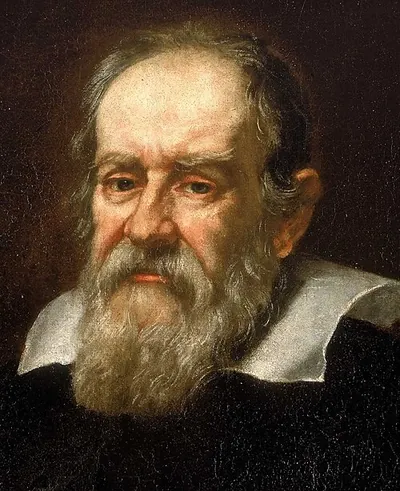 Galileo Galilei1564–1642 · Astronomy and space
 Tycho Brahe1546–1601 · Astronomy and space
 John Flamsteed1646–1720 · Astronomy and space
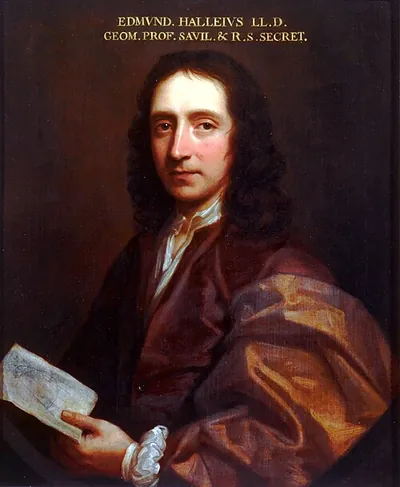 Edmond Halley1656–1742 · Astronomy and space
 James Bradley1693–1762 · Astronomy and space
