
Johann Wilhelm Meigen
German entomologist, pioneer of dipterology and creator of a method for classifying flies by combining several characters · 1764–1845
- Born
- May 3, 1764
- Died
- July 11, 1845
- Country
- Kingdom of Prussia, Duchy of Berg
- Section
- Biology
Biography
Johann Wilhelm Meigen (Solingen, 1764 – Stolberg, 1845) was a German entomologist who spent his life studying flies, mosquitoes and their relatives, the insect order known as Diptera. He worked at a time when the classification of living things was being reorganised on new foundations, and his work laid the groundwork for dipterology, the branch of entomology devoted to this order. He is widely regarded as its founding father.
He was born on 3 May 1764 in Solingen, the fifth of eight children of Johann Clemens Meigen and Sibylla Margaretha Bick. His parents ran a small shop and were comfortable without being wealthy. After the Seven Years' War, bad harvests and hasty speculation forced the sale of his grandfather's farm, and the family returned to the town. Meigen attended the local school only briefly. He learned to read and write on his grandfather's estate and went on to educate himself through wide reading at home, developing an interest in natural history. A lodger, the state surveyor Stamm, taught him mathematics, and a church organist and schoolteacher named Berger gave him lessons in piano, spelling, handwriting and, later, French. Working with Berger in Mülheim, he saw a systematic butterfly collection for the first time and learned how to catch and prepare insects.
In 1784 he took a post as resident tutor in Aachen, in the household of the merchant Pelzer. There he met his cousin Mathias Baumhauer, a skilled entomologist with an impressive butterfly collection, and his own serious work began. His first attempts to identify Baumhauer's collection, which was mostly flies, relied on a German translation of Linnaeus's classification. Meigen concluded that Linnaeus's genera were too broad and that the pattern of veins in the wings offered a better guide. Moses Harris in England and Louis Jurine in Geneva had reached the same idea, though Meigen did not know it at the time. He soon found that wing veins alone were not enough, and began drawing antennae and other body parts through a simple microscope. His decisive conclusion was that flies could only be sorted by weighing several characteristics together, an approach now called the eclectic method.
In 1786 he returned to Solingen to take over the post of organist and the French school attached to it. There, alongside his friend Weniger, he widened his interests to species from around the world, corresponding with collectors such as the banker Johann Christian Gerning. A plan to sail as a surgeon to the East Indies was dropped after his mother objected. After years disrupted by French occupation and war, he settled in 1796 in Stolberg, near Aachen, where he taught French, drawing, geography, history and astronomy for the rest of his life. In 1801 the French naturalist Count de Lacépède invited him to join a voyage around the world as a botanist, but Meigen declined. That same year he married Anna, the sister of a local clergyman, and in the following years he faced hard times as his number of pupils fell.
His first major work on flies appeared in 1804 under the title Klassifikation und Beschreibung der europäischen zweiflügeligen Insekten. His method, however, clashed with Johann Christian Fabricius, the leading authority of the day, who visited him in Stolberg that year and criticised it. In Fabricius's view, classification should rest on a single part of the body, chiefly the mouthparts. Meigen replied that Fabricius did not always follow that rule himself, but Fabricius would not adopt the eclectic method. The dispute left Meigen outside the mainstream of many of his contemporaries.
Between 1812 and 1814 he drew fossil coal plants for the French government and produced maps for the municipality of Stolberg. In 1815 the jurist Christian Rudolph Wilhelm Wiedemann offered to help him resume his work, with access to collections in Kiel and Vienna. The result was an enlarged edition of his great work, Systematische Beschreibung der bekannten europäischen zweiflügeligen Insekten, issued in seven volumes between 1818 and 1838. To cut costs, he made the lithographic plates for the last volume himself. His legacy is twofold: he described more than 3,000 taxa and left a framework that shaped later research on this group, including the fruit fly Drosophila melanogaster, now a model organism in genetics.
Main contributions
- 1800Nouvelle Classification des Mouches, a preliminary outline of his system, published with Baumhauer's help.
- 1804First major work on flies, proposing that these insects be classified by combining several characteristics at once.
- 1838Systematische Beschreibung der bekannten europäischen zweiflügeligen Insekten, a seven-volume work completing his description of European flies.
Trivia and anecdotes
A missed voyage
In 1801 he turned down Count de Lacépède's offer to join Captain Baudin's voyage around the world as a botanist.
Hand-made plates
To save money, he drew and lithographed the plates for the last volume of his great work himself.
Their contemporaries
While Johann Wilhelm Meigen was alive (1764–1845)…
Alive at the same time
Discovered or invented in those years
- 1766HydrogenThe lightest and most abundant chemical element in the universe, atomic number 1, which under normal conditions is a colourless, odourless and highly flammable gas.
- 1774OxygenA colorless, odorless gas, symbol O and atomic number 8, that forms the dioxygen in air and is essential for respiration in most living things.
- 1781UranusThe seventh planet from the Sun, an ice giant discovered by William Herschel in 1781, the first planet found with a telescope.
- 1803AtomThe basic unit of a chemical element: a nucleus of protons and usually neutrons surrounded by a cloud of electrons.
- 1821ElectricityThe set of physical phenomena linked to the presence and movement of electric charge, and one of the most versatile forms of energy in modern life.
- 1839PhotographyA technique for creating lasting images by recording light, either on a light-sensitive material or with an electronic sensor.
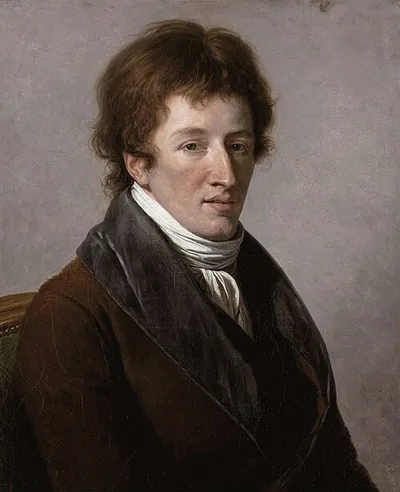 Georges Cuvier1769–1832 · Biology
 Edward Jenner1749–1823 · Biology
 Jean-Baptiste de Lamarck1744–1829 · Biology
 Charles Darwin1809–1882 · Biology
 Theodor Schwann1810–1882 · Biology
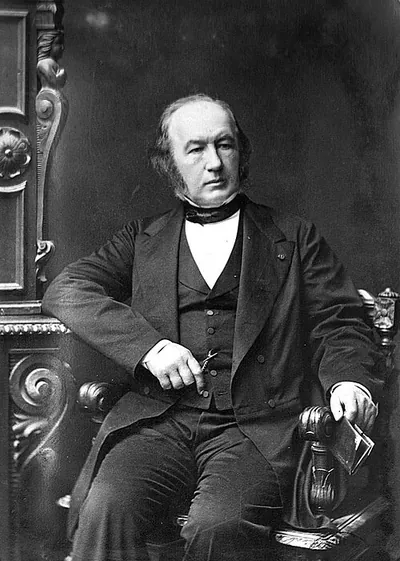 Claude Bernard1813–1878 · Biology
