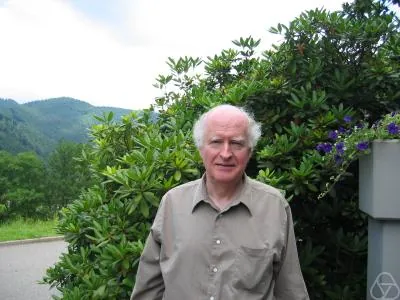
John Mather
American mathematician at Princeton University, specialist in singularity theory and Hamiltonian dynamics · 1942–2017
- Born
- June 9, 1942
- Died
- January 28, 2017
- Country
- United States
- Section
- Astronomy and space
Biography
John Norman Mather (United States, 1942-2017) was a mathematician at Princeton University whose work reshaped the study of smooth maps between curved spaces and of dynamical systems, the branch of mathematics that describes how systems following fixed rules change over time. He worked in the second half of the twentieth century, when pure mathematics was increasingly applied to the physics of complex systems, and his methods remain a reference in those fields. He should not be confused with the astrophysicist John C. Mather, who won the 2006 Nobel Prize in Physics and is a different person.
He descended from Atherton Mather (1663-1734), a cousin of Cotton Mather. His father, Norman Mather, was a professor of electrical engineering at Princeton. John studied at Harvard, where he earned his bachelor's degree in 1964, and completed his doctorate at Princeton in 1967. After two years at the Institut des Hautes Etudes Scientifiques in France, he became an associate professor at Harvard in 1969 and a full professor in 1971.
At Harvard he taught Math 55, a course known for its demanding pace. Among his students in that class were Bill Gates and Peter Galison. In 1974 he accepted a visiting professorship at Princeton, joining his father on the faculty there, and the following year the post became a full professorship. He was elected to the United States National Academy of Sciences in 1988.
His early research dealt with the stability of smooth maps between manifolds, which are curved spaces of dimensions n and p. He identified the exact dimensions for which such maps stay stable under smooth changes of coordinates. He also proved a conjecture by the French topologist René Thom: under topological equivalence, smooth maps are generically stable, meaning the stable ones form a dense set. His notes on topological stability are still a standard reference.
In the 1970s he turned to dynamical systems. He introduced what is now called the Mather spectrum and gave a characterization of Anosov diffeomorphisms, smooth transformations that stretch and squeeze a space in a highly regular way. Together with Richard McGehee, he built an example of the collinear four-body problem in which certain starting positions lead to solutions that blow up in finite time, a result that made the Painlevé conjecture seem plausible. He also developed a theory of orbits that minimize a quantity called action, first for twist maps and later in higher dimensions. The first version is known as Aubry-Mather theory, and the higher-dimensional one as Mather theory. It proved closely tied to the viscosity solution theory of Crandall and Lions, a link that Albert Fathi made explicit through his weak KAM theory.
Mather also announced a proof of Arnold diffusion for nearly integrable Hamiltonian systems with three degrees of freedom. He supplied the technique and a precise notion of genericity, although the complete solution remained an open challenge. In another series of papers he showed that, for certain regularity levels, the group of diffeomorphisms of a manifold is perfect, meaning it equals its own commutator subgroup, and he built counterexamples where the condition fails. He was also one of the three editors of the Annals of Mathematics Studies series published by Princeton University Press.
His legacy lies in the tools he left to later mathematicians in geometry, dynamical systems and partial differential equations. He received the John J. Carty Award of the National Academy of Sciences in 1978, the Brazilian Order of Scientific Merit in 2000, the George David Birkhoff Prize in applied mathematics in 2003, and the Brouwer Medal of the Royal Dutch Mathematical Society in 2014. He died on January 28, 2017.
Main contributions
- Stability of smooth maps between manifolds: identified the dimensions in which these maps remain stable under smooth changes of coordinates.
- Proof of Thom's conjecture: under topological equivalence, almost all smooth maps are stable.
- Mather spectrum and a characterization of Anosov diffeomorphisms, smooth transformations with highly regular behaviour.
- An example of the collinear four-body problem with solutions that blow up in finite time, written with Richard McGehee.
- Aubry-Mather theory: orbits that minimize action for twist maps, later extended to higher dimensions as Mather theory.
- Announcement of a proof of Arnold diffusion for nearly integrable Hamiltonian systems with three degrees of freedom.
- Proof that certain groups of diffeomorphisms are perfect, meaning they equal their own commutator subgroup.
Teachers and students
Studied under:
Taught:
Trivia and anecdotes
Students in Math 55
Among those who took his Math 55 course at Harvard were Bill Gates and Peter Galison.
A notable ancestor
He descended from Atherton Mather, a cousin of Cotton Mather, and his father also taught at Princeton.
Editor of a classic series
He was one of the three editors of the Annals of Mathematics Studies series published by Princeton University Press.
Their contemporaries
While John Mather was alive (1942–2017)…
Alive at the same time
Discovered or invented in those years
- 1945ComputerA programmable machine that takes in data, processes it by following stored instructions, and produces results, able to switch tasks simply by running different software.
- 1957Artificial satelliteAn artificial satellite is a human-made object placed in orbit around a celestial body, usually Earth, to collect information, relay signals, or carry out a specific task.
- 1969InternetA global network of interconnected computer networks that communicate using the TCP/IP protocol suite.
- 1971EmailA network service that lets users send and receive digital messages through addressed mailboxes, much like postal mail but electronic.
- 1973Mobile phoneA handheld wireless phone that lets people make and receive calls while moving across a cellular network area.
- 1989World Wide WebA system of linked documents and resources, connected by hyperlinks and accessed over the Internet with web browsers.
 Michel Mayor1942 · Astronomy and space
 Joseph Hooton Taylor1941 · Astronomy and space
 Valentina Tereshkova1937 · Astronomy and space
 Robert Wilson1936 · Astronomy and space
 Jim Peebles1935 · Astronomy and space
 Yuri Gagarin1934–1968 · Astronomy and space
