
John Philip Holland
Irish-American engineer and teacher who built the first submarine formally commissioned by the US Navy · 1840–1914
- Born
- February 29, 1840
- Died
- August 12, 1914
- Country
- Ireland, United States
- Section
- Transport
Biography
John Philip Holland (born in Liscannor, Ireland, in February 1841, though some records give 1840; died in Newark, New Jersey, in 1914) was a self-taught engineer and former schoolteacher who built the first submarine the US Navy formally commissioned. He worked in the second half of the nineteenth century, when steamships and armoured warships were changing naval warfare, and his designs paved the way for the modern military submarine.
He was born in a coastguard cottage on the west coast of Ireland, where his father served in the Royal Coastguard Service. The area was largely Irish-speaking, and he learned English properly at school. He trained with the Irish Christian Brothers, who prepared him to teach. There he met two brothers with a passion for science: Bernard O'Brien, who built telescopes and electromagnetic devices, and James Dominic Burke, who showed his students what electricity could do. Both helped spark his interest in underwater travel.
By the late 1850s he was drawing plans for a submarine, studying earlier attempts by William Bourne, David Bushnell and Robert Fulton. The American Civil War gave him a practical push. The battle between the Monitor and the Virginia showed that wooden ships were vulnerable. In 1864 the small Confederate submarine H. L. Hunley sank the Union sloop Housatonic, though the Hunley itself sank with all her crew.
He emigrated to the United States in 1873 and returned to teaching in Paterson, New Jersey. After breaking a leg on an icy Boston street, he used his recovery time to refine his designs. In 1875 the Navy rejected them as unworkable. He did, however, win funding from the Fenians, an Irish republican brotherhood that hoped to use submarines in the fight for Irish independence. With that money he built the Holland Boat No. 1 in 1878, about 4.27 metres long. In 1881 he launched the Holland II, nicknamed the Fenian Ram. His relationship with the Fenians ended badly over money, and the boat was seized in 1883.
In 1885 he built the Holland IV with the army lieutenant Edmond Zalinski, partly financed by Zalinski and his friends. The Navy eventually accepted the Holland VI in 1897, and it was bought in 1900 and commissioned as USS Holland. The Electric Boat Company, founded in 1899, soon marketed his design. Other navies, including those of Britain, Japan and Russia, adopted his ideas.
Holland died in 1914. Today he is remembered by a monument in Drogheda, where he had taught, and by a centre dedicated to his life in Liscannor.
Main contributions
- 1878Holland Boat No. 1: Holland's first one-person submarine prototype, powered by a small gas engine.
- 1881Holland II or Fenian Ram: a submarine built for the Fenians, considered by some historians the first practical submarine.
- 1885Holland IV or Zalinski Boat: an experimental submarine with novel armament, partly financed by Edmond Zalinski.
- 1897Holland VI: the first submarine able to run submerged for a considerable distance, combining electric motors and petrol engines.
- 1900USS Holland: the first submarine formally commissioned by the US Navy, after rigorous trials.
Trivia and anecdotes
A submarine seized
The Fenian Ram was stolen, or rather seized, in 1883 during an internal dispute within the Fenian Brotherhood. It is now preserved at the Paterson Museum.
Sunk and raised again
After completing his second trial, Holland sank the Holland Boat No. 1 in the Passaic River. It was raised again in 1927.
A monument at his old school
In 2014 a monument was unveiled in Drogheda beside the former school where Holland had taught, as part of the Irish Maritime Festival.
Their contemporaries
While John Philip Holland was alive (1840–1914)…
Alive at the same time
Discovered or invented in those years
- 1846NeptuneThe eighth and most distant planet of the Solar System, an ice giant found through mathematical prediction before any direct sighting.
- 1859EvolutionThe process by which the heritable traits of living populations change over generations, explaining the diversity of life from common ancestors.
- 1869Periodic tableAn arrangement of the chemical elements into rows (periods) and columns (groups), ordered by atomic number, that reveals recurring chemical behaviour and lets scientists predict properties.
- 1876TelephoneA device that carries the human voice over distance by turning sound into electrical signals and back into sound at the other end of the line.
- 1884CarA road vehicle with four wheels and its own engine, mainly built to carry people.
- 1903AirplaneA fixed-wing aircraft, heavier than air, powered by engines or rockets, that stays aloft because its wings generate lift.
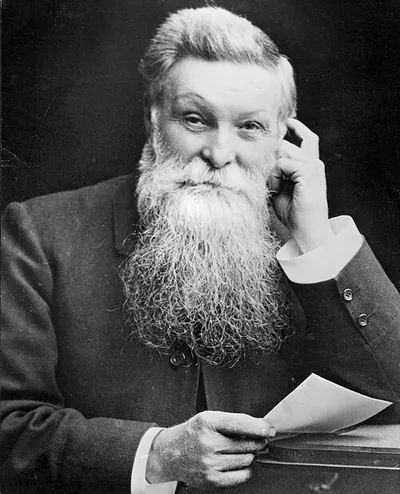 John Boyd Dunlop1840–1921 · Transport
 Clément Ader1841–1925 · Transport
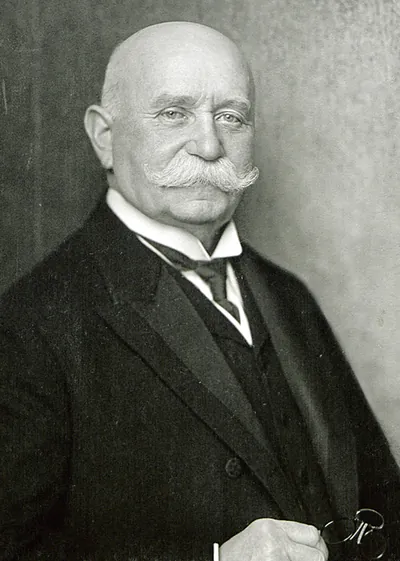 Ferdinand von Zeppelin1838–1917 · Transport
 Carl Benz1844–1929 · Transport
 Gottlieb Daimler1834–1900 · Transport
 Wilhelm Maybach1846–1929 · Transport
