
John Walter Gregory
British geologist and explorer known for his work on glacial geology and on the geography and geology of Australia and East Africa · 1864–1932
- Born
- January 27, 1864
- Died
- June 2, 1932
- Country
- United Kingdom, Australia
- Section
- Earth sciences
Biography
John Walter Gregory (Bow, London, 1864 – Peru, 1932) was a British geologist and explorer who devoted his career to the landforms of the Earth, especially glaciers, Australia and East Africa. His fieldwork and writing helped shape geology in the late nineteenth and early twentieth centuries, and his name is attached to one of the great fault zones of East Africa.
He was the only son of John James Gregory, a wool merchant, and Jane Lewis. He attended Stepney Grammar School and at fifteen went to work as a clerk at the wool sales in London. He then took evening classes at the Birkbeck Literary and Scientific Institution, studying while he worked. He graduated with first-class honours in 1891 and earned his doctorate in science in 1893. In 1887 he became an assistant in the geological department of the Natural History Museum in London, where he stayed until 1900, cataloguing fossil bryozoans and writing a monograph on Jurassic corals.
His most celebrated journey was a scientific expedition to Mount Kenya and Lake Baringo in 1892 and 1893. He was the first to mount an expedition devoted purely to science on that mountain. He made the first known attempt to climb it, passing through the forest and the high moorland to reach glaciers, bare rock and snow. Some of his observations on the local geology still hold. In his book The Great Rift Valley (1896) he described the journey. He also coined the term "rift valley", which he defined as a linear valley with nearly vertical, parallel sides that has sunk along a series of parallel faults. A glacier on Mount Kenya bears his name, although he never saw it, and other glaciers there were named after Victorian scientists he chose.
In 1896 he worked as naturalist on Martin Conway's expedition across Spitsbergen, and his memoirs on glacial geology, written with Edmund J. Garwood, belong to this period. In 1900 and 1901 he was chosen to direct the civilian scientific staff of the Discovery Expedition, but he resigned before the ship sailed for Antarctica after learning that the expedition's commander, Robert Falcon Scott, outranked him.
He was professor of geology at the University of Melbourne from 1899, and from 1901 he also directed the Geological Survey of Victoria. He travelled across central Australia and wrote textbooks and popular books. In 1904 he was awarded the chair of geology at the University of Glasgow, which he held for twenty-five years, earning a strong reputation as both teacher and administrator. He served as president of the Geological Society of London from 1928 to 1930.
In his later years he undertook expeditions to Cyrenaica, southern Angola and Tibet. He also held racist and segregationist views, which are now rightly condemned and form a serious blot on his legacy. In January 1932 he set off for the Andes, sponsored by the Royal Geographical Society, on what became the first geological traverse of the central Andes of Peru. His boat overturned in the Urubamba River, and he drowned there on 2 June 1932.
Today he is remembered as a wide-ranging researcher whose work on rift valleys and glacial geology is still cited, and whose writings on race show the prejudices of his era.
Main contributions
- 1893Mount Kenya expedition: the first scientific expedition to that mountain, with geological observations that still stand.
- 1896The Great Rift Valley: a book recounting his expedition to Mount Kenya and Lake Baringo, in which he sets out the concept of the rift valley.
- 1896Glacial geology work written with Edmund J. Garwood: studies of how ice shapes the land.
- 1906The Dead Heart of Australia: an account of his journey through central Australia, including a circuit around Lake Eyre.
- 1913The Nature and Origin of Fiords: a study of how fiords, glacial valleys flooded by the sea, were formed.
Trivia and anecdotes
The glacier he never saw
The Gregory Glacier, on the northern side of Mount Kenya, was named after him, although he never saw it.
A mineral with his name
The mineral gregoryite, first found in the Great Rift Valley, is named after him.
Their contemporaries
While John Walter Gregory was alive (1864–1932)…
Alive at the same time
Discovered or invented in those years
- 1869Periodic tableAn arrangement of the chemical elements into rows (periods) and columns (groups), ordered by atomic number, that reveals recurring chemical behaviour and lets scientists predict properties.
- 1869Deoxyribonucleic acidA double-stranded molecule that carries the genetic instructions of nearly all living things and many viruses.
- 1876TelephoneA device that carries the human voice over distance by turning sound into electrical signals and back into sound at the other end of the line.
- 1884CarA road vehicle with four wheels and its own engine, mainly built to carry people.
- 1903AirplaneA fixed-wing aircraft, heavier than air, powered by engines or rockets, that stays aloft because its wings generate lift.
- 1925TelevisionA system that sends moving pictures and sound over distance and shows them on a receiver, the television set.
 Vladimir Vernadsky1863–1945 · Earth sciences
 Vladimir A. Obruchev1863–1956 · Earth sciences
 Vilhelm Bjerknes1862–1951 · Earth sciences
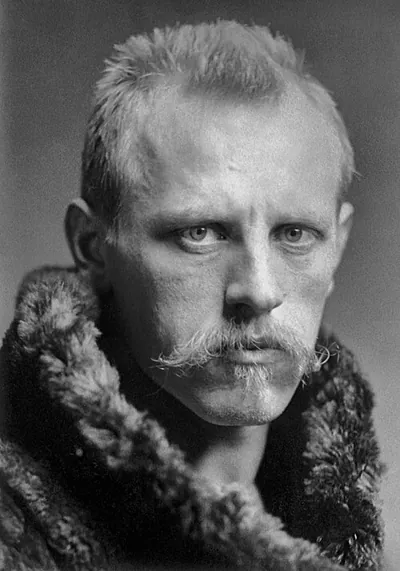 Fridtjof Nansen1861–1930 · Earth sciences
 Andrija Mohorovičić1857–1936 · Earth sciences
 Henry Fairfield Osborn1857–1935 · Earth sciences
