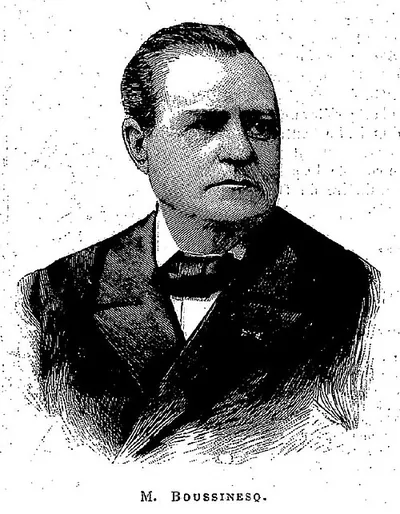
Joseph Valentin Boussinesq
French mathematician and physicist specialising in fluid mechanics · 1842–1929
- Born
- March 13, 1842
- Died
- February 19, 1929
- Country
- France
- Section
- Physics
Biography
Joseph Valentin Boussinesq (1842-1929) was a French mathematician and physicist whose career centred on fluid mechanics, the study of how water, air and other liquids move. He worked in the second half of the nineteenth century, when mathematical physics was becoming a settled part of university teaching, and his work on waves in water and on turbulent flow is still cited in hydraulic engineering and modern physics.
He was born in a small village between Béziers and Montpellier, in the south of France, into a family of modest farmers. His father expected him to take over the family farm, but the young Boussinesq left for Montpellier to pursue higher education. He earned a degree in science there in 1861. In the following years he taught at secondary schools in Agde, Vigan and Gap, while working towards a doctorate, which he obtained in 1867 from the Faculty of Sciences in Paris.
A turning point came when Barré de Saint-Venant, a respected engineer, noticed him and took him under his wing. Saint-Venant was a central figure in the mechanics of continuous materials, and his support opened the doors of university research to Boussinesq. After qualifying in physics, he was appointed professor of calculus at the University of Lille in 1873, a post he held until 1886. That year he was elected to the French Academy of Sciences and moved to Paris, where he taught mechanics, theoretical physics and probability at the Sorbonne.
His best-known work grew out of an observation by John Scott Russell, who in 1834 described a solitary wave travelling along a canal without losing its shape. Russell reported it in 1844, and the question stayed open for decades. In 1871 Boussinesq published the first mathematical theory that explained the phenomenon, and in 1877 he introduced an equation describing such waves. Lord Rayleigh published his own theory of the same effect in 1876 and acknowledged at the end of his paper that Boussinesq had got there first. The equation, later known as the Korteweg-de Vries equation, laid the groundwork for the modern physics of solitons, waves that keep their shape as they travel.
In 1897 he published the Théorie de l'écoulement tourbillonnant et tumultueux des liquides, a work that contributed greatly to the study of turbulence, the chaotic motion of a fluid full of eddies. It is worth noting that Boussinesq never used the word "turbulence" himself; he wrote of swirling and tumultuous flows. The first appearance of the term in French or English fluid mechanics literature comes in a paper by Lord Kelvin in 1887.
His legacy includes a substantial treatise on infinitesimal analysis, published in several volumes between 1887 and 1890, and volumes on the analytical theory of heat, issued between 1901 and 1903. He died in 1929, and his name remains attached to concepts and equations still taught in hydraulics and wave physics.
Main contributions
- 1871First mathematical theory of the solitary wave observed by Russell, describing a wave that travels without spreading out.
- 1877An equation describing solitary waves, later known as the Korteweg-de Vries equation.
- 1885Application des potentiels à l'étude de l'équilibre et du mouvement des solides élastiques, on the equilibrium and motion of elastic solids.
- 1887First volume of the Cours d'analyse infinitésimale, a calculus treatise aimed at those who apply it to mechanics and physics.
- 1897Théorie de l'écoulement tourbillonnant et tumultueux des liquides, a key work on the study of turbulent flows.
Teachers and students
Studied under:
Taught:
Trivia and anecdotes
A word he never used
Boussinesq studied turbulence without ever using the term, which appeared later in scientific literature.
Acknowledged by Rayleigh
Lord Rayleigh admitted at the end of his 1876 paper that Boussinesq had presented a similar theory earlier.
Related discoveries and inventions
- 1877Korteweg–De Vries equationA partial differential equation that describes long waves in dispersive media, such as solitary waves in shallow channels, and serves as the basic model of integrable nonlinear systems.
Their contemporaries
While Joseph Valentin Boussinesq was alive (1842–1929)…
Alive at the same time
Discovered or invented in those years
- 1846NeptuneThe eighth and most distant planet of the Solar System, an ice giant found through mathematical prediction before any direct sighting.
- 1859EvolutionThe process by which the heritable traits of living populations change over generations, explaining the diversity of life from common ancestors.
- 1869Periodic tableAn arrangement of the chemical elements into rows (periods) and columns (groups), ordered by atomic number, that reveals recurring chemical behaviour and lets scientists predict properties.
- 1876TelephoneA device that carries the human voice over distance by turning sound into electrical signals and back into sound at the other end of the line.
- 1884CarA road vehicle with four wheels and its own engine, mainly built to carry people.
- 1925TelevisionA system that sends moving pictures and sound over distance and shows them on a receiver, the television set.
 John William Strutt1842–1919 · Physics
 Ludwig Boltzmann1844–1906 · Physics
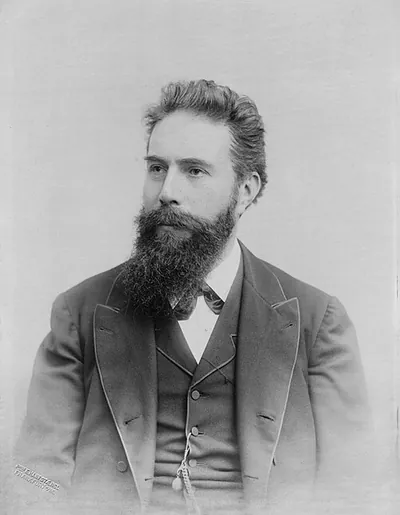 Wilhelm Röntgen1845–1923 · Physics
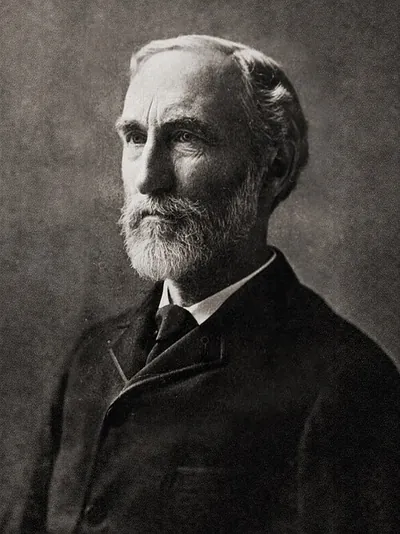 Josiah Willard Gibbs1839–1903 · Physics
 Johannes Diderik van der Waals1837–1923 · Physics
 Antoine Henri Becquerel1852–1908 · Physics
