
Jørgen Pedersen Gram
Danish mathematician and actuary, known for the Gram-Schmidt process and his work on the Riemann zeta function · 1850–1916
- Born
- June 27, 1850
- Died
- April 29, 1916
- Country
- Kingdom of Denmark
- Section
- Mathematics
Biography
Jørgen Pedersen Gram (1850–1916) was a Danish mathematician and actuary whose work spanned number theory, linear algebra and the statistics used in insurance. He lived at a time when mathematics was becoming a professional discipline and insurance companies needed rigorous calculations to set premiums and reserves. Today he is remembered mainly for the orthogonalization procedure that bears his name, a basic tool of linear algebra, and for an approximation to a function tied to the distribution of prime numbers.
Gram was born on 27 June 1850 in Nustrup, in the Duchy of Schleswig, the son of a farmer and his wife. He began higher studies in Copenhagen in 1868 and graduated in 1873. The following year he published a paper on the theory of invariants, a branch of algebra that studies the properties of expressions that remain unchanged under certain transformations. His training was that of a pure mathematician, but his career soon took a practical turn.
In 1875 he began working for the insurance company Hafnia. There he faced practical problems of statistics: estimating risks, fitting data to models and deciding how much to charge for each policy. He earned his doctorate in 1879 and married that same year. After the death of his first wife, he remarried in 1896. In 1884 he founded his own company, Skjold, and devoted much of his working life to the insurance sector. From 1910 until 1916 he chaired the Danish Insurance Council.
His mathematical work rested on the method of least squares, a technique that finds the curve best fitting a set of data by minimising the sum of squared errors. While studying series of functions obtained this way, Gram developed a procedure for turning a set of vectors into a set of mutually perpendicular vectors that span the same space. Published in 1883, this procedure is now the Gram–Schmidt process. What many textbooks present as a straightforward method began as a response to a problem of statistical approximation.
In number theory, his name is attached to an approximation of the Riemann zeta function, which is closely related to the distribution of prime numbers. Instead of the series of logarithmic integrals used by Riemann, Gram's formula employed powers of logarithms and values of the zeta function at positive integers. That expression was later superseded by a formula found by Srinivasa Ramanujan, which uses Bernoulli numbers directly. His contribution remains a step in the history of that problem.
Gram was also a pioneer in statistics. Before him, the symmetric normal curve, the bell curve associated with Gauss, was often treated almost as the rule for describing measurement errors. Gram showed that it was only one special case within a broader family of frequency curves, including asymmetric ones, and he offered a systematic theory for developing them. These ideas connect with the Gram–Charlier series and Gram's theorem, which carry his name in statistics texts.
In 1884 he received the Gold Medal of the Royal Danish Academy of Sciences and Letters for his work on prime numbers. He had been a member of the academy since 1888 and served as its treasurer. He died in Copenhagen on 29 April 1916, struck by a cyclist while on his way to an academy meeting.
His legacy lies in two worlds. In mathematics, the Gram–Schmidt process remains a central tool, and the Gram matrix bearing his name is used today in the stability analysis of control systems and in deep learning. In the insurance sector, his work showed that statistical models could be more flexible than the bell curve, an idea that still guides actuarial practice.
Main contributions
- 1874Paper on the theory of invariants, published the year after he graduated.
- 1883Gram–Schmidt orthogonalization process, which turns a set of vectors into mutually perpendicular vectors.
- 1884An approximation of the Riemann zeta function using powers of logarithms, related to the distribution of prime numbers.
- 1884Gold Medal of the Royal Danish Academy of Sciences and Letters for his work on prime numbers.
- A systematic theory of skewed frequency curves, showing that the normal curve is only a special case.
Trivia and anecdotes
Death in the street
He died in Copenhagen in 1916, struck by a cyclist on his way to an academy meeting.
A matrix with his name
The Gram matrix is used today in control theory and in deep learning, for style transfer.
Their contemporaries
While Jørgen Pedersen Gram was alive (1850–1916)…
Alive at the same time
Discovered or invented in those years
- 1859EvolutionThe process by which the heritable traits of living populations change over generations, explaining the diversity of life from common ancestors.
- 1869Periodic tableAn arrangement of the chemical elements into rows (periods) and columns (groups), ordered by atomic number, that reveals recurring chemical behaviour and lets scientists predict properties.
- 1869Deoxyribonucleic acidA double-stranded molecule that carries the genetic instructions of nearly all living things and many viruses.
- 1876TelephoneA device that carries the human voice over distance by turning sound into electrical signals and back into sound at the other end of the line.
- 1884CarA road vehicle with four wheels and its own engine, mainly built to carry people.
- 1903AirplaneA fixed-wing aircraft, heavier than air, powered by engines or rockets, that stays aloft because its wings generate lift.
 Felix Klein1849–1925 · Mathematics
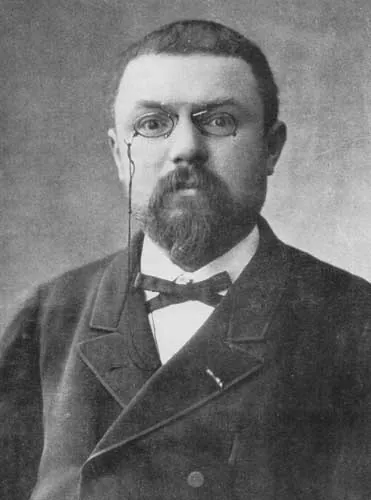 Henri Poincaré1854–1912 · Mathematics
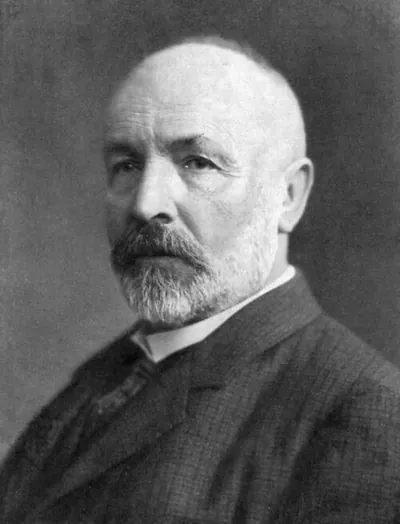 Georg Cantor1845–1918 · Mathematics
 Giuseppe Peano1858–1932 · Mathematics
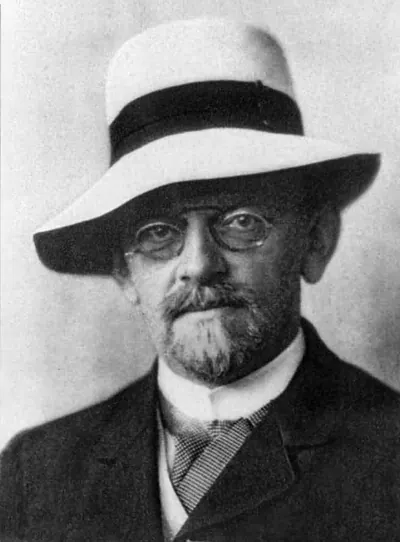 David Hilbert1862–1943 · Mathematics
 Hermann Minkowski1864–1909 · Mathematics
